
Ask a CISO how their IT and OT security teams collaborate, and the answer, even in 2025, is often some variation of “we’re working on it.” Ask the OT security lead at the same organization the same question, and you will frequently hear a different story entirely: limited visibility into what IT is doing on the network, frustration with change management processes that were designed for enterprise IT and applied blindly to industrial environments, and a persistent sense that the risk calculus IT teams use simply does not account for what operational downtime or safety impact actually means.
This disconnect is not a new problem. But its consequences are becoming more severe as the attack surface connecting IT and OT environments expands, as threat actors specifically target the IT/OT boundary, and as regulators in critical infrastructure sectors increasingly require demonstrable evidence of integrated security governance.
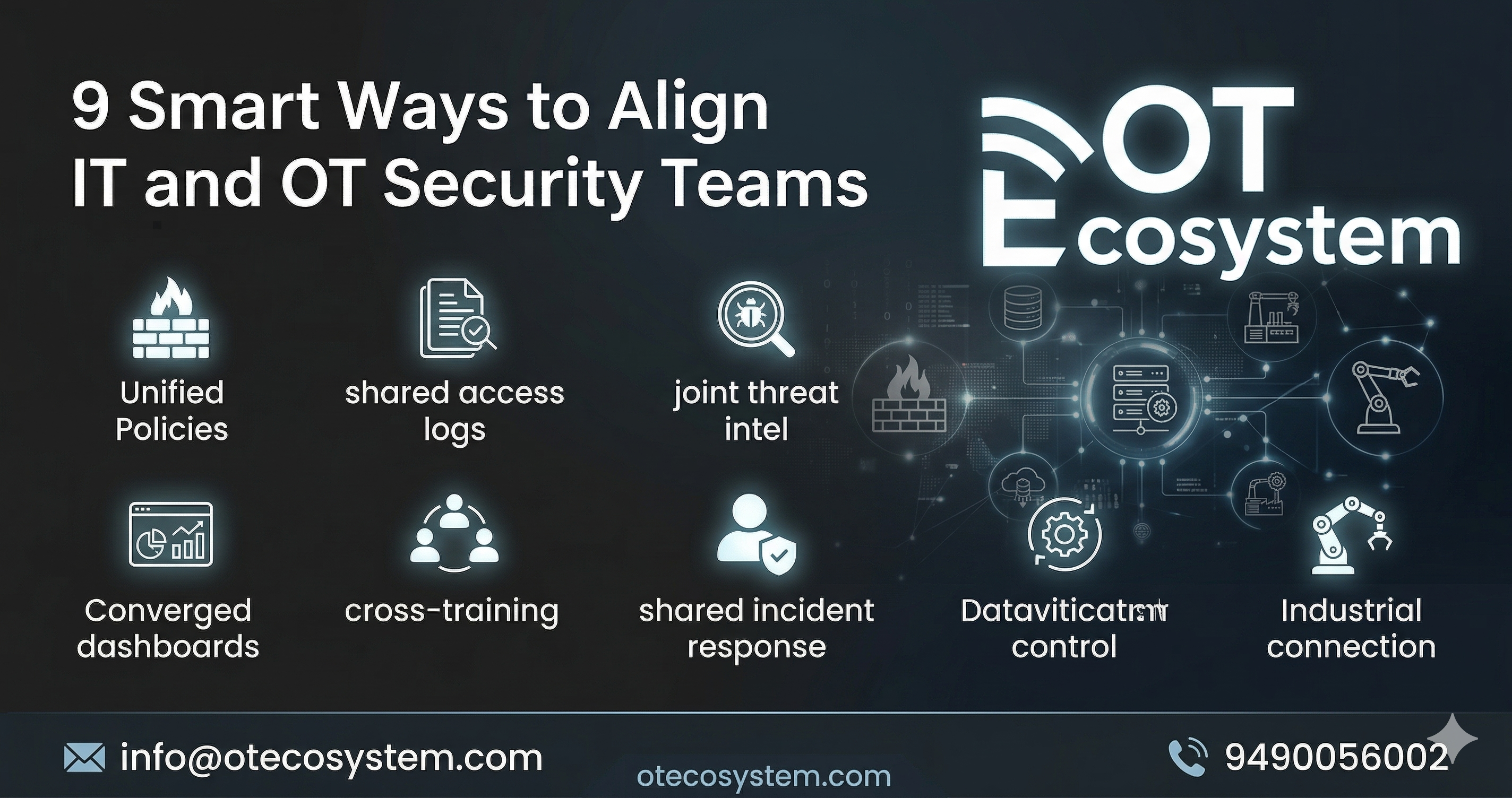
The good news is that the path forward is well understood, even if it remains poorly executed. This guide breaks down 9 smart ways to align IT and OT security teams, practical, operationally grounded strategies that security leaders can implement to close the gap between two functions that can no longer afford to operate in isolation.
1. Establish a Unified Governance Framework With Dual Accountability
Alignment begins at the governance layer, and governance begins with accountability structure. In most organizations, OT security either reports through an operational function, plant management, engineering, or operations, or it has been recently folded under the CISO with varying degrees of success. Neither arrangement automatically produces alignment.
What works is a governance model that explicitly recognizes both domains and creates shared accountability for cross-boundary risk. This typically means establishing a joint security governance committee that includes both the CISO and operational leadership, plant managers, VP of Engineering, or Chief Operations Officer, with defined decision rights over policies that affect both environments.
The governance framework should address how security decisions are made when they carry operational risk, who has authority to approve emergency changes in OT environments, how security incidents that span both domains are escalated and managed, and how security investment is allocated across IT and OT. Without structural clarity on these questions, alignment at the operational level remains fragile, dependent on interpersonal relationships rather than institutional design.
Frameworks like IEC 62443, NIST CSF, and the ISA/IEC standards provide useful reference architectures for governance design in OT environments. The goal is not compliance theater but a governance structure that both IT and OT security professionals recognize as legitimate and workable.
2. Develop a Shared Risk Language Rooted in Operational Impact
One of the most persistent sources of friction between IT and OT security teams is the absence of a common language for describing and prioritizing risk. IT security teams speak in terms of CVSS scores, vulnerability severity, attack vectors, and data breach probability. OT teams speak in terms of process impact, safety instrumented system integrity, production loss, and regulatory consequence.
Neither language is wrong. Both are incomplete without the other. And the gap between them consistently produces misaligned priorities, IT teams pushing patch urgency on vulnerabilities that OT teams assess as operationally unacceptable to address, and OT teams tolerating network configurations that IT teams correctly identify as high-risk.
Developing a shared risk language means building a risk scoring model that incorporates both cybersecurity severity and operational consequence. What is the production impact of this system going offline? What are the safety implications of this control system being compromised? What is the regulatory exposure? What is the recovery time if this asset is taken out by a ransomware infection?
When IT and OT security teams assess risk through the same lens, one that captures both cyber probability and physical consequence, prioritization conversations become fundamentally more productive. The shared language also enables meaningful reporting to executive leadership and boards, who need integrated risk views rather than siloed security metrics.
3. Build a Comprehensive, Unified Asset Inventory
You cannot protect what you cannot see, and you cannot align two security functions that are working from different, and often contradictory, pictures of what exists on the network.
In most organizations attempting IT/OT convergence, the IT team has a reasonable asset inventory for enterprise systems. The OT team may have engineering documentation, P&IDs, and equipment lists from various stages of plant construction and upgrade. Neither is a current, accurate, cybersecurity-oriented asset inventory of the OT environment.
Building one requires OT-specific approaches. Active scanning is frequently not appropriate in OT environments where legacy protocols and latency-sensitive devices cannot tolerate the traffic. Passive network monitoring using industrial protocol-aware tools provides visibility without operational risk. Manual inventory exercises, combined with network traffic analysis, build the foundation.
The objective is a unified asset register that both IT and OT security teams work from, one that captures not just IP addresses and device types, but firmware versions, communication relationships, zone and conduit memberships, vendor support status, and criticality ratings. This shared visibility is the operational foundation on which every other alignment strategy depends.
4. Design and Enforce Network Segmentation Jointly
Network segmentation, the practice of creating defensible boundaries between zones with different risk profiles and operational functions, is one of the most effective technical controls available for reducing IT/OT risk. It is also one of the areas where IT and OT teams most commonly work at cross-purposes.
IT teams design segmentation around data sensitivity and access control models developed for enterprise environments. OT teams understand segmentation through the Purdue model, or its evolving successors, and are acutely aware of how network changes affect control system communication, historian connectivity, and remote access performance.
Joint segmentation design brings both perspectives to bear: the IT team’s expertise in firewall policy, network architecture, and access control engineering combined with the OT team’s understanding of which communication paths are operationally essential and which represent unnecessary exposure.
The practical output is a segmentation architecture that both teams have contributed to and are accountable for maintaining, including agreed processes for reviewing and approving changes that affect zone boundaries, communication rules between IT and OT networks, and remote access paths into the OT environment.
5. Create a Joint Incident Response Process for Cross-Boundary Events
When a security incident spans the IT/OT boundary, and in the current threat landscape, significant incidents increasingly do, the organizational response will be only as effective as the planning and coordination that preceded it. Organizations that discover their IT and OT incident response processes are incompatible at 2 a.m. during an active intrusion are operating well below acceptable risk tolerance.
Joint incident response planning for OT environments requires deliberate adaptation of IT-centric IR frameworks. The ICS-CERT methodology and guidance from organizations like CISA provide OT-specific considerations. The core challenge is that OT incident response decisions carry operational and safety consequences that IT incident response does not, isolating an infected OT system may stop the spread of malware, or it may cause a process upset with physical consequences.
A joint IR process establishes clear escalation paths that cross the IT/OT boundary, defined decision authority for actions with operational impact, communication protocols between IT security, OT security, operations, safety, and executive leadership, and regular tabletop exercises that practice the full integrated response rather than each team’s piece of it in isolation.
The tabletop exercises deserve particular emphasis. They are where coordination assumptions get stress-tested, where gaps in communication and authority become visible before they become consequential, and where IT and OT security teams build the interpersonal trust that effective incident response actually depends on.
6. Align Security Policies Without Flattening OT-Specific Requirements
Security policy alignment does not mean applying IT security policies uniformly to OT environments. It means creating a coherent policy architecture that establishes shared principles and accountability while explicitly accommodating the operational constraints that make OT environments different.
Patch management policy is the canonical example. An IT security policy mandating critical patch deployment within 30 days is operationally unworkable for OT systems that require vendor qualification of patches, scheduled maintenance windows, and in some cases formal change management processes that take months. But an OT environment with no patch management policy, or one that simply defers all patching indefinitely, is indefensible.
The solution is a tiered policy framework that sets enterprise-wide principles and accountability structures while defining OT-specific procedures that satisfy the underlying security intent within operational constraints. Compensating controls, network segmentation, application whitelisting, enhanced monitoring, can address risk during extended patch cycles for systems that cannot be patched on IT timelines.
This policy architecture requires IT and OT security teams to build it together. Policies imposed on OT environments by IT security without operational input tend to be either unworkable or quietly ignored. Policies built collaboratively tend to be both more practical and more consistently followed.
7. Integrate Security Tooling Without Forcing IT Tools Into OT Environments
The question of security tooling sits at the intersection of technical effectiveness and operational politics. IT security teams have mature tooling ecosystems, SIEM platforms, EDR solutions, vulnerability scanners, and network detection tools, and the natural inclination is to extend these into OT environments to create unified visibility.
The problem is that many IT security tools are not designed for OT protocols, cannot interpret industrial communication correctly, and in some cases generate traffic that can disrupt sensitive OT systems. Deploying an aggressive vulnerability scanner against a legacy DCS is a memorable lesson in why OT environments require different approaches.
Effective tooling integration takes a different path: deploying OT-native visibility and detection tools, solutions designed to understand Modbus, DNP3, EtherNet/IP, PROFINET, and other industrial protocols, and feeding their output into shared platforms where IT security teams can also work. This creates unified visibility without forcing OT environments to tolerate tools they were not designed for.
The integration architecture should also address log collection and correlation, ensuring that security events from OT systems are captured, normalized, and available for analysis alongside IT security telemetry. This is the foundation of meaningful threat detection at the IT/OT boundary, where the most significant attack paths currently operate.
8. Implement Joint Training and Cross-Functional Education Programs
Technical alignment without cultural alignment is fragile. And cultural alignment between IT and OT security teams requires each function to genuinely understand the operational world the other inhabits, not as an abstraction, but as a practical reality that shapes every security decision they make.
IT security professionals who spend time in operational environments, visiting plant floors, understanding what process control systems actually do, seeing the physical consequences of the systems they are now asked to help secure, consistently develop better judgment about OT risk. OT security professionals who develop deeper understanding of IT security architecture, threat intelligence, and detection methodology become better equipped to build defensible OT environments.
Joint training programs, cross-functional job shadowing, shared participation in industry exercises like GridEx or similar sector-specific events, and combined attendance at conferences like S4, ICS-CERT training programs, or industry working groups all build the shared understanding that makes operational collaboration possible.
Certification pathways like GICSP, which specifically bridges IT and OT security knowledge, provide individual development frameworks that support this cross-functional capability building.
9. Establish Shared Metrics and Regular Cross-Team Communication Cadences
What gets measured gets managed, and what gets jointly measured gets jointly managed. One of the most practical steps toward sustained IT/OT security alignment is the development of shared metrics that both teams contribute to and are held accountable for , metrics that measure security outcomes rather than activity, and that capture risk at the organizational level rather than the functional one.
Useful shared metrics include the percentage of OT assets with current, accurate inventory records; mean time to detect and respond to security events spanning IT/OT boundaries; number of unauthorized communication paths identified between IT and OT zones; patch coverage rates by criticality tier; and completion rates for joint IR exercises.
Alongside shared metrics, a regular communication cadence, joint security reviews, shared threat intelligence briefings, and combined reporting to executive leadership, maintains the organizational relationship that prevents alignment from decaying back into silos. Security alignment is not a project with a completion date. It is an ongoing operational discipline that requires sustained investment in the relationships and processes that make it work.
Conclusion:
The 9 smart ways to align IT and OT security teams outlined in this guide are not a one-time implementation checklist. They are the components of an ongoing operational discipline, one that requires sustained leadership commitment, cross-functional investment, and the patience to build trust and capability over time rather than through a single initiative.
The organizations that are doing this well have typically been working at it for several years. They have made mistakes, recalibrated, and gradually built the governance structures, shared practices, and interpersonal relationships that effective alignment requires. They are also, not coincidentally, the organizations that are best positioned to detect, contain, and recover from the increasingly sophisticated threats targeting the IT/OT boundary.
For security leaders reading this, the most important next step is an honest assessment of where your organization currently stands across these nine dimensions, and a prioritized plan for closing the most critical gaps.
Stay Connected With OT Ecosystem
Have insights on IT/OT security, industrial cybersecurity, or operational resilience? Share your expertise and get featured with us.
We help professionals publish their insights and expand visibility across multiple trusted platforms, not just one.
📩 Email: info@otecosystem.com
📞 Call: +91 9490056002
💬 WhatsApp: https://wa.me/919490056002