
In the world of Information Technology (IT), a post incident cleanup often means wiping a server, restoring from a golden image, and resetting passwords. It is disruptive, but it is standardized.
In Operational Technology (OT), a post incident forensic cleanup is far more sensitive. The malware may exist inside the volatile memory of a PLC controlling a high temperature furnace. The cleanup cannot involve a simple reboot if that reboot causes a loss of state for a chemical reactor. As we move through 2026, the convergence of IT and OT together with AI driven threats has made forensic cleanup a discipline where cybersecurity directly impacts physical safety.
Recent research such as the FIRM OT methodology presented at the 2025 International Symposium on Digital Forensics highlights that traditional IT forensic workflows fail in industrial settings because of proprietary protocols like Modbus and DNP3.
When an incident occurs, whether it is ransomware locking an HMI or a threat actor manipulating pressure readings, the cleanup phase is where most organizations fail. Many organizations destroy evidence by panic restarting systems, while others leave hidden backdoors active by not verifying firmware integrity.
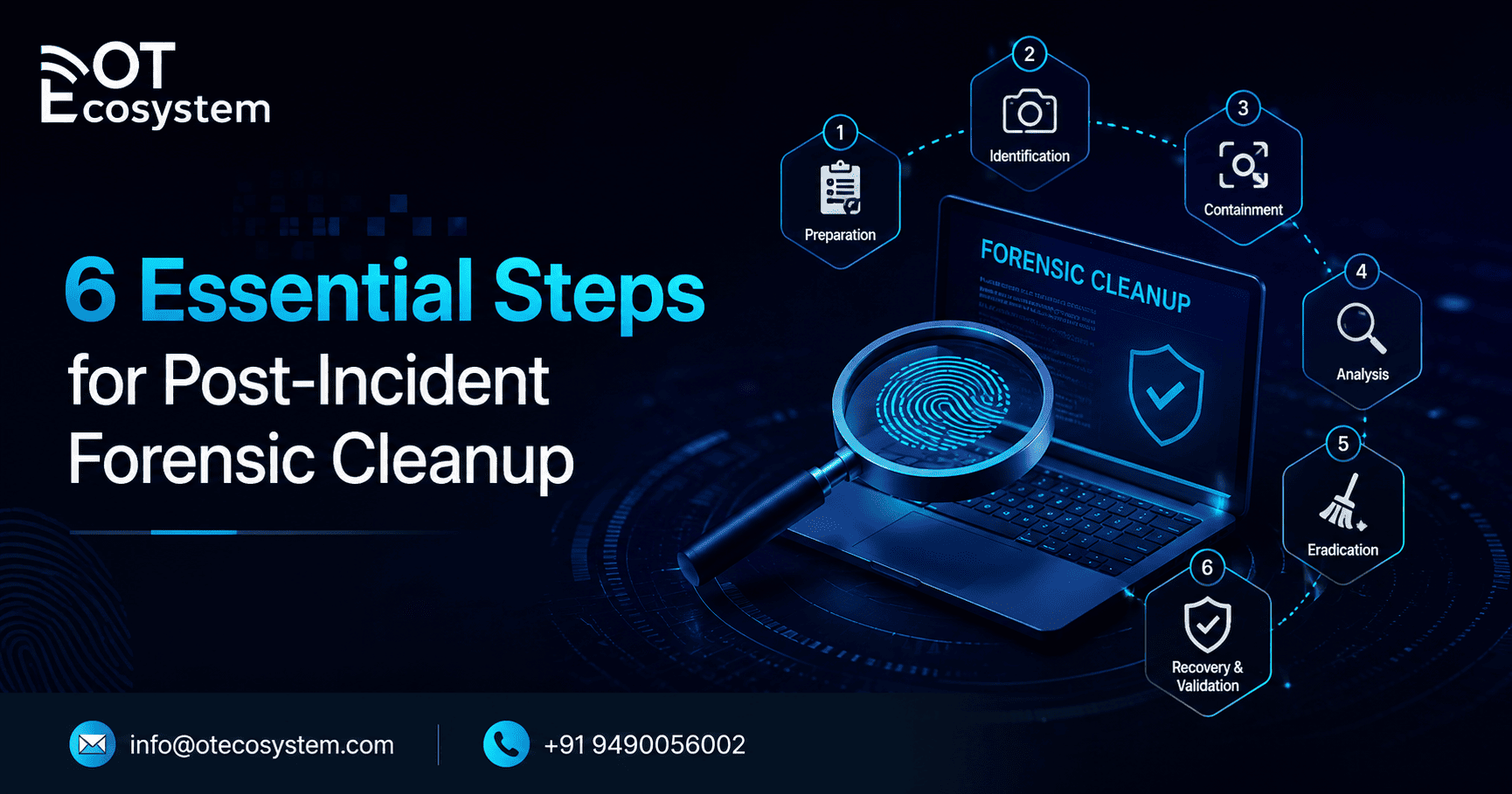
Here are the 6 essential steps for post incident forensic cleanup specifically designed for OT and IoT ecosystems.
1.Safety Override and System State Preservation
Before touching a keyboard, verify the engineering overrides or activate the emergency stop if required. In OT environments, safety always takes priority over cybersecurity. If a forensic action such as disconnecting power could trigger a mechanical failure or environmental issue, stop immediately.
The Forensic Reality:
Unlike IT environments where RAM is immediately removed for analysis, OT environments require the physical process to remain stable and safe. Once safety is confirmed, the next priority is volatile data capture.
What to do:
Use read only commands to capture the running configuration of PLCs and RTUs. Avoid stopping the controller unless it has been safely isolated.
The challenge:
Many legacy controllers lose valuable forensic data such as packet buffers and temporary memory during a power cycle.
Actionable step:
Deploy a forensic tap on the mirrored switch port before beginning cleanup so network traffic can still be captured during isolation.
2. Intelligent Containment
In IT environments, containment usually means immediate isolation. In OT, isolation may result in losing visibility of remote pipeline pumps or industrial processes.
You must differentiate between a physical kill switch and a logical pause. During forensic cleanup, the goal is to preserve the environment without disrupting critical operations.
Network Micro Segmentation
Instead of shutting down an entire production floor, use software defined networking or firewall policies to isolate only the compromised zone while allowing monitoring traffic to continue flowing outward.
Quarantine Mode:
Move infected Engineering Workstations into a quarantine VLAN. Do not reimage them immediately because they may contain critical logs showing who configured the PLC and when changes occurred.
What to Avoid:
Do not fail over to a backup PLC before imaging the primary device. Doing so can overwrite the attacker’s traces and destroy valuable evidence.
3. Sterile Field Forensic Acquisition
Cleanup requires understanding exactly what is compromised. Modern attackers increasingly use living off the land techniques by hiding inside legitimate firmware updates or modifying ladder logic.
Building the Evidence Bundle
PLC Logic Capture:
Upload the existing ladder logic from the PLC and compare it against the last verified backup using hash validation. Differences may indicate a logic bomb or malicious modification.
Firmware Imaging:
Use JTAG or vendor specific forensic tools to extract firmware images when a bootkit is suspected. Traditional antivirus solutions cannot scan PLC real time operating systems effectively.
Network Logs:
Preserve packet capture files and search for unusual write commands targeting holding registers or unauthorized protocol behaviour.
The Integrity Rule:
Apply SHA 256 cryptographic checksums to every collected file. Without a verified chain of custody, forensic evidence may become unusable for legal or regulatory investigations involving IEC 62443, NIS2, or DORA compliance.
4. Root Cause Eradication and Secure Reimaging
Once evidence has been securely stored offline, eradication can begin. This process goes far beyond formatting a drive.
OT devices often contain unique operational configurations. A specific RTU may include timing delays or calibration settings that are not present in standard firmware images.
The 2026 Cleanup Protocol
Vector Identification:
Determine the original attack vector. The compromise may have originated from a vendor laptop, a phishing attack against an administrator, or a vulnerable serial to Ethernet converter. Fixing the vector is more important than fixing the symptom.
Firmware Flashing:
Completely wipe affected devices and reflash them using vendor certified firmware. Never trust existing onboard storage after an incident.
Credential Reset:
Reset all OT service accounts, SNMP community strings, and application passwords. Assume every credential has been exposed.
Shieldworkz Integration Point
During this phase, coordination between onsite engineers and remote SOC teams becomes critical. Organizations operating distributed OT assets such as wind farms or water facilities require centralized visibility to confirm eradication across all sites. Solutions and methodologies promoted by Shieldworkz focus on automated integrity validation before systems reconnect to operational networks, ensuring the environment is genuinely clean.
5. Controlled Recovery and Burn In
Do not simply power systems back on after cleanup. A sudden recovery process in OT environments can overload electrical systems or trigger operational instability.
The Phased Restoration Approach
Sheep Dip Restoration:
Restore systems into a segmented clean room VLAN first. Prevent them from interacting with production systems or sending live commands until validation is complete.
Functional Testing:
Run systems in simulation or maintenance mode for several hours while monitoring telemetry for unusual fluctuations or mismatched sensor readings that may indicate hidden manipulation.
Integrity Verification:
Perform a complete baseline comparison to confirm the restored configuration matches the approved known good state.
6. Post Cleanup Hygiene and Immutable Defense
The cleanup may be complete, but attackers frequently leave dormant persistence mechanisms within supply chains or engineering systems.
Hardening for the New Normal
Immutable Logging:
Forward OT logs into WORM storage or blockchain based ledgers to preserve evidence and demonstrate compliance during audits or investigations.
Patch and Virtual Patching:
Apply official vendor patches wherever possible. If systems cannot tolerate downtime, deploy virtual patching through IDS or IPS technologies to block exploit traffic without restarting critical equipment.
Zero Trust Architecture:
Implement identity based micro segmentation. After an incident, no internal device should automatically be trusted. Even compromised systems should be prevented from communicating with safety controllers.
Pro Tips for Managing OT Forensic Investigations
Post incident cleanup can become chaotic, especially when distributed teams are involved. IT teams may want immediate shutdowns while OT teams prioritize uptime.
Here are five expert tips for managing OT forensic investigations effectively.
1. Pre-Define the War Room:
Clearly define who has authority to make operational shutdown decisions. In many cases, this responsibility belongs to the Senior Operations Engineer rather than the CISO.
2. Use Buddy System Forensics:
Whenever an IT forensic analyst accesses a machine, ensure an OT engineer is present to identify any operational risks or safety impacts.
3. Conduct Tabletop Exercises:
Run simulated scenarios such as ransomware affecting an HMI. Verify whether IT teams understand how to safely collect logs from industrial controllers like Rockwell Automation PLCs.
4. Shieldworkz for Remote Visibility:
Organizations managing dispersed assets such as solar farms or remote pumping stations need centralized forensic visibility. Platforms like Shieldworkz help distributed teams standardize threat hunting and cleanup procedures without compromising local safety operations.
5. Check the Human USB Port:
Physical security matters. Many OT breaches originate from contractor USB devices or unmanaged portable media entering the facility.
Conclusion
This six step framework transforms post incident forensic cleanup from a reactive scramble into a controlled and repeatable process. By prioritizing safety, preserving evidence, validating firmware integrity, and hardening systems after recovery, organizations can significantly improve resilience against future attacks.
In 2026, recovery speed and operational trust define an organization’s reputation. A robust forensic cleanup process ensures that industrial operations can survive and recover from increasingly advanced cyber threats.
Stay Connected with OT Ecosystem
📩 Email: info@otecosystem.com
📞 Call: +91 9490056002
💬 WhatsApp: https://wa.me/919490056002