
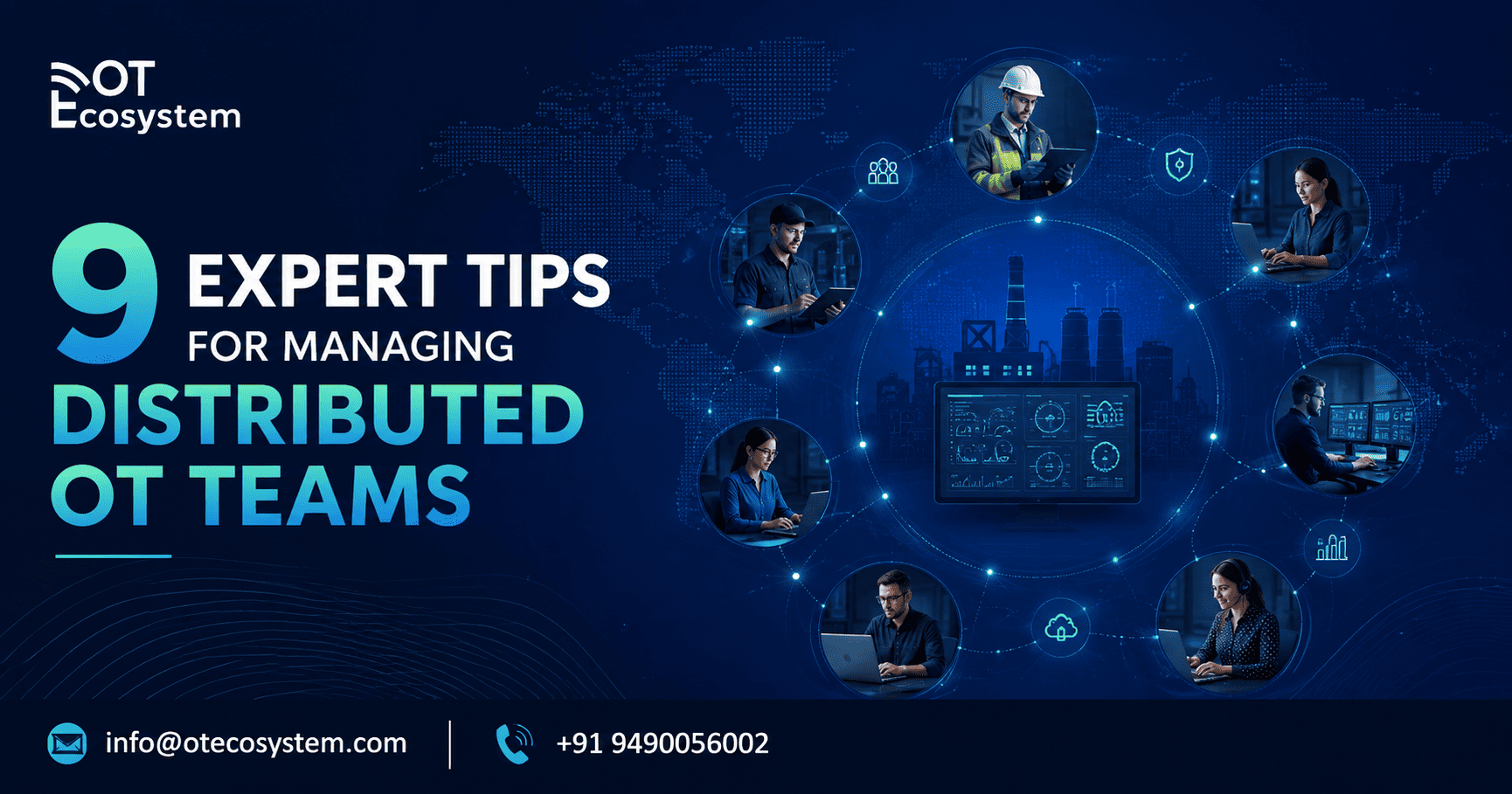
Managing Distributed OT Teams in 2026
For many years, Operational Technology environments depended completely on on site teams. Engineers, operators, and technicians had to be physically present inside plants and industrial facilities to troubleshoot PLCs, monitor turbines, manage SCADA systems, or handle safety equipment. Today, industrial operations have changed dramatically. Distributed OT teams are now becoming the standard across industries worldwide.
Modern industries are adopting Industry 4.0 technologies, Industrial IoT, cloud connected operations, and remote engineering support. Because of this transformation, OT engineers, cybersecurity analysts, OEM vendors, and plant operators often work from different cities, countries, and time zones. While this improves flexibility and operational efficiency, it also introduces new cybersecurity, communication, and operational challenges.
Managing distributed OT teams is very different from managing remote IT teams. In traditional IT environments, a connection issue may interrupt a meeting or delay a task. In OT environments, a communication failure can impact physical operations, production lines, safety systems, or critical infrastructure. This makes structured coordination, secure access, and operational visibility extremely important.
The Industrial Context Why Remote Changes Everything?
Digital transformation has reduced the isolation that once protected Critical Infrastructure environments. As organizations integrate Industrial IoT, cloud assisted operations, smart manufacturing platforms, and remote monitoring systems, the attack surface continues to expand rapidly.
Managing multi-site industrial operations now requires balancing operational continuity with cybersecurity protection. Organizations often coordinate internal employees, external contractors, equipment vendors, and cybersecurity specialists who all require different levels of access to sensitive OT environments.
Success in distributed OT management depends on secure communication, centralized visibility, operational discipline, and strong governance.
1. Establish a Unified Source of Truth for OT Asset Visibility
You cannot manage industrial operations effectively if teams cannot see the same operational data across facilities. Many organizations still rely on outdated spreadsheets and disconnected documentation systems that create visibility gaps.
Distributed teams often struggle because one facility may update firmware, modify configurations, or replace equipment without other teams knowing about the changes. This creates confusion during troubleshooting, audits, incident response, and maintenance planning.
Organizations should implement centralized OT asset management systems that provide real time visibility into industrial devices, firmware versions, network topology, and system configurations across all sites.
Passive asset discovery tools are particularly useful because they continuously monitor OT assets without interrupting operations. Remote engineers should be able to access the same information as on-site technicians instantly.
A centralized visibility strategy improves operational awareness, reduces downtime, strengthens cybersecurity, and improves coordination between distributed teams.
2. Standardize Secure Remote Access Governance
Remote access has become essential in modern industrial environments. However, insecure remote connectivity remains one of the biggest causes of OT ransomware incidents and cybersecurity breaches.
Many organizations still depend on traditional VPNs, shared passwords, or unmanaged remote desktop software. These outdated methods create major security vulnerabilities.
Modern OT environments should adopt Zero Trust security principles. Every remote user, device, and session must be verified continuously before access is granted.
Remote access should be time limited, role based, fully monitored, and recorded for auditing purposes. Multi Factor Authentication should always be mandatory for all remote OT access sessions.
For example, if a vendor needs to update a Human Machine Interface, they should only receive temporary access to the specific system required for the maintenance task instead of unrestricted network access.
Secure remote access improves operational confidence while significantly reducing cyber risks.
3. Implement Standardized Shift Handover Workflows
Distributed operations increase the risk of communication gaps during shift transitions. Important operational details can easily be missed when teams work across multiple locations or time zones.
Traditional verbal handovers are no longer sufficient for modern industrial operations. Organizations should use standardized digital handover templates that document operational status, active alarms, maintenance activities, cybersecurity observations, and unresolved issues.
Clear handover procedures help prevent missed safety events, duplicate maintenance activities, accidental equipment restarts, and delayed incident responses.
Every shift handover should include details about active system alarms, maintenance in progress, network changes, cybersecurity concerns, and pending operational tasks.
Strong handover management improves operational continuity and strengthens accountability between distributed teams.
4. Optimize Collaboration Through Integrated OT Platforms
Industrial communication requires more than simple chat applications. Remote engineers often need access to schematics, process data, operational logs, equipment manuals, and live system information to troubleshoot problems effectively.
Integrated industrial collaboration platforms help distributed teams work more efficiently by combining secure communication with technical context.
Many organizations now use augmented reality solutions, remote visual support systems, and smart wearable devices that allow remote experts to guide field technicians during maintenance or troubleshooting activities.
Industrial collaboration platforms also improve document sharing, remote diagnostics, engineering support, and operational coordination across facilities.
Improved collaboration reduces downtime, accelerates troubleshooting, and increases productivity across distributed OT teams.
5. Harmonize Cross Site Cybersecurity Policies
One insecure facility can expose an entire industrial organization to cyber threats. Attackers often target smaller or less protected facilities to gain access to larger operational networks.
Organizations managing distributed OT operations should establish a global cybersecurity baseline across all facilities. Frameworks such as ISA IEC 62443 provide strong guidance for securing Industrial Control Systems and maintaining consistent security practices.
Cybersecurity policies should cover password management, removable media controls, patch management, incident reporting, remote access, and network segmentation.
Regular cybersecurity audits and tabletop exercises help ensure alignment between facilities and improve communication between engineering, operations, and security teams.
Consistent cybersecurity governance reduces operational risk and strengthens industrial resilience.
6. Formalize Third Party and Vendor Coordination
In modern industrial environments, vendors and OEMs are often part of daily operations. However, unmanaged vendor access creates serious cybersecurity and operational risks.
Organizations should require all third-party vendors to use approved remote access systems instead of personal software or unofficial tools.
Vendor activities should be monitored carefully, logged completely, and restricted only to authorized systems and maintenance tasks.
Strong vendor governance helps organizations maintain visibility into who accessed industrial systems, what changes were made, and when activities occurred.
Formalized vendor coordination reduces supply chain risks, improves accountability, and strengthens OT security.
7. Centralize Incident Response Coordination
Distributed teams require structured incident response processes to handle operational disruptions and cybersecurity incidents effectively.
An OT specific incident response plan should clearly define responsibilities for on-site personnel, remote analysts, engineering teams, and management leadership.
Organizations should establish clear escalation paths, communication channels, investigation procedures, and recovery workflows.
Many industrial companies now use OT focused Security Orchestration Automation and Response platforms to automate data collection and improve incident coordination.
Fast and organized incident response reduces downtime, protects safety systems, and minimizes operational disruptions.
8. Prioritize Contextual Training and Workforce Development
Remote engineers can become disconnected from the physical realities of industrial environments over time. Understanding the physical behaviour of machinery remains extremely important in OT operations.
Organizations should provide regular practical training opportunities for distributed teams whenever possible. Site visits, simulation exercises, digital twin technologies, and virtual training labs help maintain operational familiarity.
Training programs should also include industrial cybersecurity awareness, secure engineering practices, operational safety procedures, and incident response simulations.
Continuous workforce development helps distributed OT teams remain technically skilled, operationally aware, and aligned with evolving industry requirements.
9. Leverage KPI Tracking for Operational Visibility
Managing distributed OT operations requires data driven decision making. Organizations should use operational metrics and cybersecurity KPIs to measure efficiency, responsiveness, and system reliability.
Important metrics include Mean Time to Detect incidents, Mean Time to Repair systems, alarm response times, patch deployment timelines, and remote access activity trends.
Comparing KPIs across facilities helps identify operational bottlenecks, staffing shortages, technology limitations, and cybersecurity weaknesses.
Data driven operational management improves resource allocation, increases efficiency, and supports long term industrial resilience.
Common Mistakes Organizations Make
Many organizations still depend heavily on tribal knowledge where experienced personnel hold critical operational information that is not documented properly. When those individuals retire or work remotely, valuable knowledge can disappear quickly.
Another major mistake is treating OT systems exactly like traditional IT systems. Aggressive patching, automated reboots, or forced updates can disrupt sensitive industrial operations and create safety risks.
Communication silos between maintenance teams, engineering teams, and cybersecurity personnel also create operational inefficiencies and increase cyber risks.
Some organizations also allow unofficial remote access methods because official systems are considered inconvenient. These unauthorized connections create dangerous cybersecurity backdoors into industrial networks.
Future Trends in Distributed OT 2026 and Beyond
Artificial Intelligence will continue transforming industrial operations by helping operators prioritize alarms, detect anomalies, and automate operational analysis.
Zero Trust architecture will become increasingly important as organizations eliminate assumptions about trusted internal networks. Every user, device, and communication session will require continuous verification.
Cloud assisted engineering environments are also expanding rapidly. Engineers can securely access advanced industrial software, simulations, and PLC programming environments from remote locations without relying on powerful local workstations.
Digital twins will further improve workforce training, predictive maintenance, operational simulations, and remote troubleshooting capabilities.
FAQ ‘s
How do we ensure remote access does not compromise safety?
Organizations should implement Physical Presence Required procedures for high risk operational changes. Remote engineers may prepare changes remotely, but local operators should physically confirm and authorize critical actions before implementation.
What is the most important tool for a distributed OT manager?
A centralized OT asset management and change management system is one of the most important tools because it provides visibility into operational changes, system configurations, and user activities across facilities.
Can we manage OT teams using standard collaboration tools like Teams or Slack?
General communication platforms are useful for messaging and coordination, but industrial operations often require specialized OT collaboration tools that provide access to technical documentation, operational logs, engineering schematics, and real time industrial data.
Conclusion
Managing distributed OT teams successfully requires balancing operational flexibility with strong cybersecurity governance. Organizations must enable remote collaboration while protecting critical infrastructure, industrial processes, and safety systems.
Companies that invest in centralized visibility, secure remote access, standardized communication, workforce development, and cybersecurity governance will create stronger and more resilient industrial operations.
Distributed OT operations are no longer a future concept. They are now a core part of modern industrial infrastructure. Organizations that adapt early will improve efficiency, reduce downtime, strengthen cybersecurity, and build scalable industrial ecosystems for the future.
Stay Connected with OT Ecosystem
📩 Email: info@otecosystem.com
📞 Call: +91 9490056002
💬 WhatsApp: https://wa.me/919490056002