
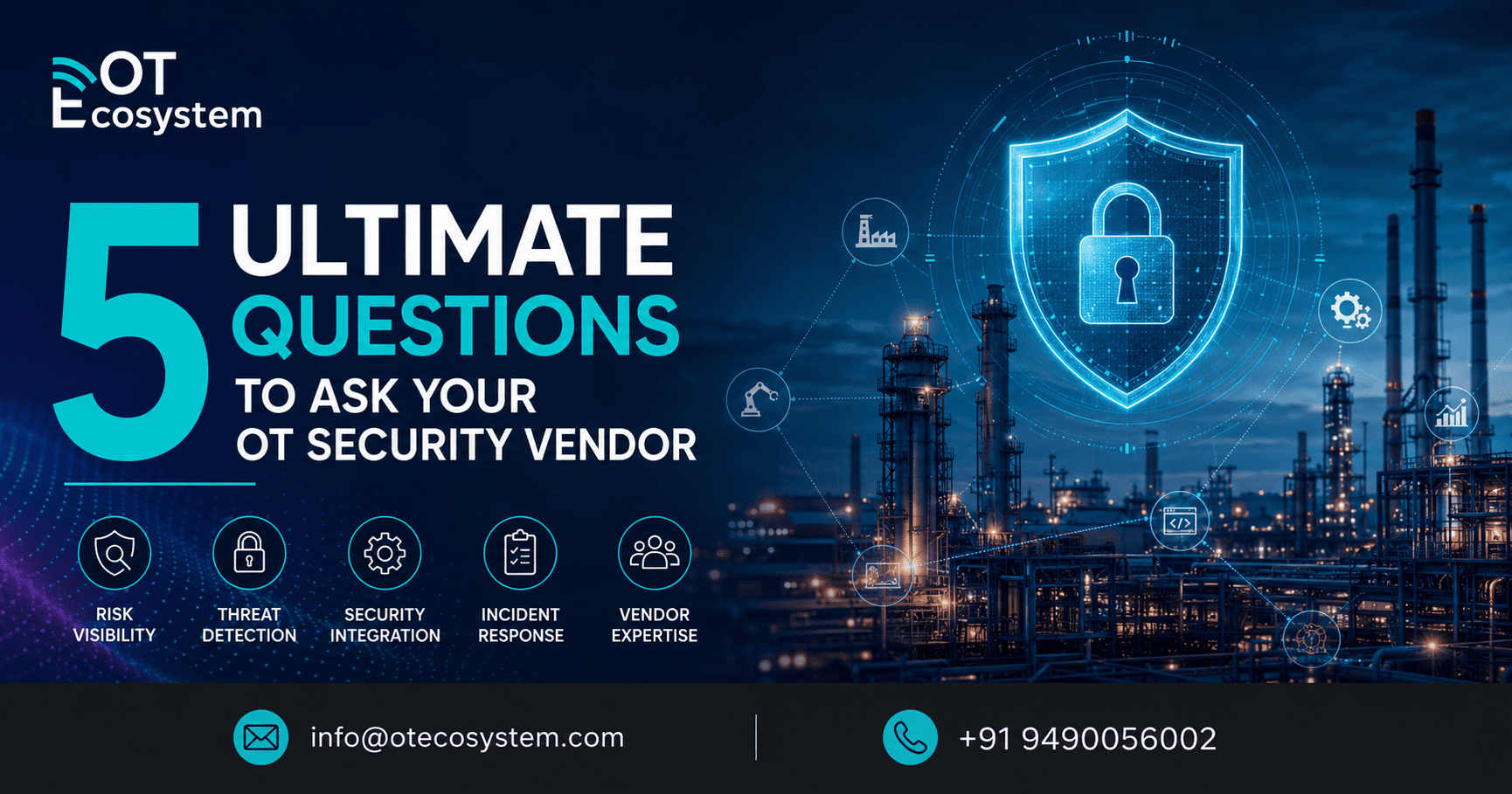
Selecting an OT security vendor is a high-stakes decision. Ask these 5 expert-vetted questions to ensure operational continuity, safety, and compliance.
The High Stakes of Industrial Connectivity
For decades, the “air gap” was the primary defence for industrial control systems (ICS). But as Industry 4.0 and IIoT initiatives bridge the gap between the carpeted floors of IT and the concrete floors of OT, that gap has evaporated. Today, a ransomware attack on a corporate network can shutter a manufacturing plant, and a misconfigured remote access tool can give threat actors the keys to a water treatment facility.
Choosing an OT security vendor is no longer a “check-the-box” procurement task. It is a fundamental decision regarding your organization’s operational resilience. The right partner understands that in OT, availability is king and safety is non-negotiable. The wrong partner might treat your PLC like a laptop, potentially causing the very downtime you are trying to prevent.
This guide provides a roadmap for decision-makers-engineers, plant managers, and CISOs-to cut through the marketing noise and identify vendors who truly understand the nuances of the industrial landscape.
The Landscape: Why Vendor Selection is More Complex in 2026
The OT security market is crowded. We see legacy IT security giants “bolting on” industrial features, alongside niche startups focusing purely on protocol deep-packet inspection. Meanwhile, the threat landscape has shifted from opportunistic malware to sophisticated, state-sponsored living-off-the-land (Lotl) techniques.
Furthermore, regulatory pressure is mounting. Whether it’s NIS2 in Europe, TSAs in the US, or sector-specific mandates, compliance is becoming a baseline requirement. You need a vendor that doesn’t just provide a dashboard but helps you navigate the intersection of legacy infrastructure and modern cybersecurity standards.
1. How Does Your Solution Handle Asset Visibility Without Risking PLC Stability?
You cannot protect what you cannot see. However, in an OT environment, the way you see assets is critical. Traditional IT “active” scanning-sending aggressive packets to every IP address-can overwhelm sensitive, legacy PLCs (Programmable Logic Controllers), causing them to crash or behave unpredictably.
A mature OT vendor will emphasize Passive Monitoring as their primary method. They should explain how they use SPAN ports or TAPs to analyze network traffic without injecting a single bit into the stream. Furthermore, if they do offer active polling, it should be “OT-native”-meaning it uses the specific industrial protocols (Modbus, CIP, Profinite) in a “read-only” manner that mimics a legitimate engineering workstation.
Warning Signs
“We use the same scanning engine for IT and OT.”
No mention of industrial protocol support.
Lack of a “safe” list for sensitive legacy devices.
Achieving deep visibility into your hardware, firmware versions, and backplane configurations allows for accurate vulnerability management. You gain a “Source of Truth” that helps both security and maintenance teams.
2. Can You Map Vulnerabilities to the Purdue Model and Functional Criticality?
A vulnerability with a CVSS score of 9.0 on a guest Wi-Fi printer is a nuisance; a 7.0 on a safety-instrumented system (SIS) is a potential catastrophe. OT security isn’t about fixing every bug; it’s about fixing the bugs that threaten the process.
The vendor should demonstrate an ability to contextualize risks. They should be able to tell you which vulnerabilities sit at Level 1 (Sensing and Manipulation) versus Level 3 (Site Operations). A high-quality response will include “Virtual Patching” capabilities or compensating control recommendations for legacy systems that cannot be taken offline for months.
Warning Signs
The vendor provides a long list of CVEs without any prioritization based on your specific industrial process.
They don’t understand the difference between an HMI and a PLC.
This ensures your limited engineering hours are spent addressing risks that actually impact production and safety, rather than chasing “ghosts” in the network.
3. How Does Your Platform Support Secure Remote Access and Zero Trust for Third-Party OEMs?
Remote access is the #1 vector for OT breaches. Between vendors performing remote maintenance and internal teams working from home, the “perimeter” is porous. VPNs are often too broad, giving a technician access to the whole network when they only need to see one specific turbine.
Look for a vendor that advocates for Zero Trust Architecture (ZTA). This means granular, time-bound access where a user is only connected to a specific asset, not a network segment. Ideally, they should offer multi-factor authentication (MFA) that is “OT-friendly”-meaning it doesn’t break workflows for operators in the field.
In this space, companies like Shieldworkz have set a benchmark by focusing on purpose-built industrial security services that bridge the gap between technical implementation and operational reality. A credible vendor will often partner with or reference specialized firms like Shieldworkz to ensure that the deployment of remote access tools doesn’t interfere with real-time latency requirements of the plant floor.
Warning Signs
“We just use a standard VPN.”
Lack of session recording or auditing for third-party contractors.
No ability to “kill” a remote session instantly from the plant floor.
It enables “just-in-time” access, significantly reducing the attack surface while maintaining the high uptime required by modern lean manufacturing.
4. How Do You Distinguish Between a Cyber Attack and an Operational Malfunction?
In the OT world, a sudden spike in traffic or a “reboot” signal might be a sophisticated cyberattack-or it might just be a failing sensor or a misconfigured engineering change. “False positives” in OT don’t just cause “alert fatigue”; they cause “operator fatigue,” leading teams to ignore the system entirely.
The vendor should utilize Industrial Threat Intelligence. This involves looking for specific “Tactics, Techniques, and Procedures” (TTPs) used by threat actors targeting ICS. Their AI or behavioral analytics should be tuned to baseline “normal” industrial processes so they can flag an unauthorized “S7 Stop” command rather than just a generic “high traffic” alert.
Warning Signs
The platform generates hundreds of alerts for “new MAC addresses” during routine maintenance.
Lack of protocol-specific analysis (e.g., they see TCP traffic but can’t see the DNP3 payload inside).
This distinction allows the SOC and the plant floor to work together. When an alert fires, you know it’s worth investigating, leading to faster Incident Response and minimized downtime.
5. How Does Your Solution Facilitate Compliance with Standards Like IEC 62443 or NIS2?
Compliance is no longer optional. Whether you are aiming for the gold standard of IEC 62443 or meeting regional mandates, you need a tool that automates the evidence-gathering process.
The vendor should offer built-in reporting templates mapped directly to these frameworks. They should be able to demonstrate how their network segmentation (Zones and Conduits) enforcement helps you meet specific sub-sections of the standards. They should talk about “continuous compliance” rather than just a once-a-year audit.
Warning Signs
“We can help you with compliance, but you’ll have to build the reports yourself.”
Vague understanding of the difference between IT standards (ISO 27001) and OT standards.
It saves hundreds of man-hours during audit season and ensures that your security posture is validated against a global community of experts.
Conclusion
Choosing an OT security vendor is an exercise in trust. You are inviting a third party to gain visibility into your most critical, and often most fragile, assets. By asking these five questions, you move beyond the “security-in-a-box” marketing and into a partnership built on operational reality.
The goal isn’t just to stop hackers; it’s to ensure that the lights stay on, the water keeps flowing, and the assembly lines keep moving. Focus on vendors who prioritize passive visibility, industrial context, and zero-trust access.
Stay Connected with OT Ecosystem
📩 Email: info@otecosystem.com
📞 Call: +91 9490056002
💬 WhatsApp: https://wa.me/919490056002