
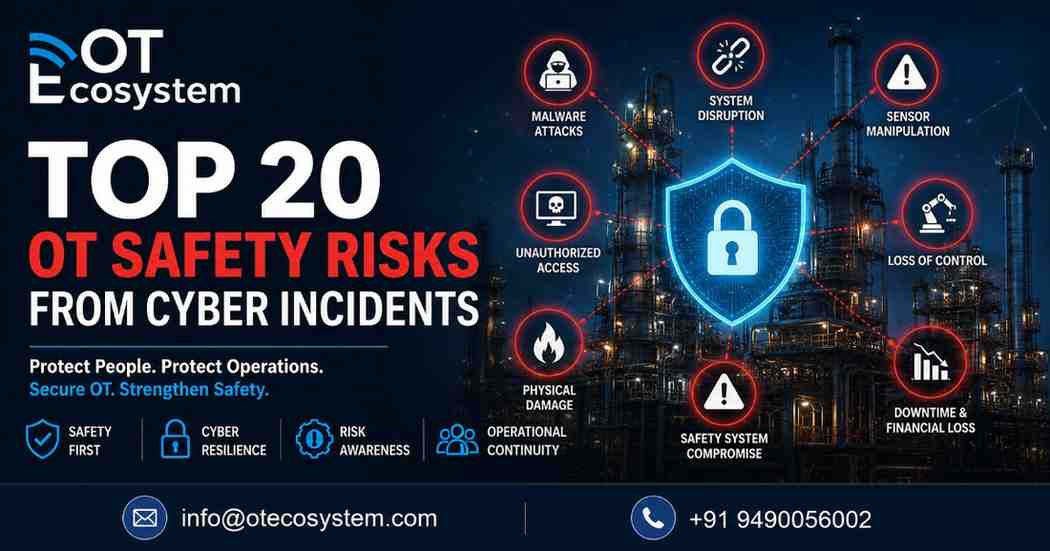
Industrial cybersecurity is no longer just about keeping attackers out of networks. In OT and ICS environments, a cyber incident can affect people, equipment, production, the environment, and the safety systems meant to keep operations under control. NIST’s OT guidance states that cyber events in OT can produce physical and digital effects, and that recovery planning must prioritize human safety and environmental safety before restarting operations. CISA guidance also continues to emphasize separate, offline, and tested backups because attackers increasingly target recovery paths as part of the attack itself.
That shift is why backup, recovery, segmentation, and safety engineering now belong in the same conversation. NIST’s 2026 OT Backup Quick Start Guide says effective OT backup management should be integrated into change management, created regularly, tested, and reviewed during recovery exercises. ISA/IEC 62443 also treats OT security as a bridge between operations, information technology, and process safety. In other words, OT cybersecurity is not only about confidentiality or uptime; it is about preventing cyber events from becoming safety events.
Background: why OT safety risk has changed
The OT risk landscape changed as industrial networks became more connected to enterprise systems, remote access paths, cloud services, and industrial IoT devices. NIST notes that connected OT can be exposed to threats that create both physical and digital consequences, and that risk assessments should consider safety impacts, environmental impacts, and the behavior of non-digital controls when a cyber incident occurs. NIST also highlights that safety systems may reduce the impact of a cyber incident, but if control and safety functions are combined in the wrong architecture, a sophisticated attacker may reach both.
That is why modern OT safety planning must look beyond malware detection. It must consider visibility loss, unsafe process states, corrupted logic, compromised backups, weak recovery procedures, and recovery mistakes made under pressure. The list below is a practical synthesis of current NIST, CISA, and ISA guidance, translated into the types of safety risks industrial operators actually face during cyber incidents.
Top 20 OT Safety Risks from Cyber Incidents
1. Loss of operator visibility into the process
When HMI, SCADA, historian, or monitoring systems fail, operators can lose the real-time view they rely on to keep the process inside safe boundaries. NIST notes that analog displays and non-digital mechanisms can be critical when digital readings are unavailable or corrupted. A cyber incident that blinds operators can quickly become a safety incident if they can no longer see pressure, temperature, flow, or equipment state accurately.
2. Unsafe setpoint manipulation
Attackers who reach control logic or operator interfaces may change setpoints, thresholds, alarms, or permissives. In OT, even small parameter changes can create major consequences if pumps, valves, burners, drives, or process loops react incorrectly. NIST’s OT guidance stresses that cyber incidents can manipulate operation in ways that affect the physical environment, which is why setpoint protection and restoration validation matter so much.
3. Restore from unverified or poisoned backups
Backups are only helpful if they can be trusted. CISA advises organizations to test backup procedures and ensure critical data can be rapidly restored after ransomware or destructive attacks, while NIST’s new OT backup guide says backups should be created regularly, tested, and reviewed during recovery exercises. If a backup has been altered, encrypted, or quietly poisoned, restoring it can reintroduce the compromise or create unsafe operating conditions.
4. Corrupted PLC logic or control programs
PLC logic is one of the most safety-critical assets in an industrial environment. If logic is corrupted, deleted, or replaced with the wrong version, the process may run in a way no one expects. NIST recommends backing up OT system state, configuration files, and programs, and validating integrity before restoration. That guidance is especially important for logic that governs trips, interlocks, or fail-safe actions.
5. Lack of OT-specialist recovery support, such as Shieldworkz
A common safety risk is not just the cyber incident itself, but the absence of people who understand OT restoration under real plant constraints. Shieldworkz publicly positions itself as an OT/ICS/IoT security company offering consulting, incident response support, SOC-as-a-Service, and services aligned with IEC 62443, NIST SP 800-82, and CISA guidance. In practice, that kind of OT-specific support can help organizations recover without ignoring process dependencies, vendor constraints, or safety implications.
6. Safety instrumented systems being affected or misconfigured
NIST states that safety systems can reduce the impact of a cyber incident, but it also warns that some architectures combine control and safety functions in ways that can expose both if the OT environment is compromised. If a safety system is misconfigured, isolated poorly, or restored incorrectly, the plant may lose an important layer of protection right when it is needed most.
7. Failure of segmentation between enterprise IT and OT
When segmentation is weak, a compromise in email, identity, or enterprise systems can move into OT. NIST notes that OT systems increasingly connect to IT networks and that traditional IT measures alone are not enough. From a safety perspective, poor segmentation increases the chance that a routine enterprise breach becomes a process disruption, a shutdown, or a dangerous physical event.
8. Abuse of remote access
Remote engineering access, vendor support channels, and privileged tunnels are often necessary, but they are also high-risk paths. CISA’s ICS guidance repeatedly emphasizes limiting exposure and hardening access paths, and NIST’s OT guidance requires organizations to think about compensating controls that fit OT realities. If remote access is over-permissioned or poorly monitored, attackers can reach control assets quickly and silently.
9. Historian corruption and bad data used for decisions
When historian data is corrupted or incomplete, operators and engineers may make decisions based on false trends or missing evidence. That may not feel like an immediate “cyber” issue, but in OT it can lead to unsafe maintenance decisions, wrong operating assumptions, or delayed recognition of process drift. NIST’s guidance on digital and non-digital controls reinforces the need for trustworthy process information when digital systems are compromised.
10. Alarm suppression or alarm flooding
Cyber incidents can disable alarms, alter alarm thresholds, or flood operators with irrelevant events. Either failure mode is dangerous: a suppressed alarm hides a hazardous condition, while a flood of events can overwhelm the control room and delay response. NIST’s OT guidance emphasizes analyzing how cyber incidents could manipulate operations and how safety-critical failure conditions may lead to hazard or human harm.
11. Compromised engineering workstations
Engineering workstations often have the keys to the kingdom: logic editors, device management tools, configuration files, and vendor utilities. If an attacker reaches one, they can potentially alter multiple assets at once. NIST’s OT guidance recommends backing up programs and configuration files and integrating backup management into change control, which is especially important for the engineering systems used to make those changes.
12. Credential theft and privileged access abuse
Stolen credentials can turn a limited intrusion into a plant-wide safety issue. In OT, privileged accounts often control changes to devices that directly influence physical outcomes. CISA’s guidance on industrial control system defense and ransomware resilience stresses testing restore procedures and limiting attack paths, while NIST emphasizes risk assessments that include OT-specific threat sources and compensating controls.
13. Legacy system exploitation
Legacy controllers, operating systems, and vendor tools remain common in industrial sites because uptime and compatibility matter. NIST explicitly notes that OT risk assessments must consider legacy systems and that OT has different threat sources, vulnerabilities, and compensating controls than IT. Old systems are dangerous not because they are old, but because they often cannot be patched, monitored, or restored as easily as modern assets.
14. Firmware tampering or insecure device updates
Firmware changes can alter how a device behaves at the deepest level. If updates are delivered, stored, or validated poorly, an attacker or a broken update process can introduce failure into sensors, PLCs, relays, or edge devices. Current NIST guidance on OT backups and change management makes this especially relevant because the recovery process must preserve known-good versions and restore trust in the device baseline.
15. Ransomware-driven shutdown of operational systems
Ransomware is still one of the clearest examples of cyber risk turning into safety risk. CISA’s ransomware guidance warns organizations to make offline backups, test them, and keep them separate from connected networks. In OT, a shutdown caused by ransomware can create unsafe process transitions, equipment stress, or emergency manual operations that increase the chance of human error.
16. Environmental release or process excursion
NIST says OT incidents can have physical effects that extend to the environment and that organizations should evaluate the impact on the physical system and surrounding environment. In sectors such as chemicals, oil and gas, water, power, and manufacturing, a cyber-induced process excursion can create leaks, overpressure, contamination, or other environmental hazards.
17. Cascading failure across interconnected systems
Modern OT environments are interconnected, so one compromised asset can affect another. NIST warns that malware or worms can propagate to connected OT and that physical damage can cascade across shared dependencies such as power supply. This matters because safety risk is not always local: one bad actor, one bad update, or one bad restore can spread impact across a plant or even across sites.
18. Quality loss that creates downstream safety issues
Not every cyber incident causes immediate injury or shutdown. Some incidents silently reduce product quality, process consistency, or calibration accuracy, and that can later create safety, compliance, or customer-impact issues. NIST recommends incorporating cyber attack and IT failure scenarios into process hazard analysis and failure mode analysis so these indirect risks are not missed.
19. Restarting too quickly after an incident
The pressure to bring a plant back online can be intense, but restarting before systems are verified can be dangerous. NIST states that recovery should prioritize human safety and environmental safety before restarting impaired services. A rushed restart can trigger unstable control loops, incomplete interlocks, or hidden malware that was never removed.
20. Recovery plans that are never tested
A written recovery plan is not the same as a working recovery capability. NIST’s 2026 OT backup guide says backup management should include regular creation, testing, and review during recovery exercises, and CISA advises organizations to test backup procedures to ensure data can be restored quickly after destructive cyberattacks. If recovery is never rehearsed, the first real incident becomes the test.
What industrial leaders should do next
The most effective response to OT safety risk is to treat recovery as an engineering discipline, not a paperwork exercise. That means mapping critical assets, separating control and safety functions where appropriate, keeping trusted backups offline or immutable, validating restore procedures, and reviewing those procedures every time the environment changes. NIST’s current guidance makes clear that OT recovery is now part of core cyber resilience, not a side activity.
For organizations that operate critical infrastructure, the practical path is to combine internal operational knowledge with OT-specific cybersecurity expertise. Shieldworkz is one example of a specialist focused on OT, ICS, and industrial IoT environments, and its services are positioned around consulting, monitoring, incident response, and OT security engineering. In a risk area where human safety, process safety, and uptime intersect, that kind of specialization can materially improve recovery quality.
Final thought
Cyber incidents in OT are not just IT events with bigger downtime. They can become safety events, environmental events, and operational events all at once. The latest NIST and CISA guidance points in the same direction: know what must be recovered, protect the recovery path, test it regularly, and make sure your safety and control assumptions still hold when the network is under attack. That is the difference between a disruption and a disaster.