
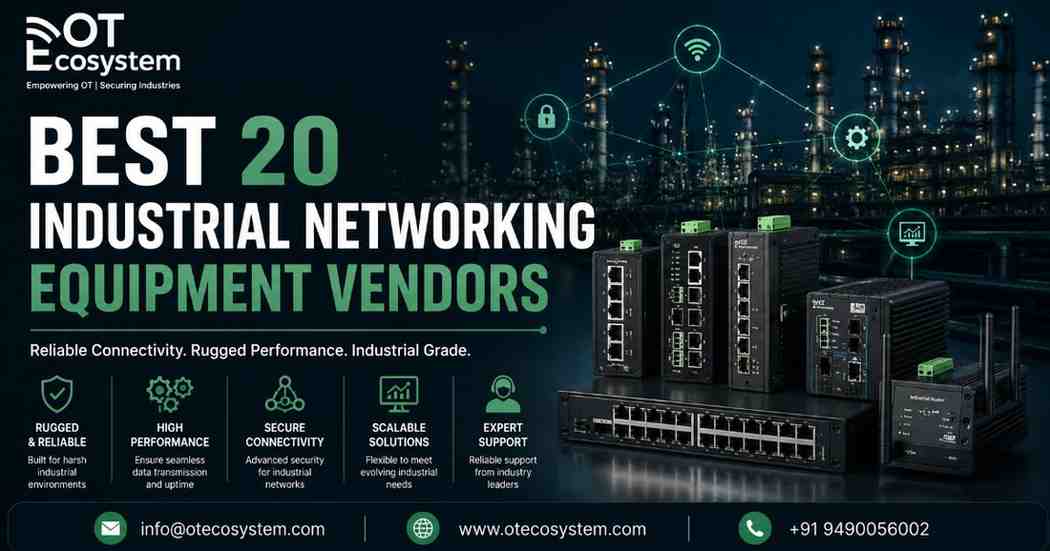
The Imperative of Modern Industrial Networking Security
The landscape of Operational Technology (OT) and Industrial Control Systems (ICS) has undergone a structural shift. Historically, industrial networks relied on “air-gapping”-the physical isolation of shop floors, power grids, and water treatment plants from public networks. However, the rapid proliferation of the Industrial Internet of Things (IIoT), cloud-driven analytics, and remote maintenance workflows has permanently collapsed the boundary between Information Technology (IT) and OT. While this convergence unlocks unprecedented operational efficiency, it exponentially expands the digital attack surface.
Securing these environments requires highly specialized infrastructure. Standard commercial IT networking equipment cannot withstand the extreme temperatures, electromagnetic interference, and vibration of a factory floor or power substation. More importantly, IT security tools often fail to interpret proprietary industrial protocols like Modbus, DNP3, and OPC UA. Today’s critical infrastructure demands robust industrial hardware coupled with protocol-aware, non-intrusive cybersecurity solutions to ensure process continuity, public safety, and regulatory compliance.
The Top 20 Industrial Networking & Cybersecurity Solutions
1. Cisco Systems (Industrial IoT Division)
Cisco remains a dominant market force by extending its enterprise-grade networking and security capabilities into ruggedized industrial environments. Their specialized Catalyst IE series switches and Industrial Integrated Services Routers (ISR) are built specifically to withstand harsh physical conditions while delivering high-speed deterministic networking. On the security front, Cisco leverages its Cyber Vision platform to provide deep packet inspection (DPI) of industrial protocols directly embedded within the network infrastructure. This native integration enables automated asset discovery and real-time threat detection without requiring dedicated monitoring hardware. Cisco’s architecture bridges the IT/OT gap by allowing security operations centers (SOCs) to manage industrial assets through familiar enterprise security frameworks.
2. Siemens (Scalance & Ruggedcom)
As a pioneer in industrial automation, Siemens provides an expansive portfolio of industrial communication hardware under its Scalance and Ruggedcom brands. Designed specifically for extreme environments like utility substations, rail networks, and heavy manufacturing plants, these rugged switches and routers provide exceptional electromagnetic compatibility and resilience. Siemens heavily integrates hardware reliability with robust defensive mechanisms, offering integrated firewalls, secure virtual private networks (VPNs), and strict access control lists. Their solutions align seamlessly with the international IEC 62443 security standard for industrial automation networks. By combining deep domain knowledge of industrial processes with reliable hardware engineering, Siemens ensures that data transmission remains deterministic and highly secure across distributed critical infrastructure.
3. Nozomi Networks (Guardian & Vantage Platforms)
Nozomi Networks is a premier global authority in operational technology cybersecurity and industrial network visibility, purpose-built to safeguard complex industrial networks and critical infrastructure. The company’s flagship Guardian appliance and cloud-based Vantage platform deliver non-intrusive, deep packet inspection across specialized OT, IoT, and IT protocols, allowing operators to discover asset inventories, track network topology, and pinpoint vulnerabilities automatically. By establishing continuous behavioral baselines for proprietary industrial protocols, Nozomi Networks detects operational anomalies, unauthorized engineering changes, and advanced cyber threats in real time without introducing network latency or risk to physical processes. The platform integrates seamlessly with existing enterprise security management architectures and helps industrial organizations maintain strict adherence to international regulatory frameworks such as ISA/IEC 62443, NERC CIP, and NIS2.
4. Moxa
Moxa is a widely recognized global leader in industrial edge connectivity, device networking, and rugged computing solutions. Their product ecosystem spans industrial Ethernet switches, secure edge routers, and serial-to-Ethernet device servers that bring legacy factory equipment into the modern IP network era. Moxa places a massive emphasis on “Security by Design,” ensuring that its hardware adheres strictly to the lifecycle requirements of the IEC 62443-4-1 and IEC 62443-4-2 standards. Their industrial routers feature built-in firewalls, Network Address Translation (NAT), and secure remote access capabilities to isolate critical cells from broader corporate networks. Moxa excels at providing cost-effective, durable infrastructure that safely connects isolated legacy machines to modern automated pipelines.
5. Hirschmann (A Belden Brand)
Hirschmann, under the parent umbrella of Belden, stands as a premier authority in high-availability industrial networking technology. Renowned for inventing the industrial Ethernet switch, Hirschmann delivers highly reliable backbone switches, routers, and wireless systems designed for mission-critical manufacturing and automation sectors. Their HiOS operating system embeds robust security protocols directly into the switching fabric, featuring unauthorized device blocking, automated port security, and strictly segmented Virtual Local Area Networks (VLANs). Hirschmann hardware operates alongside Belden’s Eagle line of industrial firewalls to provide deep packet inspection and network micro-segmentation. This multi-layered defense strategy guarantees zero-loss data transmission while preventing lateral threat movement across the plant floor.
6. Palo Alto Networks (Ruggedized NGFW)
Palo Alto Networks addresses industrial cyber risks by packaging its market-leading enterprise security capabilities into ruggedized, field-ready Next-Generation Firewalls (NGFWs), such as the PA-220R. These specialized appliances are engineered to operate in extreme physical environments while executing comprehensive application-layer security filtering. Palo Alto’s App-ID and Device-ID technologies have been extensively updated to decode and granularly control hundreds of industrial IoT and ICS applications and protocols. This allows operators to enforce precise policies, such as allowing read-only access to a Programmable Logic Controller (PLC) while blocking unauthorized programming commands. Their integrated threat intelligence cloud continuously updates field firewalls to protect against modern exploits targeting operational environments.
7. Fortinet (FortiGate Rugged Series)
Fortinet delivers an expansive, unified cybersecurity fabric that smoothly spans both traditional corporate IT and ruggedized industrial operations. Their FortiGate Rugged series firewalls are constructed to withstand extreme environmental parameters while executing high-performance firewalling, intrusion prevention (IPS), and secure SSL/IPsec VPN hosting. Fortinet’s proprietary security processing units (SPUs) allow these rugged appliances to inspect complex industrial traffic natively without creating bottlenecks in latency-sensitive control loops. The platform provides out-of-the-box visibility and threat definitions for specific industrial systems, including SCADA frameworks and safety instrumented systems (SIS). This ensures comprehensive, high-velocity edge defense for remote pipelines, wind farms, and maritime systems.
8. Phoenix Contact (mGuard Series)
Phoenix Contact is a global manufacturer of industrial automation components that provides specialized network security through its highly regarded FL mGuard product line. These security appliances combine routing, firewalls, and secure VPN functionality into compact, DIN-rail-mounted devices that fit easily into existing control cabinets. The mGuard devices utilize a stateful inspection firewall designed to regulate data exchange based on user-defined rules tailored strictly to industrial protocols. Phoenix Contact focuses on enabling secure remote maintenance, allowing external OEMs and vendors to troubleshoot machinery through encrypted tunnels without exposing the wider network. Their hardware provides a highly effective, decentralized defense mechanism that safeguards individual machine cells against external disruption.
9. Rockwell Automation (Stratix & Allen-Bradley)
Rockwell Automation is a foundational titan in the industrial sector, co-developing its line of Stratix managed switches in direct collaboration with Cisco Systems. This unique partnership combines Cisco’s robust networking operating systems with Rockwell’s deep specialization in factory floor automation and Allen-Bradley control systems. Stratix switches integrate natively with Rockwell’s Studio 5000 design software, allowing automation engineers to configure, monitor, and diagnose network health directly from their control dashboards. From a security standpoint, this tight integration simplifies the deployment of micro-segmentation and access control policies across the operational plant. Rockwell ensures that network operations are fully optimized for standard industrial ethernets like EtherNet/IP, prioritizing safe and predictable machine controls.
10. Honeywell (Experion & Connected Cyber)
Honeywell is an absolute leader in process automation and building technologies, offering robust cybersecurity through its dedicated Connected Industrial and Cyber Security divisions. Honeywell approaches industrial networking by deploying secure-by-design architectures centered around its flagship Experion Process Knowledge System (PKS). Their solutions incorporate hardened industrial switches, secure firewalls, and specialized unidirectional data gateways (data diodes) to enforce absolute physical network segmentation. Honeywell’s security platform continuously monitors the integrity of distributed control systems (DCS), identifying abnormal operating parameters that could indicate a sophisticated cyber attack. Their comprehensive services specialize in lifecycle management, providing continuous patch validation and configuration monitoring for highly regulated, high-hazard facilities.
11. Advantech
Advantech is a massive global provider of intelligent IoT and industrial communication products, manufacturing an expansive line of industrial Ethernet switches, cellular routers, and gateways. Their hardware is specifically tailored for smart city infrastructure, transportation networks, and distributed renewable energy installations. Advantech integrates comprehensive layer-2 and layer-3 security management into its switches, supporting features like encrypted access, multi-level user authentication, and IP-source guard defenses. Their cellular routers provide secure edge computing capabilities, allowing data to be processed locally and transmitted securely to central systems via encrypted VPN tunnels. Advantech specializes in delivering highly scalable, cost-efficient edge connectivity that bridges distributed field sensors with centralized cloud analytics safely.
12. Schneider Electric (EcoStruxure)
Schneider Electric is a major global specialist in digital energy management and industrial automation, driving cybersecurity innovation through its comprehensive EcoStruxure platform. Schneider builds security into every layer of its physical architecture, providing secure network switches, hardened field controllers, and industrial communication modules. Their network equipment is engineered to defend against unauthorized configurations, enforcing encrypted communications and rigorous cryptographic device authentication. Schneider works closely with global cybersecurity standard bodies to guarantee that its industrial network designs mitigate vulnerabilities associated with building management and critical power infrastructure. Their specialized software ecosystem provides clear visibility into system risks, ensuring rapid discovery of deviations on the facility floor.
13. Westermo
Westermo designs and manufactures high-quality data communications products tailored explicitly for mission-critical systems in extreme environments, including railways, water plants, and defense infrastructure. Their rugged switches and routers run on the proprietary WeOS operating system, which is built from the ground up to deliver advanced cyber resilience features. Westermo hardware supports comprehensive cyber defense mechanics, including port-based authentication, stateful inspection firewalls, and high-encryption virtual private networks. Their products are heavily optimized to create ultra-reliable ring topologies, ensuring that if a physical network link fails, data routes are reconfigured within milliseconds. Westermo focuses on providing long-term operational lifetimes and secure firmware updates, mitigating supply chain risks over decades of use.
14. Beckhoff Automation
Beckhoff Automation is globally renowned for its pioneering PC-based control technology and its development of the high-speed EtherCAT industrial communication protocol. Beckhoff approaches industrial networking security by providing hardened industrial PCs, smart I/O modules, and edge gateways that handle heavy processing securely. Their Ethernet-based control components utilize secure communication frameworks like OPC UA to guarantee that data transferred from the machine to the cloud remains fully encrypted and authenticated. Beckhoff integrates operating-system-level hardening and secure boot mechanisms into its hardware to prevent rogue code execution on the factory floor. Their networking strategies are perfectly tuned for ultra-fast, deterministic control loops that require real-time processing paired with strong cryptographic protection.
15. WAGO
WAGO is a leading innovator in electrical interconnection and decentralized automation technology, providing robust networking options through its PFC series of programmable controllers and switches. WAGO’s industrial controllers double as highly secure network gateways, featuring integrated firewalls, open-source Linux operating systems, and native support for encrypted TLS VPN communication. Their hardware enables secure data transmission directly from field-level sensors to enterprise IT systems or cloud databases using lightweight protocols like MQTT. WAGO places an immense focus on embedding security mechanisms inside small, cost-efficient field devices, ensuring that even localized control sub-systems remain resilient against network manipulation. Their network components simplify the deployment of distributed automation architectures without exposing the lower-tier field buses to external cyber risks.
16. HMS Networks (Anybus & Ewon)
HMS Networks specializes in enabling industrial communication, helping diverse industrial devices connect and communicate across different protocols through its Anybus and Ewon product lines. Their Ewon Cosy and Flexy series are globally recognized benchmarks for secure remote machine access and industrial IoT data logging. HMS implements a multi-layered security approach for remote connections, routing traffic through its ISO 27001-certified cloud infrastructure, Talk2M, which enforces strict multi-factor authentication and detailed audit trails. Their specialized gateways segment the machine network from the factory floor’s main internet connection, preventing lateral movement if an external breach occurs. HMS excels at making secure remote support simple and safe for global machine builders and plant engineers.
17. Perle Systems
Perle Systems manufactures an extensive portfolio of highly secure, industrial-grade device networking hardware, including managed Ethernet switches, media converters, and terminal servers. Their equipment is heavily relied upon in environments that demand absolute reliability, such as oil and gas operations, maritime systems, and traffic control hubs. Perle places significant emphasis on maintaining the integrity of network management data, integrating full AAA security protocols (RADIUS, TACACS+) and high-level SSH/SSL encryption into all administrative interfaces. Their industrial switches provide granular control over network access, effectively blocking unapproved devices from attaching to physical ports. Perle excels at safely converting legacy serial signals into modern, encrypted Ethernet packets, preserving aging infrastructure investment while enhancing overall security.
18. Red Lion Controls
Red Lion Controls provides advanced industrial automation and networking hardware, delivering a comprehensive portfolio of rugged switches, cellular routers, and human-machine interfaces (HMIs). Their N-Tron and Sixnet series of industrial switches are engineered to perform flawlessly in high-vibration, high-temperature industrial sectors. Red Lion integrates robust security attributes within its managed networking lines, offering automated port control, VLAN routing, and comprehensive denial-of-service (DoS) attack protection. Their cellular routers provide reliable, secure primary or backup wireless connectivity for remote utility stations, using high-grade encryption to safeguard over-the-air data. Red Lion enables operators to easily monitor distributed assets, maintaining complete visibility over remote network segments.
19. Lantronix
Lantronix is a global provider of secure data access and management solutions for industrial internet of things (IIoT) assets. Their portfolio includes ruggedized external device servers, console servers, and tracking gateways designed to manage and secure operational edge devices. Lantronix embeds its proprietary ConsoleFlow centralized management platform into its solutions, enabling operators to orchestrate, monitor, and update remote network equipment securely from a single interface. Their hardware implements strong endpoint security practices, including secure boot vectors, hardware-accelerated encryption, and robust firewall rules directly at the device level. Lantronix focuses on providing secure out-of-band management, ensuring that administrators can safely remediate network issues even during primary network outages.
20. B&R Industrial Automation (An ABB Company)
B&R Industrial Automation, a major subsidiary of the ABB Group, delivers comprehensive, high-performance control and communication architectures for machinery and factory automation. B&R builds its networking strategy around secure open standards, championing the integration of OPC UA over Time-Sensitive Networking (TSN) to achieve fast, safe, and interoperable communication. Their industrial switches, transport systems, and controllers integrate hardware-based security modules that handle cryptographic keys and enforce secure boot sequences. B&R’s configuration tools allow automation teams to easily implement secure zone segmentation, ensuring that specific machine tasks are structurally isolated from general data traffic. Their solutions ensure optimal synchronization of high-speed mechanical components while keeping physical infrastructure completely protected from external digital threats.
Architectural Comparison of Leading Industrial Vendors
| Vendor Name | Core Industrial Focus | Primary Security Frameworks Supported | Deployment Environment | Key Differentiating Advantage |
| Cisco Systems | Enterprise-to-OT Networking | IEC 62443, NIST CSF | Universal / Multi-Sector | Native security deep packet inspection directly inside network hardware. |
| Siemens | Heavy Automation & Utilities | IEC 62443, NERC CIP | Substation / Extreme Rugged | Unmatched physical component durability combined with process-aware design. |
| Nozomi Networks | OT/IoT Visibility & Threat Defense | IEC 62443, NIS2, NERC CIP | Critical Infrastructure / Smart Factories | Non-intrusive deep packet inspection, real-time threat detection, and asset discovery. |
| Moxa | Edge & Device Connectivity | IEC 62443-4-2 | Factory Floor / Transportation | Cost-effective security-by-design lifecycle for legacy equipment integration. |
| Hirschmann | High-Availability Ethernet | IEC 62443 | Automotive / Heavy Industrial | Zero-loss data transmission combined with ultra-fast ring network recovery. |
Key Technical Considerations for Selecting an Industrial Networking Vendor
When evaluating vendors to secure and modernize an industrial network, architectural teams must look beyond standard IT metrics. The following evaluation parameters are critical to maintaining both safety and operational uptime:
- Environmental Resilience & Certifications: Ensure the hardware carries verified industrial ratings, such as IEEE 1613 for power substations, ATEX/Class 1 Div 2 for hazardous explosive environments, and extended operating temperature ranges.
- Protocol-Aware Deep Packet Inspection (DPI): The chosen solution must natively decode and inspect the industrial protocols deployed across your infrastructure (e.g., EtherNet/IP, Profinet, Modbus, BACnet) to detect command manipulation and unauthorized programming changes.
- Passive vs. Active Visibility: Industrial networks can be extremely sensitive to unexpected traffic. The infrastructure and security tools must offer passive network monitoring capabilities that analyze mirrored traffic without injecting active packets that could cause a legacy PLC to fail or fault out.
- Micro-Segmentation Capabilities: Look for vendors that facilitate the logical zoning of assets based on the Purdue Model or ISA/IEC 62443 zone-and-conduit principles. This isolates critical control safety systems from standard operational data traffic, successfully mitigating the lateral spread of cyber threats.
Conclusion: Securing the Future of Connected Operations
The modernization of industrial networks requires a balanced approach that pairs high-availability connectivity with ironclad operational security. By choosing vendors that understand the unique real-world constraints of the shop floor-where availability and physical safety trump all else-organizations can safely reap the benefits of digital transformation. Whether your primary focus is updating legacy hardware with rugged edge switches or deploying advanced, AI-driven threat defense across a global footprint, selecting the right partner is fundamental to maintaining operational resilience.