
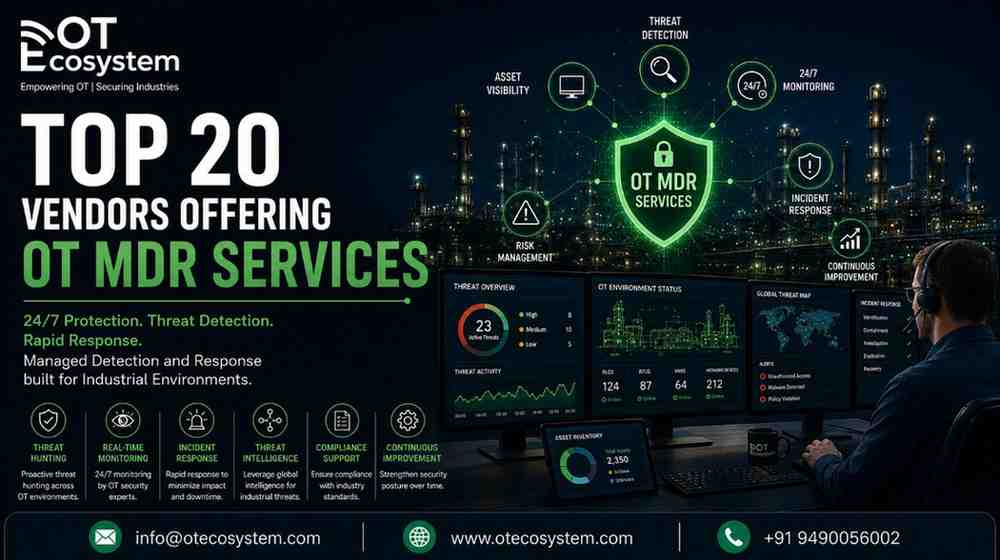
The Evolution of Industrial Security: Why OT MDR is No Longer Optional
In the rapidly evolving landscape of 2026, the convergence of Information Technology (IT) and Operational Technology (OT) has created unprecedented operational efficiencies, but it has also significantly expanded the attack surface for industrial organizations. Traditional IT-focused Managed Detection and Response (MDR) services often fall short in industrial environments because they lack the necessary context to understand industrial protocols, sensitive control systems, and the overarching priority of safety and uptime. Unlike IT environments where confidentiality is paramount, OT environments prioritize safety, process availability, and system integrity. Applying aggressive IT security controls-such as isolating a critical controller during an active production cycle-can result in catastrophic physical consequences.
OT MDR (Managed Detection and Response) fills this critical void by combining specialized industrial threat intelligence with 24/7 human-led expertise. It is not merely about alerting; it is about providing actionable, context-aware responses that protect the process floor without interrupting production. By leveraging passive network monitoring, deep packet inspection (DPI) of industrial protocols, and behavior-based anomaly detection, these services provide the visibility required to defend complex SCADA, DCS, and PLC ecosystems. As we move through 2026, the integration of agentic AI and automated threat hunting within these services has become the benchmark, allowing organizations to detect subtle, low-and-slow attacks that could otherwise bypass traditional signature-based security tools.
Understanding the OT MDR Landscape: Key Capabilities
To evaluate an OT MDR provider, one must look beyond marketing claims and focus on technical depth. The most mature providers in 2026 offer capabilities specifically engineered for the shop floor:
- Non-Intrusive Asset Discovery: A foundational element that maps all industrial assets-PLCs, RTUs, and IIoT devices-without sending active probes that could crash fragile legacy equipment.
- Protocol-Aware Deep Packet Inspection: The ability to decode proprietary industrial traffic (like Modbus, PROFINET, or CIP) to identify malicious commands or unauthorized configuration changes hidden in legitimate traffic.
- Safety-First Incident Response: Playbooks that are developed in consultation with plant engineers, ensuring that response actions are vetted against physical safety and process continuity requirements.
- Industrial-Specific Threat Intelligence: Intelligence feeds that focus on vulnerabilities in ICS/OT hardware, specialized malware targeting industrial controllers, and nation-state activity targeting critical infrastructure.
- Compliance-Ready Reporting: Automated generation of audit trails and risk assessments mapped to frameworks like IEC 62443, NIST CSF, and sector-specific mandates, crucial for demonstrating due diligence to regulators.
Top 20 Vendors Offering OT MDR Services in 2026
The following list represents a curated selection of vendors that have demonstrated significant capability in the OT/ICS security domain. These providers combine deep industrial domain knowledge with the rigorous response standards required for modern industrial operations.
1. Shieldworkz
Shieldworkz has established itself as a leader in the energy and utilities sector by delivering end-to-end OT security solutions that prioritize operational continuity. Their OT-MDR service is uniquely powered by specialists who are trained in both power systems and control engineering, ensuring that every detection is analyzed with the operational context required for critical infrastructure. By integrating agentic AI into their compliance and threat ingestion layers, they simplify the management of complex OT environments. Their non-intrusive asset discovery and deep protocol analysis allow for rapid risk reduction without disrupting the sensitive industrial processes that keep plants running.
2. Dragos
Dragos remains a cornerstone in the OT security market, offering a comprehensive platform that combines their world-class industrial threat intelligence with a managed service offering. They are widely recognized for their deep visibility into the ICS/OT environment, providing clients with unparalleled insight into adversary tactics, techniques, and procedures (TTPs) specifically targeting industrial organizations. Their analysts work closely with site operators to provide meaningful context during incidents, focusing on the preservation of safety and process integrity while ensuring rapid threat containment.
3. Claroty (via their Managed Services Partners)
Claroty’s extensive ecosystem of managed service partners leverages their industry-leading XDOR (Extended Detection and Response) platform to provide robust OT monitoring. The platform is designed to provide visibility into the extended IoT/OT environment, identifying potential vulnerabilities and threats across the enterprise and control networks. By partnering with global cybersecurity providers, Claroty ensures that clients receive 24/7 expert analysis that is deeply integrated with the specific requirements of their unique industrial automation environment.
4. Nozomi Networks
Nozomi Networks provides unparalleled visibility into the industrial network through their advanced monitoring and threat detection platform. Their managed service capabilities are bolstered by a vast network of security partners who utilize Nozomi’s real-time monitoring and anomaly detection to identify threats across the most complex global infrastructures. With a focus on scalability and deep industrial protocol support, they empower security teams to effectively manage risks in environments ranging from manufacturing plants to utility grids, ensuring that operations remain both secure and resilient.
5. Tenable (Tenable OT Security)
Tenable has significantly expanded its OT security footprint, offering sophisticated vulnerability management and monitoring capabilities that are essential for a mature OT-MDR strategy. Their platform provides the high-fidelity asset and vulnerability data that managed service providers need to make informed decisions. By integrating with leading security operation centers, Tenable helps organizations bridge the gap between IT and OT, allowing for a unified view of risk that ensures vulnerabilities in industrial controllers are prioritized alongside IT endpoint security flaws.
6. Cisco (Industrial Security Solutions)
Cisco leverages its deep networking expertise to provide secure, resilient connectivity for the industrial internet of things (IIoT). Their managed industrial security services combine their robust hardware portfolio with sophisticated detection and response capabilities designed to protect the critical communication paths within industrial environments. With a strong focus on visibility and segmentation, they enable organizations to enforce strict access controls and monitor traffic patterns, which are vital for preventing lateral movement by adversaries in interconnected OT networks.
7. Fortinet (FortiGuard Industrial Security)
Fortinet offers a converged approach to IT and OT security, providing a wide array of industrial-grade security appliances that support deep inspection and automated response. Their managed service offerings benefit from a massive global threat intelligence network, which is particularly effective at identifying threats that traverse the boundaries between IT and OT. By providing consistent security policies and centralized visibility across distributed industrial sites, Fortinet helps organizations streamline their security operations and reduce the time required to detect and contain threats.
8. Microsoft (Defender for IoT)
Microsoft’s Defender for IoT has become a powerful force in the OT security market, providing deep visibility and threat detection that integrates seamlessly with the broader Azure security ecosystem. Their service is designed to help organizations secure both their IT and OT assets using a unified platform, which simplifies management and accelerates the response to complex, cross-domain attacks. By utilizing cloud-scale AI and threat intelligence, they provide rapid detection of anomalous activities, helping industrial teams maintain visibility and control over their entire infrastructure.
9. Siemens (Managed OT Security Services)
Leveraging their deep expertise as a global industrial automation provider, Siemens offers managed security services that are intrinsically linked to the physical processes they protect. Their services are specifically tailored for industrial environments, ensuring that security measures are compatible with the strict reliability requirements of Siemens’ own control systems. By combining vendor-specific knowledge with broader cybersecurity best practices, they provide a level of operational assurance that is difficult to replicate with generic IT security services.
10. Schneider Electric (Cybersecurity Services)
Schneider Electric brings decades of engineering experience to the cybersecurity market, offering comprehensive managed services that cover the entire lifecycle of industrial infrastructure protection. Their approach emphasizes the integration of security into the operational design, ensuring that safety, reliability, and security are addressed in tandem. By offering tailored services for the energy, data center, and manufacturing sectors, they ensure that their clients benefit from deep, context-aware protection that accounts for the nuances of specific industrial processes.
11. Rockwell Automation (Managed Services)
Rockwell Automation focuses on providing security solutions that enhance the operational uptime of industrial plants while mitigating cyber risks. Their managed service model is designed to support the specific needs of automated manufacturing environments, offering 24/7 monitoring and incident response that is sensitive to the high-performance requirements of production lines. By providing expert support for both their proprietary control systems and the broader industrial network, they ensure that security does not come at the expense of operational productivity.
12. Honeywell (Industrial Cybersecurity Services)
Honeywell provides a holistic suite of security services that span consulting, managed detection, and incident response for the oil and gas, chemical, and utility industries. Their deep-rooted understanding of process control systems allows them to deliver security services that are highly effective at identifying and preventing threats that target industrial logic and safety systems. By leveraging their global reach and specialized domain experts, they provide continuous protection for some of the most complex and mission-critical industrial infrastructures in the world.
13. ABB (Industrial Security Services)
ABB offers specialized cybersecurity services for the power and automation sectors, focusing on providing secure, reliable operations for complex industrial systems. Their managed services are built on a deep understanding of energy infrastructure and process automation, ensuring that security controls are optimized for the specific protocols and operational constraints of these environments. By providing continuous monitoring and rapid response capabilities, ABB helps their clients defend against targeted attacks while maintaining the strict safety standards required in the utility and manufacturing sectors.
14. FireEye (now Mandiant, part of Google Cloud)
Mandiant provides elite-level incident response and managed detection services that are heavily informed by their industry-leading threat intelligence regarding nation-state actors. Their OT capabilities draw upon their extensive experience in responding to some of the most sophisticated cyber-attacks against critical infrastructure globally. By combining human expertise with advanced automation, they provide organizations with the ability to detect and remediate threats that are often invisible to standard security tools, offering a high level of confidence for industrial organizations facing persistent adversaries.
15. IBM (Managed Security Services)
IBM provides a wide-ranging set of managed security services that include specialized offerings for industrial environments. By leveraging their extensive resources in AI, threat hunting, and global incident response, they provide a powerful defense capability that is well-suited for large, geographically distributed organizations. Their focus on integrating disparate data sources from both IT and OT environments allows for a more holistic view of risk, which is essential for managing the increasingly complex threat landscape facing modern industry.
16. Accenture (Security Services)
Accenture offers a robust portfolio of industrial cybersecurity services that focuses on strategic transformation and operational resilience. Their managed services are designed to help organizations integrate security into their operational processes, leveraging deep industry expertise to tailor solutions for specific sectors like automotive, energy, and chemicals. By focusing on both the people and process aspects of security, Accenture helps industrial companies build a sustainable and mature security posture that evolves alongside emerging threats and technological changes.
17. Deloitte (Cyber Risk Services)
Deloitte provides a high-level strategic approach to industrial cybersecurity, offering managed services that are designed to align security outcomes with business goals. Their team combines extensive industry knowledge with technical expertise in OT and ICS security, providing clients with the insights and tools necessary to manage cyber risks effectively. By emphasizing governance, compliance, and resilience, Deloitte helps industrial organizations navigate the complex regulatory and operational challenges of the modern digital industrial landscape.
18. PwC (Cybersecurity and Privacy)
PwC offers comprehensive cybersecurity services that assist industrial organizations in assessing, designing, and operating their security environments. Their managed services are particularly strong in providing the visibility and governance necessary for large enterprises to maintain compliance and security across diverse and complex industrial sites. By focusing on identifying and mitigating critical risks to operational continuity, PwC ensures that their clients can maintain the trust of their stakeholders and the stability of their operations.
19. EY (Industrial Cybersecurity)
EY provides a range of managed services focused on protecting critical infrastructure by integrating cybersecurity with operational safety and efficiency. Their approach is built on a deep understanding of the unique challenges faced by the energy, manufacturing, and transportation sectors. By combining technical assessment capabilities with strategic security planning, EY helps industrial leaders build resilient organizations capable of detecting and responding to threats while maintaining the high levels of reliability required for modern industrial processes.
20. Kudelski Security
Kudelski Security brings a unique perspective to the OT MDR market, focusing on high-end, consultative managed services that prioritize personalized attention and deep technical integration. Their approach is particularly well-suited for organizations that require a tailored security model that accounts for their specific industrial protocols, legacy assets, and unique risk profiles. By emphasizing strong analyst expertise and close collaboration with the customer’s internal teams, they ensure that each client receives the focused, effective response they need to maintain security in their industrial operations.