
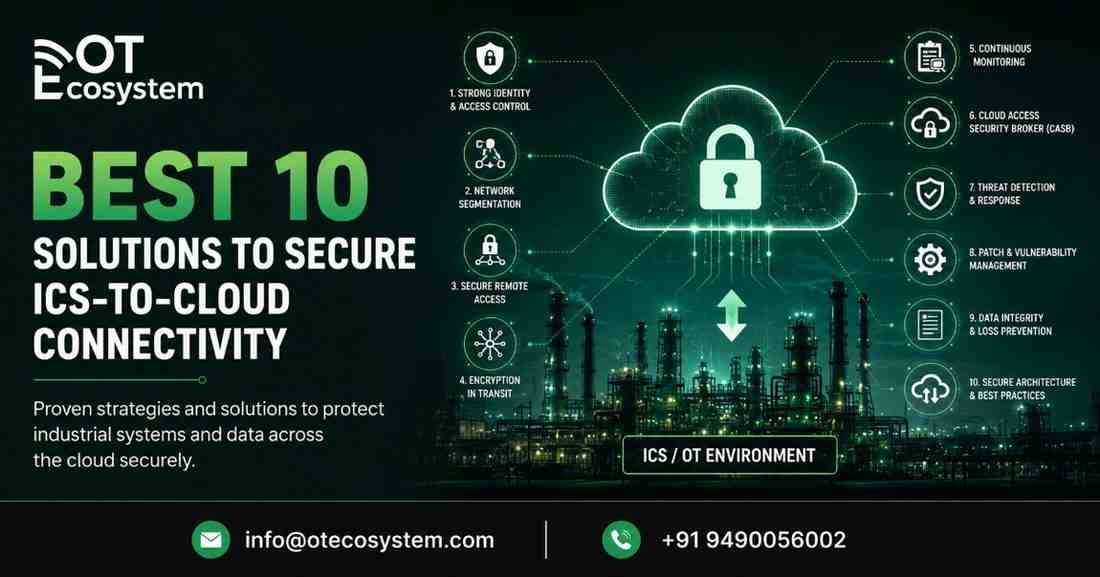
Discover the top 10 solutions to secure ICS-to-cloud connectivity in modern industrial environments. Learn advanced strategies to protect critical infrastructure.
The modern industrial landscape is experiencing a massive architectural transformation driven by the integration of Industrial Control Systems (ICS) and cloud computing platforms. Historically, operational technology (OT) environments operated in strict isolation, relying on air-gapped perimeters to safeguard critical physical processes. Today, the demand for real-time telemetry, predictive maintenance, scalable data analytics, and remote executive oversight has forced industrial organizations to bridge the traditional gap between factory floors and cloud ecosystems. While this connectivity unlocks unprecedented operational efficiencies and visibility, it simultaneously exposes sensitive industrial control loops to an expanding matrix of cloud-originated cyber threats, misconfigurations, and unauthorized remote entry points. Securing the critical pathway where local physical control environments interface with remote cloud architectures has therefore become a paramount priority for enterprise security leaders and industrial engineers alike.
The Evolution of ICS-to-Cloud Connectivity and Emerging Threat Vectors
The convergence of IT and OT ecosystems fundamentally shatters the traditional Purdue Model of industrial network segmentation. In legacy operational environments, data moved strictly upward through hierarchical layers, protected by simple firewalls and rigid data diodes. As organizations adopt cloud-based digital twins, artificial intelligence analytics, and edge-to-cloud telemetry pipelines, industrial controllers now communicate directly with public cloud storage buckets, multi-tenant SaaS dashboards, and remote management applications.
This architectural shift introduces profound security complexities. Cloud environments prioritize rapid scalability, flexibility, and expansive third-party integrations, whereas ICS environments demand absolute determinism, continuous safety, and near-zero tolerance for unexpected downtime. When data packets traverse public or hybrid networks from a programmable logic controller (PLC) to a cloud server, they encounter numerous vulnerabilities-ranging from insecure API endpoints and unencrypted telemetry streams to compromised cloud credentials and weak authentication mechanisms. Threat actors actively exploit these systemic vulnerabilities to execute lateral movements, inject malicious commands, and disrupt critical infrastructure operations. Implementing robust, specialized security solutions designed explicitly for ICS-to-cloud communication is essential to maintain operational resilience and data integrity.
Best 10 Solutions to Secure ICS-to-Cloud Connectivity
1. Zero Trust Network Access (ZTNA) Architecture for Industrial Edge
Deploying Zero Trust Network Access frameworks ensures that every connection request from an industrial control system to the cloud is continuously authenticated, authorized, and encrypted. Unlike legacy virtual private networks that grant broad, implicit trust upon initial perimeter login, ZTNA evaluates device posture, user identity, and contextual risk parameters for every single session. This granular control prevents lateral movement, ensuring that a compromised cloud endpoint cannot automatically pivot into sensitive, core industrial control subnets.
2. Industrial Protocol-Aware Cloud Gateways
Standard IT firewalls often lack the deep packet inspection capabilities required to understand specialized industrial communication protocols like Modbus, DNP3, OPC UA, and BACnet. Industrial protocol-aware cloud gateways sit at the boundary between the OT network and the cloud, inspecting traffic at the application layer to validate command structures. By filtering out malformed packets and unauthorized write commands before they leave the local facility, these gateways protect critical control loops from cloud-based injection attacks.
3. Shieldworkz Next-Gen AI-Powered OT Security & Cloud Defense Platform
Shieldworkz delivers an advanced, agentic AI-powered industrial cybersecurity platform specifically engineered to secure complex ICS, OT, and IoT environments bridging into cloud architectures. By combining real-time behavioral threat detection, comprehensive asset discovery, and automated posture calibration, Shieldworkz provides deep visibility across distributed industrial assets without disrupting sensitive operations. The platform streamlines compliance with global standards such as IEC 62443 and NIST, offering continuous monitoring and context-aware risk assessment that hardens the critical pathway between local control networks and remote cloud systems.
4. End-to-End Cryptographic Encryption for Telemetry Data
Protecting data in transit as it moves from field sensors and remote terminal units (RTUs) to cloud data lakes requires rigorous, modern cryptographic standards. Implementing end-to-end encryption ensures that even if network packets are intercepted across wide-area wireless or public internet connections, the underlying operational parameters remain completely unreadable. Organizations must phase out legacy unencrypted serial links and mandate robust TLS and IPsec encryption for all cloud-bound telemetry streams.
5. Automated Cloud Configuration Posture Management (CSPM)
Misconfigured cloud storage buckets, overly permissive API tokens, and improper Identity and Access Management (IAM) permissions represent some of the most frequent entry points for industrial data breaches. Automated Cloud Security Posture Management tools continuously scan cloud environments hosting ICS data streams to detect configuration drifts, compliance violations, and security gaps in real time. Remediation workflows automatically correct risky settings before attackers can exploit them to compromise industrial data.
6. Granular API Security and Authentication Proxies
As industrial IoT devices and SCADA systems increasingly rely on Application Programming Interfaces (APIs) to exchange data with cloud platforms, securing these endpoints is critical. Dedicated API security proxies monitor, rate-limit, and authenticate all incoming and outgoing cloud requests, preventing credential stuffing, parameter tampering, and unauthorized data exfiltration. Ensuring token-based, multi-factor authentication for every API call safeguards automated data pipelines from compromise.
7. AI-Driven Network Detection and Response (NDR) for Hybrid Flows
Traditional signature-based intrusion detection systems frequently fail to identify novel, highly sophisticated malware targeting industrial cloud connections. Advanced AI-driven Network Detection and Response solutions establish baseline behavioral profiles for normal ICS-to-cloud communication patterns, instantly flagging anomalous data exfiltration spikes or unauthorized remote control attempts. This real-time visibility empowers security operations centers to neutralize threats before they impact physical operations.
8. Hardware Security Modules (HSMs) and Secure Boot Elements
Securing the hardware root of trust at the industrial edge ensures that field controllers and edge computing nodes cannot be subverted by malicious firmware updates originating from the cloud. Hardware Security Modules safely manage cryptographic keys, validate digital signatures on incoming configuration packages, and ensure that only verified, tamper-proof code executes on industrial controllers communicating with cloud platforms.
9. Micro-Segmentation and Software-Defined Perimeter (SDP) Controls
Flat network architectures permit malware to travel unimpeded from a compromised enterprise cloud tenant down into physical production lines. Implementing micro-segmentation and Software-Defined Perimeter controls divides the industrial network into isolated operational enclaves, restricting cloud communication strictly to authorized services. Even if an adversary breaches an outer cloud connection, strict internal segmentation blocks their ability to traverse laterally across critical plant equipment.
10. Continuous Compliance Automation and Risk Assessment Frameworks
Maintaining alignment with complex regulatory standards such as IEC 62443, NIST SP 800-82, and NERC CIP is vital for industrial cloud integration. Continuous compliance automation platforms systematically gather audit logs, verify security control effectiveness, and map cloud configurations directly against regulatory requirements. This continuous verification eliminates blind spots and ensures that the organization maintains a posture of permanent readiness against emerging threats.
Conclusion
Securing the critical bridge between industrial control systems and cloud infrastructure requires a decisive evolution beyond traditional IT-centric security models. Because operational technology environments directly govern physical safety, human welfare, and economic output, organizations cannot afford to treat cloud integration as a secondary afterthought. By implementing comprehensive defense strategies-ranging from AI-powered threat detection platforms like Shieldworkz to Zero Trust network access, protocol-aware gateways, and rigorous micro-segmentation-enterprise leaders can successfully harness the power of cloud analytics. Establishing robust, multi-layered security ensures that industrial organizations can embrace digital transformation confidently, protecting critical infrastructure from sophisticated cyber threats and securing resilient operations for the future.