
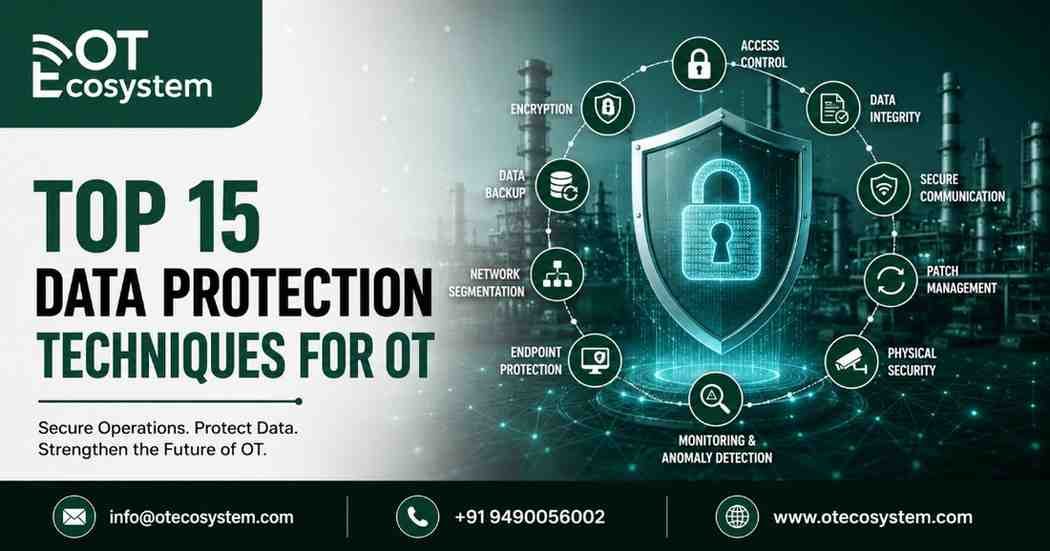
When we discuss “data protection” in Operational Technology (OT), we are not just talking about encrypting social security numbers or protecting intellectual property. We are talking about safeguarding the precise mathematical commands that dictate the speed of a centrifuge, the temperature of a chemical reactor, or the voltage across a power grid. If a threat actor subtly alters the data stored in a SCADA historian or intercepts a Modbus “write” command in transit, the physical consequences can be devastating. As IT and OT environments aggressively converge, driven by Industrial IoT (IIoT) and edge analytics, this highly sensitive operational data is moving across wider networks than ever before. Protecting this data requires moving beyond the illusion of the “air gap” and deploying specialized, OT-native security controls.
Top 15 Data Protection Techniques for OT
1. Enforce Unidirectional Data Diodes
One of the most effective ways to protect OT data is to ensure that it can only flow outward to the IT network, never inward. Data diodes are physical hardware devices that permit data to travel in only one direction, effectively guaranteeing that corporate analytics platforms can read plant data without exposing the control network to inbound IT malware. This provides a mathematically provable barrier against remote adversaries attempting to inject malicious data or commands into the OT environment.
2. Implement Deep Packet Inspection (DPI) for Industrial Protocols
Legacy industrial protocols like DNP3 and Modbus transmit data in cleartext, meaning standard firewalls cannot differentiate between a legitimate read request and a malicious command. Deploying DPI firewalls specifically tuned for OT allows defenders to look deep inside the payload of the packets. This enables organizations to create granular rules, ensuring that data manipulation commands are blocked if they do not originate from an explicitly authorized engineering workstation.
3. Encrypt Data in Transit with Secure Protocol Variants
While ripping and replacing legacy equipment is often impossible, organizations must prioritize upgrading their communications to secure protocol variants wherever supported. Utilizing standards like Secure DNP3 or BACnet/SC introduces cryptographic authentication and payload encryption to the data exchange. This technique drastically raises the cost for attackers attempting to eavesdrop on operational data or conduct replay attacks against physical controllers.
4. Deploy Out-of-Band Network Taps for Passive Monitoring
You cannot protect OT data if your monitoring tools are inadvertently disrupting the flow of that data. Active IT vulnerability scanners can easily overwhelm and crash older PLCs. Utilizing out-of-band network taps and SPAN ports ensures that security sensors receive an exact mirror of the network traffic. This allows for continuous anomaly detection and data integrity analysis without introducing any latency or instability to the live control systems.
5. Establish Immutable Historian Backups
A SCADA historian records the critical time-series data of an industrial process, which adversaries often attempt to manipulate to hide the physical reality of an attack. Protecting this data requires implementing immutable backup architectures, where the stored data cannot be altered or deleted, even by an administrator with root access. This guarantees that forensic investigators have an untampered, mathematically verifiable record of the physical processes leading up to an incident.
6. Implement Microsegmentation at the Process Level
Relying solely on macro-segmentation (such as a single IT/OT firewall) is insufficient to protect sensitive data flowing between specific industrial processes. Microsegmentation involves placing internal firewalls to isolate specific manufacturing cells, control loops, or safety instrumented systems from one another. By applying the principle of least privilege at the network level, you ensure that compromised data in a non-critical subsystem cannot pivot into the core operational network.
7. Mandate Cryptographic Code Signing for PLC Firmware
Threat actors frequently attempt to upload malicious logic or altered firmware to PLCs to manipulate how the physical machinery interprets data. Utilities and manufacturers must ensure that all edge devices are configured to strictly require cryptographically signed firmware from the Original Equipment Manufacturer (OEM). If the digital signature does not perfectly match the vendor’s public key, the device must immediately reject the update and alert the security operations center.
8. Deploy Hardware-Based Anti-Tamper Mechanisms
In OT environments, the physical security of a device is intrinsically linked to the protection of the data it processes. A remote pump station or commercial smart meter might be located in an easily accessible, unmonitored physical location. Deploying anti-tamper mechanisms ensures that if a cabinet is forced open or an unauthorized serial cable is attached, the device instantly drops its encryption keys and severs its logical connection to the grid.
9. Restrict USB and Removable Media via Group Policy
The infamous Stuxnet attack demonstrated the catastrophic potential of using removable media to bridge the IT/OT gap and deliver malicious data directly to offline controllers. Strict Group Policy Objects (GPOs) must be enforced across all engineering workstations to disable unauthorized USB mass storage devices. When USB usage is absolutely unavoidable for maintenance, the organization must utilize dedicated “sheep dip” stations to rigorously scan the media before it enters the plant floor.
10. Implement Identity-Based Access Controls (ZTNA)
The traditional method of using persistent, broad-access VPNs for vendor maintenance allows too much unrestricted data flow across the OT boundary. Transitioning to Zero Trust Network Access (ZTNA) ensures that users and third-party contractors are continuously authenticated and authorized. ZTNA grants access only to the specific application or PLC required for the job, severely limiting the amount of operational data exposed during a remote session.
11. Utilize Cloud-Native Confidential Computing for IIoT
As industrial data is increasingly pushed to the cloud for predictive maintenance and AI analytics, it must be protected while it is actively being processed. Confidential computing leverages hardware-based Trusted Execution Environments (TEEs) to encrypt data even while it is in use by the CPU. This ensures that even if the cloud provider’s hypervisor is compromised, the sensitive industrial telemetry remains completely inaccessible to the attacker.
12. Establish Baseline Deterministic Modeling
OT networks are highly deterministic, meaning they perform the same actions and transmit the same types of data on very predictable schedules. Implementing machine learning tools to establish a baseline of this “normal” data flow is critical for early threat detection. If an HMI that normally sends 10 kilobytes of data per minute suddenly attempts to export gigabytes of configuration files, the system can instantly flag the anomaly and block the exfiltration.
13. Secure Engineering Project Files with File Integrity Monitoring (FIM)
Adversaries are increasingly targeting the engineering project files stored on operator workstations, subtly altering the parameters before they are even compiled and pushed to the controllers. File Integrity Monitoring (FIM) continuously hashes and monitors these critical configuration files for unauthorized changes. If a threat actor attempts to manipulate the logic files offline, the FIM solution generates an immediate, high-priority alert before the corrupted data reaches the physical machinery.
14. Mandate Role-Based Access Control (RBAC) in SCADA Software
Providing a single “admin” login for all plant floor operators is a massive data protection failure, making it impossible to audit who altered a specific physical setpoint. Modern SCADA and HMI software must be configured with strict Role-Based Access Control (RBAC), tying specific permissions to individualized user accounts. This ensures that an entry-level operator can view the data to monitor processes, but only a senior engineer possesses the credentials necessary to alter critical safety parameters.
15. Enforce Regular, Hands-On Data Recovery Drills
The ultimate protection for OT data is the proven ability to recover it when an attack eventually succeeds. Organizations must move beyond theoretical tabletop exercises and require facility technicians to perform hands-on restoration drills. Testing the ability to pull uncorrupted logic files from an offline backup and safely push them to a bare-metal PLC ensures that the organization can actually recover its operational data and resume physical production during a crisis.
Conclusion
In the realm of Operational Technology, data protection is fundamentally about maintaining control over physical reality. As adversaries shift their focus toward manipulating critical infrastructure, industrial defenders can no longer rely on outdated IT strategies or the dangerous assumption of network isolation. Securing the plant floor requires a rigorous, multi-layered approach that includes unidirectional hardware, deep protocol inspection, cryptographic verification, and immutable backups. By implementing these 15 specialized techniques, critical infrastructure operators can ensure the integrity of the data that governs their machinery, safeguarding both operational continuity and public safety.