
Welcome back to the cybersecurity desk. As an editor tracking the front lines of IT, OT, and MIoT convergence, I’ve analyzed countless industrial breaches and compliance audits. One theme consistently emerges: organizations fail not because they lack firewalls, but because their operational reality does not match their documentation. According to recent CISA and NIST guidance, securing Operational Technology (OT) demands a fundamentally different approach than IT. In IT, confidentiality is king; in OT, an availability incident is immediately a safety incident. When regulators or insurers audit your plant, or when an incident response (IR) team is scrambling during a ransomware outbreak, they don’t care what you think your network looks like-they rely on what is explicitly documented. From mapping Purdue Model segments to defining IEC 62443 Target Security Levels, your documentation is your ultimate safety net. Here are the top 10 mandatory documentation requirements to future-proof your OT environment against modern cyber-physical threats.
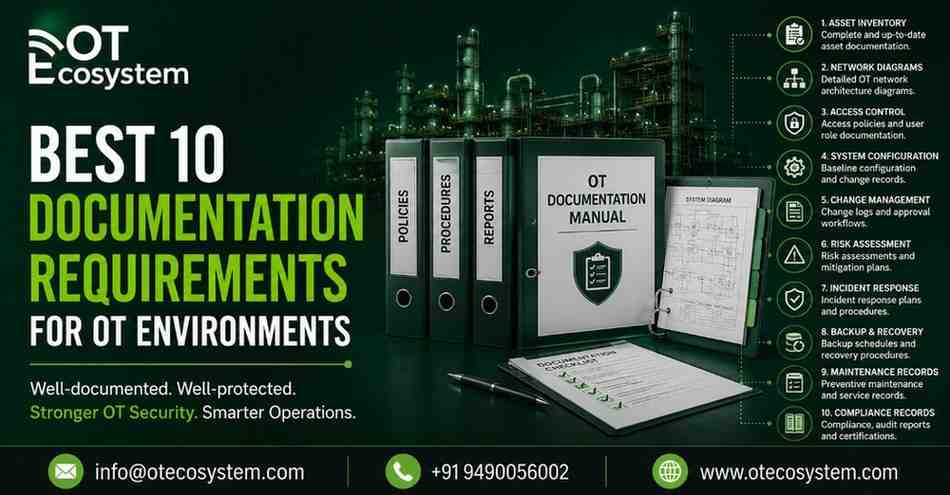
Best 10 Documentation Requirements for OT Environments
1. Comprehensive OT and Shadow IoT Asset Inventory
An outdated Excel spreadsheet is a liability, not an inventory. CISA’s latest guidelines for OT environments mandate a dynamic, attribute-rich catalog of every connected device. Your documentation must capture exact IP addresses, MAC addresses, firmware versions, active communication protocols (like Modbus or DNP3), and exact physical locations on the factory floor. Crucially, it must categorize the operational criticality of every programmable logic controller (PLC), remote terminal unit (RTU), and cellular edge gateway. A blind spot in your inventory is exactly where a threat actor will deploy their initial payload.
2. IEC 62443 Zone and Conduit Architecture Diagrams
Flat networks are a primary enabler for lateral ransomware movement. Your documentation must visually and logically prove that you have implemented the Purdue Enterprise Reference Architecture. This means producing strict Zone and Conduit diagrams that define exactly where the IT/OT boundary sits, how industrial Demilitarized Zones (DMZs) isolate traffic, and the specific communication channels permitted between different operational cells. The drawings must match the exact deep packet inspection (DPI) rules deployed on your industrial firewalls; if a conduit exists in reality but not on paper, your architecture is fundamentally compromised.
3. Target Security Levels (SL-T) and Cybersecurity Requirements Specification (CRS)
You cannot apply a blanket security policy across a power plant. Following the IEC 62443-3-2 methodology, your documentation must define a Target Security Level (SL-T) for every individual zone based on consequence analysis. For example, a Safety Instrumented System (SIS) protecting a hazardous chemical process requires a highly resilient SL-3 or SL-4, while a corporate historian may only require SL-1. All of these risk decisions, assumptions, and required defensive mechanisms must be formally packaged into a Cybersecurity Requirements Specification (CRS), which becomes your primary audit artifact for regulatory compliance.
4. Process Hazard Analysis (PHA) to Cyber Threat Mapping
In OT, cybersecurity is process safety. Your security documentation must intersect with engineering safety documentation, specifically your plant’s Hazard and Operability (HAZOP) studies. Security architects must document exactly how specific cyber threat scenarios (e.g., unauthorized command injection, denial of service to a safety function, or spoofed process telemetry) map to the physical hazards identified by process engineers. Documenting this crossover ensures that security controls are prioritized based on the potential for physical destruction, environmental release, or human injury, rather than abstract CVSS scores.
5. OT-Specific Incident Response Playbooks
If your OT Incident Response plan is simply your IT IR plan with “OT” slapped on the cover, your facility is in grave danger. Underwriters and regulators require dedicated runbooks for specific industrial assets: a playbook for a PLC logic compromise, another for historian ransomware, and a distinct workflow for HMI malware. This documentation must explicitly detail escalation paths that include process safety engineers, not just IT personnel. IT cannot unilaterally take a running physical process offline; the exact criteria for that joint operational decision must be documented in advance.
6. Manual Fallback and System Restoration Procedures
When a sophisticated wiper malware attack takes down your entire SCADA system, your plant must survive. Your documentation must detail the exact manual fallback procedures required to run the physical process without digital oversight. Are operators trained to manually control valves if the network is isolated? Additionally, you must formally document your Recovery Time Objectives (RTO) and outline the precise, step-by-step procedures for restoring PLC logic and HMI configurations from immutable, air-gapped backups to bare-metal hardware under extreme duress.
7. Compensating Controls Register for Legacy Systems
We all know the reality of the factory floor: patching a 15-year-old control system on a 24/7 production line is often impossible without voiding the OEM warranty or risking a catastrophic trip. When patching is not an option, regulators like CISA and frameworks like NIST SP 800-82 require a meticulously maintained Compensating Controls Register. This document must list the unpatched legacy assets, acknowledge the accepted risk, and detail the exact alternative security controls-such as physical air-gapping, virtual patching at the firewall, or stringent application allowlisting-that protect the vulnerable machine.
8. Remote Access and Third-Party Vendor Logs
The majority of critical infrastructure breaches begin with a compromised third-party vendor connection. Your documentation must explicitly track every integration point, vendor VPN, and external engineering gateway. Furthermore, you must maintain exhaustive logs of who requested access, what multi-factor authentication (MFA) was used, and the precise time boundaries of the connection. Formalizing these access policies ensures that external integrators and original equipment manufacturers (OEMs) cannot leave persistent, unmonitored backdoors open into your operational environment.
9. Software Bill of Materials (SBOM) and Supply Chain Contracts
As adversaries increasingly target the industrial supply chain to introduce vulnerabilities deep within firmware, asset owners must demand transparency. Your documentation repository should require a Software Bill of Materials (SBOM) for every new automation asset introduced into the plant. Additionally, your procurement documentation must explicitly outline the contractual security terms placed on system integrators, holding OEMs legally accountable for timely vulnerability disclosures, secure-by-design principles, and safe remote maintenance practices throughout the entire lifecycle of the equipment.
10. Converged IT/OT Governance and Roles Matrix
The greatest vulnerability in OT security is the cultural divide between corporate IT and facility engineering. To bridge this gap, your overarching security program-aligned with IEC 62443-2-1-must document a clear, converged governance structure. This includes a responsibility assignment matrix (RACI) that delineates exactly who owns the risk, who implements the controls, and who maintains the systems. Establishing a cross-functional steering committee on paper ensures that IT brings the threat intelligence while OT dictates the process safety context, eliminating dangerous operational silos.
Conclusion
Effective OT security is not about collecting flashy security appliances; it is about building a defensible, auditable posture rooted in engineering reality. Thorough documentation transforms your cybersecurity strategy from a theoretical concept into a reproducible, legally resilient operational standard. By aligning your paperwork with frameworks like NIST SP 800-82 and IEC 62443, you ensure that when the worst-case scenario occurs, your engineering teams have the exact blueprints required to isolate the threat, protect physical safety, and rapidly restore industrial operations. Treat your security documentation with the same rigor as your safety instrumentation-because today, they are one and the same.