
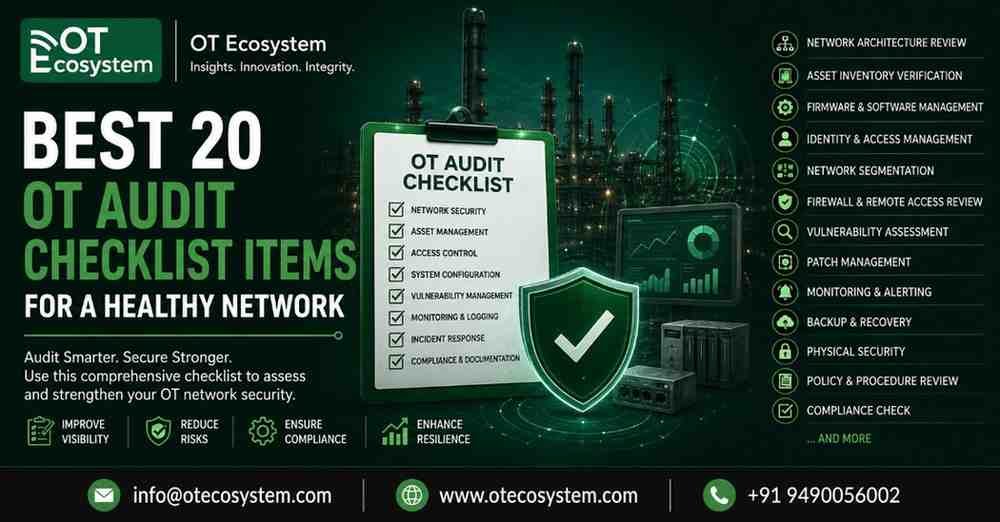
Welcome back to the front lines of industrial cybersecurity. As an editor mapping the convergence of IT, OT, and MIoT, I frequently encounter organizations treating their Operational Technology (OT) audits exactly like their standard IT compliance checks. This is a fatal mistake. In IT, a breach compromises data; in OT, a breach compromises physical safety, environmental integrity, and continuous production.
Threat actors are actively hunting for legacy unpatched systems and flat networks. To protect your critical infrastructure, you cannot rely on assumptions. You need rigorous, evidence-based validation of your factory floor’s digital perimeter. Below is the definitive 20-point OT cybersecurity audit checklist you must implement to ensure a healthy, resilient industrial network.
The Essential 20-Point OT Security Audit Checklist
1. Automated OT Asset Inventory
You cannot protect what you cannot see, making absolute visibility the cornerstone of any industrial cybersecurity program. Ensure your organization maintains a complete, dynamically updated inventory of all PLCs, RTUs, SCADA systems, HMIs, and edge sensors. Relying on manual spreadsheets or outdated documentation is no longer acceptable in modern threat landscapes; you must utilize passive Network Detection and Response (NDR) tools. These platforms map your network and maintain high accuracy without actively polling or disrupting delicate, proprietary industrial protocols that could easily crash legacy equipment during production.
2. Firmware and OS Documentation
Every legacy endpoint on your factory floor represents a potential entry vector for sophisticated adversaries. Your comprehensive audit must rigorously verify the exact documentation of firmware versions, operating systems, and patch levels for every single OT device connected to the network. Establishing this detailed baseline is absolutely critical for prioritizing your vulnerability management efforts and lifecycle planning. It allows security teams to rapidly identify end-of-life systems or unpatchable legacy controllers that require immediate, strict network isolation or compensating controls to prevent exploitation by zero-day threats.
3. Asset Criticality Classification
Not all industrial assets require the same level of intensive security protection, and treating them equally wastes valuable resources. Ensure every device on the network is accurately classified by its true operational criticality-for example, distinguishing between life-safety PLCs and non-critical environmental temperature sensors. This strict classification hierarchy directly dictates your incident response priorities during a crisis and helps properly align your defensive architecture with recognized industry frameworks like ISA/IEC 62443. By understanding what matters most, you can apply your strongest defensive layers exactly where a breach would cause the most devastating physical or financial impact.
4. IT/OT DMZ Implementation
Operating a flat network is essentially an open invitation for lateral ransomware movement from corporate emails straight to the production line. You must rigorously validate the existence and strict enforcement of an industrial Demilitarized Zone (DMZ) sitting securely between your enterprise IT environment and your OT networks. There should be absolutely no direct, unmediated communication allowed between the corporate environment and the factory floor under any circumstances. All necessary traffic must terminate within the DMZ and be proxied through secure, heavily monitored jump servers to ensure malicious payloads cannot easily traverse boundaries.
5. Elimination of Dual-Homed Devices
Adversaries actively hunt for and exploit architectural bridges between segmented networks to bypass perimeter firewalls entirely. Your audit must aggressively seek out and rigorously confirm the complete elimination of dual-homed devices-such as historical data servers, engineering workstations, or administrative laptops-that possess network interfaces active in both the IT and OT environments simultaneously. These devices completely negate the security benefits of a DMZ, creating an invisible backdoor that allows attackers to move laterally into your critical control networks without ever tripping an external alarm or deep packet inspection rule.
6. Purdue Model Micro-Segmentation
It is no longer sufficient to just separate IT from OT; you must compartmentalize the factory floor itself. Organize your entire OT environment into distinct, logical operational layers (enterprise, DMZ, supervisory control, and field devices) adhering to the Purdue Model. The audit should verify that advanced micro-segmentation isolates individual production lines from one another and heavily restricts any unnecessary workstation-to-workstation traffic. By utilizing explicitly defined access control lists (ACLs) and stateful firewalls, you ensure that if one machine cell is compromised by malware, the infection is physically and logically contained, preventing facility-wide outages.
7. Isolation of Safety Systems (SIS)
Safety Instrumented Systems (SIS) act as your absolute last line of defense against catastrophic physical disasters, explosions, or hazardous environmental releases. Your audit must strictly ensure that these critical safety controllers are completely logically and physically isolated from the basic process control network. They must never share underlying network infrastructure, engineering workstations, or administrative credentials with the primary SCADA systems. This extreme isolation guarantees that if a sophisticated attacker manages to hijack the main control systems, they cannot simultaneously blind or disable the safety mechanisms designed to gracefully shut down the plant.
8. Enforced MFA for Remote Access
Compromised, stolen, or brute-forced credentials remain one of the primary attack vectors for infiltrating industrial networks from the outside. The audit must demand hard, unassailable evidence that phishing-resistant Multi-Factor Authentication (MFA) is strictly and universally enforced across all remote connections terminating in the OT network. This mandatory requirement must apply equally to third-party vendor VPNs, remote desktop protocol (RDP) sessions, and internal engineering access. Relying on passwords alone is negligence; implementing hardware tokens or app-based authenticators ensures that a stolen password cannot translate into physical sabotage.
9. Dedicated OT Jump Servers
Vendors, system integrators, and internal engineers should never be permitted to connect directly to a sensitive PLC or HMI from an external or corporate network. Verify that a dedicated, highly secure jump server acts as the singular, heavily monitored entry point into the OT environment. This architectural chokepoint severely limits the attack surface for remote administration by forcing all traffic through a unified inspection layer. Furthermore, these jump servers must log every session, record all commands issued, and enforce strict session timeouts to ensure external access is automatically terminated when the maintenance window closes.
10. Elimination of Shared and Default Credentials
Default passwords on legacy industrial controllers are widely documented on the dark web and are the first things attackers test during reconnaissance. You must confirm the absolute, complete elimination of all default credentials on every PLC, network switch, and OT device across the facility. Furthermore, ensure that individual, trackable user accounts are implemented wherever technically feasible, entirely replacing the high-risk practice of utilizing shared administrative logins. When an anomalous command is executed on the factory floor, your SOC must be able to tie that action back to a specific, identifiable human being rather than a generic administrative account.
11. Passive OT Network Monitoring
Traditional active vulnerability scanning, commonly used in IT, is notoriously dangerous in OT and can easily crash legacy HMIs or disrupt time-sensitive manufacturing processes. Ensure your industrial security stack utilizes continuous, passive network traffic monitoring via strategically placed SPAN or TAP ports. These specialized tools must be fully capable of performing deep packet inspection that is precisely tailored for parsing proprietary industrial protocols. By passively analyzing the traffic without injecting packets, you gain total visibility into asset behavior and threat signatures without introducing any operational risk or latency to the control loops.
12. Protocol-Aware Anomaly Detection
Your threat monitoring tools are effectively useless if they cannot natively understand the specific languages spoken on the factory floor. Validate that your Security Operations Center (SOC) is receiving high-fidelity alerts based on specific anomalies within industrial protocols like Modbus TCP, OPC UA, PROFINET, or DNP3. The system must be tuned to flag highly dangerous, out-of-bounds activities, such as unauthorized firmware downloads, unexpected changes to critical register setpoints, or an engineering workstation initiating a “stop” command to a controller during an active production shift.
13. Centralized and Survivable Logging
In the chaotic aftermath of a cyber-physical breach, pristine forensic logs are your only reliable roadmap to understanding the attack path and recovering operations securely. Ensure that logs from all jump hosts, industrial firewalls, and key OT servers are continuously forwarded to a centralized, highly secure repository. Crucially, this logging server must be protected from the same domain trust structure that a ransomware operator might compromise during an attack. Storing immutable logs in an isolated enclave ensures that adversaries cannot cover their tracks or delete evidence before your incident response team begins their investigation.
14. Immutable PLC Logic Backups
If a sophisticated wiper malware or ransomware variant destroys your control configurations, production stops indefinitely and rebuilding from scratch could take weeks. The audit must rigorously confirm the existence and regular updating of offline, immutable copies of all PLC configurations, SCADA project files, and controller logic. These backups must be stored securely away from the primary network so they cannot be encrypted during a breach. Furthermore, you must verify that the engineering team regularly tests restoring these logic files to bare-metal hardware to ensure rapid recovery during a catastrophic failure.
15. Golden Images for Engineering Workstations
Rapid recovery during a critical incident dictates having known-good starting points for your most vulnerable endpoints. Verify the creation and meticulous maintenance of offline “golden images” for all critical SCADA servers, HMIs, and engineering workstations. If a Windows-based operator station is compromised by ransomware, incident responders should not waste time trying to clean the malware; they should immediately wipe the drive and reimage it from the secure baseline. Having these pristine images readily available drastically reduces your Recovery Time Objective (RTO) and gets the plant back online safely.
16. Risk-Based Patching and Compensating Controls
Applying security patches to a continuous manufacturing process is notoriously difficult, often requiring scheduled downtime that plant managers simply will not approve. Where immediate patching is impossible, ensure a formally documented, risk-based vulnerability strategy is actively in place. This strategy must utilize robust compensating controls-such as deploying virtual patching at the firewall level, enacting strict network isolation, or implementing application allowlisting-to protect the vulnerable asset. This ensures the machine remains shielded from known exploits until the next scheduled maintenance outage permits a safe software update.
17. Application Allowlisting
Preventing the execution of unauthorized binaries is vastly more effective than attempting to catch every new, polymorphic malware signature that hits the network. Ensure your audit verifies the strict enforcement of application allowlisting on all highly vulnerable endpoints. This is particularly critical for legacy engineering workstations and Windows-based OT servers, guaranteeing that only explicitly approved, cryptographically signed software is permitted to run. This zero-trust approach at the endpoint level neutralizes ransomware and malicious payloads entirely, even if the malware successfully bypasses your perimeter defenses.
18. OT-Specific Incident Response Playbooks
A generic corporate IT incident response plan will not save a melting turbine or safely shut down a chemical reactor. You must confirm the existence of meticulously documented, OT-specific incident response playbooks that incorporate both cybersecurity protocols and physical process safety. These playbooks must cover highly specific industrial scenarios, such as the sudden loss of an HMI, unauthorized PLC logic changes, or the detection of lateral movement in the DMZ. They must explicitly outline the exact criteria and chain of command required to make the critical decision to physically disconnect the plant from the network.
19. Manual Failover and Recovery Testing
Can your plant safely continue to operate, or at least shut down gracefully, if all the digital screens suddenly go dark? The audit must verify that floor engineers are actively trained in manual production startup and control procedures. Furthermore, tabletop recovery exercises must be conducted regularly-bringing IT and OT teams together-to validate the step-by-step restoration documentation under simulated duress. If your operators have not practiced running the physical process without their digital interfaces, your facility remains highly vulnerable to catastrophic disruption during a major cyber event.
20. Cross-Functional IT/OT Governance
The most advanced technical security controls will inevitably fail when corporate IT dictates policy without deeply understanding physical engineering constraints. Ensure a unified, collaborative governance model exists, featuring a designated security steering committee that explicitly includes OT process engineers, IT cybersecurity personnel, and plant production management. This cross-functional alignment guarantees that security policies enhance resilience rather than causing accidental downtime, fostering a culture where physical safety and digital security are managed as a single, cohesive operational imperative.
Track Your Audit Progress
Use the interactive checklist below to map your facility’s current compliance against these critical OT security requirements:
Conclusion
Executing a robust OT cybersecurity audit requires moving far beyond generic vulnerability scans. It demands a deep, structural understanding of how your network architecture directly impacts process safety and production continuity. By rigorously applying these 20 checklist items-from enforcing Zero Trust boundaries at the DMZ to ensuring your safety systems are physically air-gapped-you eliminate the blind spots that sophisticated threat actors rely on. Treat your security audit with the exact same engineering precision as your safety instrumentation, because in the modern industrial landscape, they are functionally identical.