
Welcome back to the cybersecurity desk. In the high-stakes world of digital publishing and media operations, coordinating comprehensive, multi-week editorial workflows requires absolute precision and rigorous oversight. Securing the industrial supply chain demands that exact same rigor. As an editor tracking the convergence of IT, OT, and MIoT, I frequently see organizations lock down their perimeters, only to leave the back door wide open through unsecured third-party vendors.
The data is sobering: recent industry analysis reveals that over 35% of breaches stem directly from third-party access, and more than 41% of ransomware attacks originate within the supply chain. In Operational Technology (OT), a vendor breach doesn’t just compromise data-it jeopardizes physical safety, environmental integrity, and continuous production.
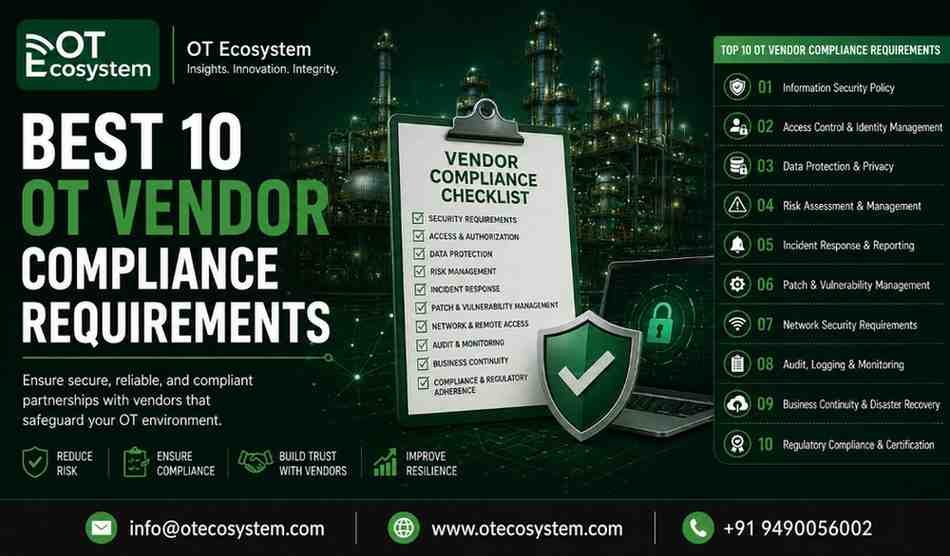
To protect your critical infrastructure, you must transition from handshake agreements to strict, verifiable technical requirements. Here are the top 10 non-negotiable vendor compliance requirements you must implement to secure your OT environment.
Best 10 OT Vendor Compliance Requirements for Securing the Supply Chain
1. Mandate IEC 62443 Alignment and Certifications
You can no longer accept generic IT security frameworks for industrial control systems. Your compliance checklist must require OT vendors-especially component suppliers-to demonstrate alignment with IEC 62443-4-1, which governs a secure product development lifecycle. Contractually require vendors to provide evidence of their certifications rather than relying on self-attestation. If a vendor builds PLCs or HMIs without secure-by-design principles, they introduce inherent risk into your Purdue Model architecture before the device is even powered on.
2. Contractually Enforce Strict Incident Notification Timelines
A delayed breach notification can turn a contained incident into a catastrophic plant shutdown. Your vendor agreements must include legally enforceable security terms dictating timely breach notification-typically within 24 to 72 hours of discovery. The contract must explicitly outline the secure communication channels they will use and the specific incident response stakeholders they are required to contact. If your vendor is breached, the clock is ticking on your own network’s integrity.
3. Require Comprehensive Software Bills of Materials (SBOMs)
As adversaries increasingly target firmware and software dependencies, asset owners must demand total transparency. Require an SBOM for all new automation assets and software platforms before deployment. This allows your security operations center (SOC) to instantly cross-reference new CVEs against your exact deployment footprint. If a vendor cannot tell you what open-source libraries are baked into their proprietary controllers, you are accepting unquantifiable risk.
4. Implement Phishing-Resistant MFA for All Remote Access
Remote vendor support is one of the most heavily exploited vectors in critical infrastructure. Compliance requirements must mandate that any vendor requesting remote access to the OT network utilizes phishing-resistant Multi-Factor Authentication (MFA), such as FIDO2 hardware keys. Furthermore, this access must be routed exclusively through a dedicated, monitored industrial Demilitarized Zone (DMZ) or jump server, strictly enforcing the principle of least privilege.
5. Establish Rigorous Patching and Vulnerability SLAs
Industrial environments require 24/7 uptime, making patch management notoriously difficult. Vendors must be contractually bound to Service Level Agreements (SLAs) regarding vulnerability disclosures and patch delivery timelines. Ask vendors for their historical patching cadence. For legacy systems that cannot be patched without voiding warranties, the vendor must actively assist in defining and validating compensating controls, such as application allowlisting or strict network micro-segmentation.
6. Conduct Pre-Deployment Security Reviews and Penetration Testing
Never trust a device straight out of the box. Require pre-deployment security reviews for all new vendor equipment, including vulnerability assessments of vendor-supplied systems. For critical software or cloud integrations, demand to see recent, independent penetration testing results and SOC 2 Type II reports. Verify the remediation dates of any identified exceptions to ensure the vendor is proactively closing their own security gaps.
7. Enforce Strict Data Handling and Encryption Standards
Whether it is a cloud-based predictive maintenance platform or an on-premise historian, vendors must explicitly document their data handling and encryption practices. Ensure contracts specify that process telemetry and sensitive configurations are encrypted both at rest and in transit. You must maintain absolute clarity on where your data is geographically stored, who has administrative access to it, and the exact conditions under which it can be exported or analyzed.
8. Demand Continuous External Cyber Risk Monitoring
A vendor’s security posture is not static; it degrades over time if not maintained. Incorporate continuous vendor risk monitoring and scoring into your compliance program. Utilize external threat intelligence platforms to monitor your vendors’ DNS hygiene, exposed ports, and malware infections. Contracts should stipulate that vendors must maintain a minimum cybersecurity rating, requiring them to participate in immediate remediation if their external exposure score drops below acceptable thresholds.
9. Evaluate Fourth-Party Risk and Dependency Chains
Your vendor’s vendors are your problem. Nearly 5% of all breaches extend into fourth-party ecosystems. Ask your primary OT vendors to explicitly disclose their own critical dependencies and subcontractors. Your compliance checklist must require that your primary vendors hold their subcontractors to the exact same stringent security, encryption, and notification standards that you hold them to, ensuring no weak links exist down the chain.
10. Define Clear Vendor Offboarding and Credential Revocation Procedures
Vendor relationships end, but their network access often persists, creating highly vulnerable, unmonitored backdoors. Your compliance program must outline strict vendor offboarding and termination procedures. This includes the immediate, automated revocation of all remote access credentials, physical badge access, and VPN tunnels. Require documented proof that the vendor has purged your proprietary network schematics, data, and configurations from their internal systems upon contract termination.
Conclusion
Securing your operational technology requires moving beyond internal firewalls and taking aggressive ownership of your digital supply chain. Threat actors view poorly secured vendors as the path of least resistance into highly defended critical infrastructure. By integrating these 10 compliance requirements directly into your procurement policies and legal contracts, you shift the burden of proof back onto the vendor. In 2026, a resilient OT cybersecurity posture means that a vendor’s security culture must be just as advanced and verifiable as the hardware they are selling you.