
Welcome back to the cybersecurity desk. As an editor tracking the high-stakes convergence of IT, OT, and MIoT, I spend a lot of time analyzing how adversaries pivot through our critical networks. Right now, the global power sector is facing an unprecedented storm. Cyberattacks targeting utilities surged by nearly 70% year-over-year globally in 2024, driving the grid cybersecurity market toward a projected $18.35 billion by 2030.
The North American Electric Reliability Corporation (NERC) recognizes that legacy perimeter defenses are no longer sufficient. With the release of the 2026 NERC CIP Roadmap, the regulatory landscape has fundamentally shifted. “Low-impact” generation assets are no longer considered low-risk, and the regulatory gap covering third-party cloud platforms and distributed energy resources is slamming shut. Non-compliance isn’t just an operational risk-it’s a financial liability, with Federal Energy Regulatory Commission (FERC) penalties reaching up to $1 million per day per violation.
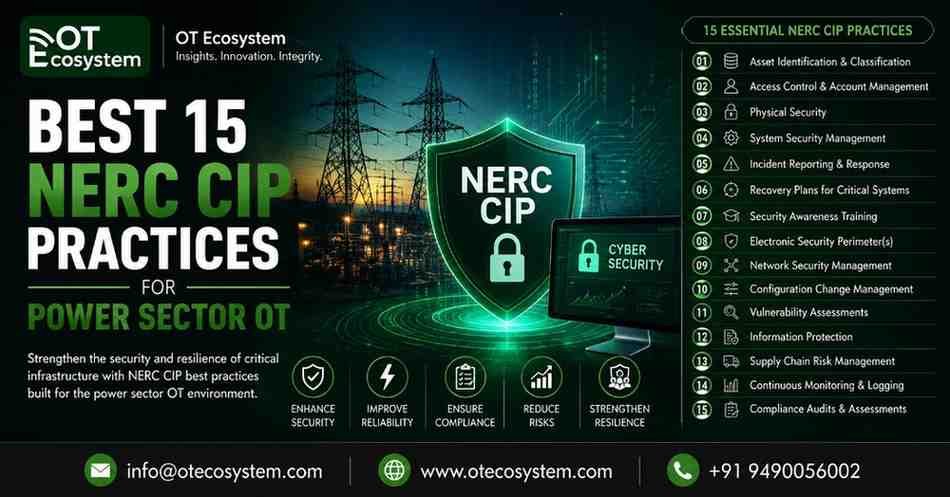
Best 15 NERC CIP Practices for Power Sector OT
1. Dynamic Asset Identification & Classification (CIP-002)
You absolutely cannot protect what you cannot see. The foundational step of CIP compliance is maintaining a 100% accurate, dynamically updated inventory of all BES Cyber Systems and their associated cyber assets. Relying on manual spreadsheets introduces fatal blind spots. Modern facilities must deploy passive Network Detection and Response (NDR) tools that continuously map PLCs, RTUs, and cellular gateways by sniffing traffic via SPAN ports, doing so without ever actively polling or disrupting fragile legacy control protocols.
2. Strict Electronic Security Perimeters (ESP) (CIP-005)
A flat network is an open invitation for lateral ransomware movement. CIP-005 dictates that critical assets must reside within a strictly controlled Electronic Security Perimeter. This requires implementing the Purdue Enterprise Reference Architecture by deploying deep packet inspection (DPI) firewalls and industrial Demilitarized Zones (DMZs) between the corporate IT environment and the factory floor. All traffic crossing these boundaries must be mediated, inspected, and explicitly allowed via rigid access control lists (ACLs).
3. Phishing-Resistant MFA for Remote Access
The 2026 NERC CIP Roadmap explicitly targets remote access as the single most powerful vector for credential theft and third-party compromise. While Multi-Factor Authentication (MFA) has long been required at the boundaries of High- and Medium-Impact systems, the new mandate pushes MFA down to Low-Impact BES Cyber Systems. You must enforce phishing-resistant MFA-such as FIDO2 hardware keys or strict app-based authenticators-across all interactive remote access sessions, including vendor VPNs and engineering jump servers.
4. Internal Network Security Monitoring (INSM)
Because perimeter defenses inevitably fail, you must have visibility deep inside the OT network. Deploying Internal Network Security Monitoring (INSM) ensures that your Security Operations Center (SOC) can detect adversaries who have already bypassed the ESP. By establishing a behavioral baseline of normal machine-to-machine communication, INSM flags anomalous lateral movement, unauthorized configuration downloads, or unexpected Modbus command injections in real time before physical sabotage occurs.
5. Continuous Vulnerability & Patch Management (CIP-007 R2)
Patching continuous manufacturing systems is notoriously difficult, yet CIP-007 R2 requires entities to evaluate security patches every 35 days and either install them or formally document a mitigation plan. You must establish a risk-based patching workflow. When an aging SCADA server cannot be patched without voiding warranties or risking a catastrophic trip, you must meticulously document and deploy compensating controls-such as virtual patching at the firewall level or extreme network isolation.
6. Malicious Code Prevention via Allowlisting (CIP-007 R4)
Traditional IT antivirus software relies on heavy signature scanning that can easily crash a legacy Human-Machine Interface (HMI) or cause unacceptable latency. To comply with CIP-007 R4 safely, OT environments must shift to strict application allowlisting. By cryptographically locking down Windows-based engineering workstations and historians so they can only execute explicitly approved binaries, you completely neutralize ransomware payloads and unauthorized scripts without the overhead of active scanning.
7. Hardening Ports and Disabling Unused Services (CIP-007 R3)
Every open port and active service is a potential attack vector. CIP-007 R3 mandates a drastic reduction of the attack surface on all BES Cyber Systems. You must conduct rigorous configuration audits to identify and permanently disable unused logical ports, default web servers, and unnecessary legacy protocols like Telnet or FTP. For the services that absolutely must remain active, ensure they are strictly filtered by localized host-based firewalls to accept traffic only from explicitly trusted IP addresses.
8. Rigorous Supply Chain Risk Management (CIP-013)
The SolarWinds attack proved that your network is only as secure as the vendors building your software. CIP-013 forces organizations to implement aggressive supply chain risk management programs. You must transition from handshake agreements to strict, verifiable technical requirements. Demand dynamic Software Bills of Materials (SBOMs) for all new automation assets, enforce binding incident notification SLAs, and subject third-party OEM hardware to rigorous penetration testing before it ever touches your production floor.
9. Centralized and Immutable Security Event Logging (CIP-007 R5)
In the chaotic aftermath of a cyber-physical breach, pristine forensic logs are your only roadmap to recovery. CIP-007 R5 requires comprehensive security event monitoring. You must ensure that logs from jump hosts, industrial firewalls, and critical controllers are continuously forwarded to a centralized SIEM. Crucially, this logging repository must be logically isolated and immutable, guaranteeing that ransomware operators cannot encrypt or delete the evidence to cover their tracks.
10. Granular Identity & Access Management (CIP-004)
Human error and insider threats account for a massive percentage of industrial breaches. CIP-004 demands rigorous personnel risk assessments and access management controls. Implement strict Role-Based Access Control (RBAC) so that engineers only have the exact privileges required for their shift. Furthermore, establish an automated offboarding process to immediately revoke VPN access, Active Directory credentials, and physical badge access the minute an employee or contractor is terminated.
11. Immutable Backups and Bare-Metal Recovery (CIP-009)
If a sophisticated wiper malware destroys your control configurations, production stops indefinitely. CIP-009 requires robust recovery plans that must be actively tested every 15 months. You must maintain the 3-2-1 backup rule, ensuring that immutable, verified copies of all PLC logic, SCADA project files, and system “golden images” are stored completely offline. Regularly practice restoring these configurations to bare-metal hardware under simulated duress to minimize your Recovery Time Objective (RTO).
12. Protocol Hardening and Traffic Encryption
Legacy industrial protocols like Modbus TCP and DNP3 were designed for reliability, not security; they transmit commands and telemetry in cleartext. As OT networks converge with cloud analytics, this poses a severe Man-in-the-Middle (MitM) risk. You must implement protocol hardening by utilizing industrial security gateways or proxies to wrap vulnerable legacy traffic inside encrypted IPsec VPN tunnels, ensuring that real-time control communications cannot be intercepted or manipulated in transit.
13. Cross-Functional IT/OT Incident Response Testing (CIP-008)
An IT-centric incident response plan will not safely shut down a cascading failure in a balancing authority. CIP-008 dictates that you must have highly documented cybersecurity incident response plans. The critical best practice here is conducting cross-functional tabletop exercises that force your corporate IT SOC to collaborate directly with plant floor process engineers. They must practice the exact chain of command and technical thresholds required to physically disconnect the plant from the network during an attack.
14. Physical Security Perimeters (PSP) (CIP-006 & CIP-014)
Cybersecurity is irrelevant if an attacker can walk through an unlocked door and plug a rogue laptop directly into a core switch. CIP-006 and CIP-014 require establishing robust Physical Security Perimeters (PSP) around critical substations and control centers. This necessitates deploying biometric access controls, intrusion detection sensors, comprehensive video surveillance, and establishing rapid communication protocols with local law enforcement to mitigate physical sabotage or vandalism.
15. Elevating Low-Impact Assets to Foundational Hygiene
Historically, NERC CIP treated “Low-Impact” assets with a lighter touch. The 2026 Roadmap explicitly dismantles that assumption, recognizing that aggregated attacks across thousands of small, distributed assets (like inverters and DERs) can cause system-wide grid instability. You must proactively apply foundational cyber hygiene-including strict asset identification, network topology mapping, and basic vulnerability management-to your entire low-impact fleet before it becomes a strict, auditable regulatory mandate.
Conclusion
Achieving NERC CIP compliance is not a quarterly paperwork exercise; it is the absolute baseline for ensuring the survivability of our electrical grid. As the attack surface expands into the cloud and adversaries target the seams between IT and OT, treating cybersecurity as an afterthought is a recipe for physical disaster. By rigorously applying these 15 practices-anchored in Zero Trust, continuous monitoring, and unassailable physical perimeters-you transform your power generation and transmission assets from vulnerable targets into a highly resilient, legally defensible infrastructure.