
Welcome back to the cybersecurity desk. As an editor mapping the high-stakes convergence of IT, OT, IoT, and MIoT, I spend my days analyzing how threat actors pivot through our networks. Right now, the industrial landscape is facing a reckoning. The traditional “air gap” is officially dead, and ransomware groups are actively pivoting from corporate networks to target the unpatched, legacy systems running our critical infrastructure.
The numbers are sobering: in 2025, 60% of organizations experienced an Operational Technology (OT) security incident, yet only 52% had dedicated OT monitoring in place. Even more telling, 96% of these OT security incidents originated from IT-level compromises. The global industrial cybersecurity market is projected to reach $91.1 billion in 2025, driven by the urgent need to lock down these vulnerabilities.
To protect the factory floor, the energy grid, and the water supply, relying on generic IT security frameworks is a recipe for physical disaster. Enter ISA/IEC 62443-the internationally recognized series of standards purpose-built for Industrial Automation and Control Systems (IACS).
Unlike IT standards that prioritize data confidentiality, IEC 62443 prioritizes safety, availability, and system integrity. It breaks down industrial security into tangible Maturity Levels and Security Levels (SL 1-4), allowing organizations to defend against everything from casual human errors to well-funded, nation-state adversaries.
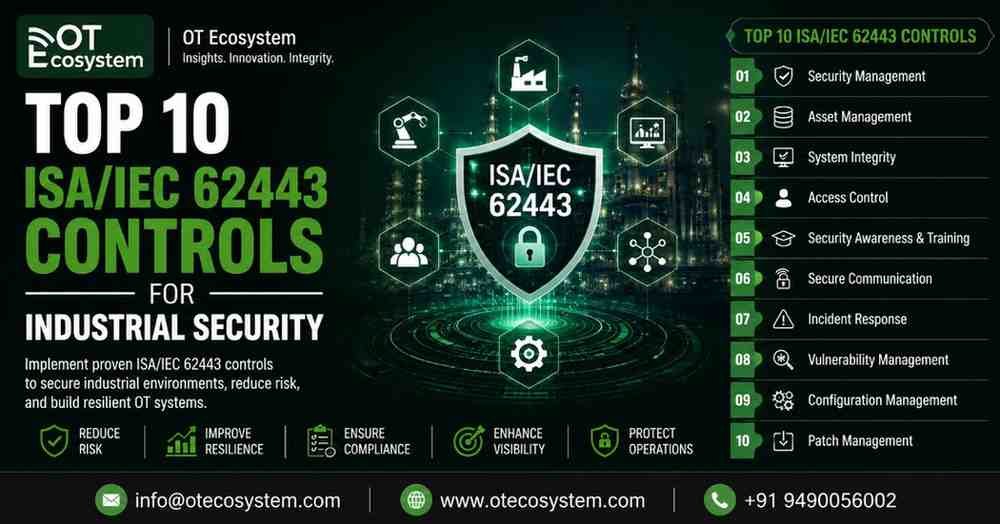
Top 10 ISA/IEC 62443 Controls for Industrial Security
1. Cyber Risk Assessment and Target Security Levels (IEC 62443-3-2)
You cannot apply a blanket security policy across a complex manufacturing facility. IEC 62443-3-2 requires engineering and security teams to conduct a detailed risk assessment to define a Target Security Level (SL-T) for every system. For example, a Safety Instrumented System (SIS) protecting a hazardous chemical process requires a highly resilient SL-3 or SL-4, while a basic environmental sensor may only need SL-1. This ensures your security budget is spent exactly where a breach would cause the most devastating physical impact.
2. Zones and Conduits Architecture
The era of the flat manufacturing network is over. The standard mandates logically grouping assets into “Zones” based on their functional requirements and criticality. The communication channels between these zones are defined as “Conduits”. By strictly mapping these pathways-often aligning with the Purdue Enterprise Reference Architecture-defenders can implement deep packet inspection (DPI) and industrial Demilitarized Zones (DMZs) to mathematically limit the blast radius of any malware infection.
3. Identification and Authentication Control (Foundational Requirement 1)
Every user, software process, and MIoT device must be strictly identified and authenticated before accessing the IACS. In modern OT environments, this means eliminating shared administrative passwords on legacy Human-Machine Interfaces (HMIs) and enforcing phishing-resistant Multi-Factor Authentication (MFA) for all remote vendor access. Machine-to-machine (M2M) communication must also be authenticated to prevent rogue devices from injecting commands into the control loop.
4. Use Control and Privilege Management (Foundational Requirement 2)
Authentication proves who is on the network; Use Control dictates what they can do. This control enforces the principle of least privilege through Role-Based Access Control (RBAC). A maintenance technician’s credentials should allow them to view diagnostic data but strictly prohibit them from altering Programmable Logic Controller (PLC) code or changing critical safety setpoints on the factory floor.
5. System Integrity and Tamper Detection (Foundational Requirement 3)
In OT, an unauthorized change to a configuration file can cause a physical catastrophe. System Integrity controls protect the IACS from unauthorized manipulation. This involves maintaining immutable backups of PLC logic, utilizing cryptographic hashing to verify firmware updates before installation, and deploying application allowlisting on engineering workstations to ensure only explicitly trusted binaries can execute.
6. Data Confidentiality for OT (Foundational Requirement 4)
While availability is the king of OT, data confidentiality remains critical-especially as intellectual property and proprietary manufacturing recipes traverse the network. This control mandates the encryption of sensitive process telemetry and administrative credentials, both at rest and in transit. As organizations push OT data to cloud-based predictive maintenance analytics, robust encryption prevents industrial espionage and Man-in-the-Middle (MitM) attacks.
7. Restricted Data Flow Across Boundaries (Foundational Requirement 5)
This control operationalizes your Zones and Conduits. It requires the deployment of stateful firewalls, unidirectional gateways (data diodes), and access control lists (ACLs) to physically or logically restrict data flow between segmented areas. Because 96% of OT incidents start in IT, a compromised corporate email account in the IT network should never be able to directly ping a Level 1 field controller.
8. Timely Response to Events (Foundational Requirement 6)
An IT-centric incident response plan will not safely shut down a melting turbine. IEC 62443 requires prompt response mechanisms specifically tailored to the safety requirements of the plant floor. This means deploying continuous, passive OT network monitoring tools that understand proprietary industrial protocols (like Modbus or DNP3) to detect anomalies early, paired with dedicated IR playbooks for safely failing over to manual operations.
9. Resource Availability and Resilience (Foundational Requirement 7)
Industrial systems must remain available even while under attack. This control mandates safeguards against Denial of Service (DoS) conditions, ensuring that essential control loops and safety systems have the network bandwidth and compute resources necessary to function during a crisis. It also covers robust disaster recovery protocols to minimize Recovery Time Objectives (RTOs).
10. Secure Product Development Lifecycle (IEC 62443-4-1)
Securing your perimeter is useless if the hardware you purchase is compromised from the factory. Part 4-1 shifts the burden to the Original Equipment Manufacturers (OEMs), outlining strict secure-by-design requirements for control systems and products. Asset owners must demand compliance with this standard during procurement, ensuring vendors provide dynamic Software Bills of Materials (SBOMs), secure coding practices, and aggressive vulnerability management.
Conclusion
Compliance with ISA/IEC 62443 is no longer just a theoretical best practice; regulatory bodies and insurers globally are demanding it as the baseline for operational survival. With industrial cyber threats scaling in sophistication, organizations must shift from reactive perimeter defense to proactive, risk-based engineering. By bridging the cultural divide between IT security and physical engineering, this standard transforms your operational technology from a fragile, vulnerable target into a highly resilient, legally defensible infrastructure.