
The convergence of Information Technology and Operational Technology, heavily driven by Mission-Critical IoT deployments, has dramatically expanded the enterprise attack surface. Threat actors no longer stop at IT network boundaries; they pivot directly into physical industrial environments to disrupt critical infrastructure. Understanding adversary behavior through specialized threat intelligence is essential for modern security teams guarding complex manufacturing plants, power grids, and automated facilities.
To navigate this evolving landscape effectively, security architects rely heavily on the MITRE ATT&CK for ICS framework. Unlike traditional corporate matrices focused solely on data theft or ransomware encryption, this specialized framework maps out sophisticated techniques designed to manipulate physical processes, disable safety systems, and cause real-world devastation. Below is an expert breakdown of the top ten techniques every industrial defender must master to protect modern operational environments.
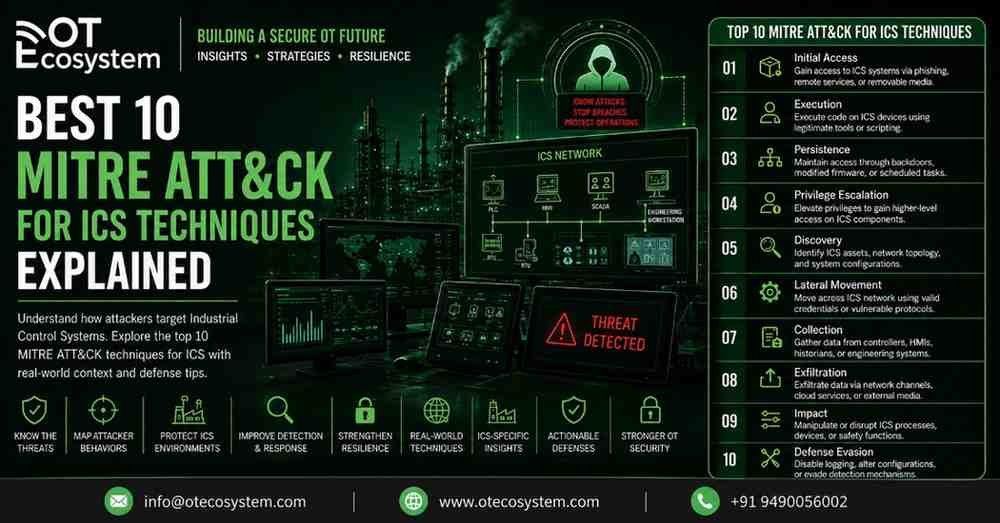
Best 10 MITRE ATT&CK for ICS Techniques Explained
1. Program Download (T0843)
Adversaries frequently utilize native device programming functions to upload malicious or heavily modified control logic directly to PLCs, RTUs, and distributed controllers. Famously deployed in historical operations like Stuxnet and Industroyer, unauthorized program downloads allow attackers to alter underlying physical processes silently. This can cause equipment to over-speed, valves to lock open, or pressures to spike dangerously beyond structural limits. To mitigate this risk effectively, defenders must enforce strict cryptographic signing for all firmware and logic updates, maintain offline backups of golden configuration files, and implement physical hardware key locks on all accessible controllers.
2. Manipulation of Control (T0831)
Once attackers secure a foothold within engineering workstations or control domains, they often actively manipulate running control loops, operational setpoints, and analog output signals. Instead of rewriting complete logic files, they send direct commands to actuators, motors, and critical valves to drive industrial processes far outside safe operational boundaries. This malicious interference results in catastrophic mechanical wear, ruined product batches, or severe structural hazards by overriding automated thermal safety controls. Securing this vector requires robust network segmentation following the Purdue Model and continuous monitoring of fieldbus serial communications for anomalous setpoint modifications.
3. Loss of Safety (T0880)
Deliberately disabling, bypassing, or misconfiguring Safety Instrumented Systems-the independent, fail-safe layers engineered to automatically shut down industrial processes during primary failures-represents an ultimate endgame technique. By disabling safety layers, attackers remove the absolute final line of defense against physical disaster, ensuring subsequent malicious inputs maximize structural damage. Mitigating this catastrophic risk demands rigorous out-of-band monitoring for dedicated safety controllers, mandatory multi-factor authentication for all safety engineering changes, and absolute physical air-gapping between safety networks and basic process control systems.
4. Alarm Suppression (T0878)
Sophisticated threat actors routinely modify configuration files or issue direct commands to Human-Machine Interfaces and centralized alarm servers to suppress, mask, or delete critical operational alarms. By blinding human operators to abnormal process states, attackers gain an extended operational runway to execute destructive phases without triggering emergency intervention. Defenders can counter this tactic by maintaining strict integrity monitoring on all HMI configuration files, utilizing independent hardware-based alarm annunciation systems, and logging every single operator station modification within an immutable, centralized SIEM architecture.
5. Unauthorized Command Message (T0855)
Adversaries frequently craft and inject illegitimate protocol-specific command messages directly onto unsegmented industrial networks. By exploiting unauthenticated and unencrypted legacy protocols such as Modbus TCP, DNP3, or IEC 60870-5-104, attackers effortlessly impersonate master telemetry stations. Because many legacy ICS protocols lack native authentication features, injected packets instructing breakers to trip appear completely legitimate to receiving field devices. Defending against these intrusions requires deploying industrial deep packet inspection firewalls capable of parsing operational traffic down to specific function codes.
6. Denial of Service – Control System Device (T0814)
Industrial controllers, network switches, and critical engineering servers are highly vulnerable to targeted resource-exhaustion commands and malformed traffic floods that cause devices to crash or enter fail-closed states. These disruptive events trigger unplanned operational shutdowns, severe production downtime, and profound loss of visibility for monitoring personnel. In continuous process industries like chemical manufacturing or oil refining, abrupt system shutdowns can be just as hazardous as over-pressurization events. Mitigation strategies include deploying strict rate-limiting at network boundaries, hardening device firmware against buffer overflows, and ensuring highly resilient redundant network paths.
7. Device Restart / Shutdown (T0816)
Attackers occasionally issue deliberate reboot or power-down commands to core operational technology infrastructure, including RTUs, industrial historians, and master terminal units. This tactic serves a dual purpose: acting as a disruptive smokescreen to hide concurrent data exfiltration and lateral movement, or directly knocking critical monitoring nodes offline during peak operational windows. Preventing unauthorized reboots requires restricting administrative access to device power-management functions and enforcing strict role-based access control policies across all engineering development and maintenance environments.
8. Valid Accounts – Engineering Workstations (T0859)
Rather than relying on noisy brute-force credentials, advanced adversaries systematically compromise legitimate user accounts belonging to system integrators, maintenance technicians, or external vendors. Engineering workstations are prime tactical targets because they house specialized software tools like STEP7 or RSLogix necessary to interface directly with field hardware. Valid accounts grant attackers seamless living-off-the-land capabilities, allowing malicious traffic to blend indistinguishably with normal administrative maintenance. Organizations must enforce hardware-token-backed multi-factor authentication across all engineering access points and monitor for anomalous software execution during off-hours.
9. Loss of Protection (T0828)
Adversaries frequently target and disable localized protective relays, circuit breakers, or software-based defensive trip limits to amplify physical destruction. Similar to safety system tampering, this technique strips away localized electrical protection such as thermal overload or overcurrent limits, ensuring minor induced electrical faults escalate rapidly into catastrophic transformer explosions or generator failures. Countering this technique involves conducting routine logic verification audits, protecting relay settings groups with cryptographic authorization barriers, and deploying passive network monitoring to detect unexpected configuration write requests.
10. Remote System Discovery (T0819)
Before launching precision-targeted industrial attacks, adversaries systematically map complex network topologies by identifying active IP addresses, gateway subnets, active protocols, and vendor firmware versions. Because industrial environments are notoriously undocumented and prone to shadow assets like unmanaged modems and legacy test rigs, discovery techniques allow attackers to tailor payloads precisely to target hardware ecosystems. Maintaining a dynamic, real-time asset inventory and deploying network intrusion detection systems configured to alert on internal network scanning probes remain essential defensive countermeasures.
Conclusion
The MITRE ATT&CK for ICS framework transforms abstract threat intelligence into actionable, structured defensive strategy. By shifting focus away from reactive signature matching and toward behavioral profiling of adversary tactics-from initial reconnaissance to final physical disruption-critical infrastructure owners can harden their operational environments. Implementing rigorous visibility, robust network segmentation, and advanced monitoring platforms ensures that industrial organizations remain resilient against the next generation of sophisticated cyber-physical threats.