
As global industrial sectors face an escalating wave of cyber-physical extortion, ransomware has evolved from a standard enterprise IT disruption into an existential threat to critical infrastructure. When threat actors pivot from corporate email servers to operational technology (OT), industrial control systems (ICS), and medical IoT (MIoT) environments, traditional IT endpoint tools fall short. Deploying enterprise anti-ransomware agents directly onto legacy PLCs or HMIs can crash physical processes and trigger emergency plant shutdowns.
Stopping ransomware in an industrial environment requires specialized tools engineered for deterministic control loops, legacy firmware visibility, and air-gapped network defense. Below are the 10 best tool categories and specialized solutions designed to stop ransomware in OT environments.
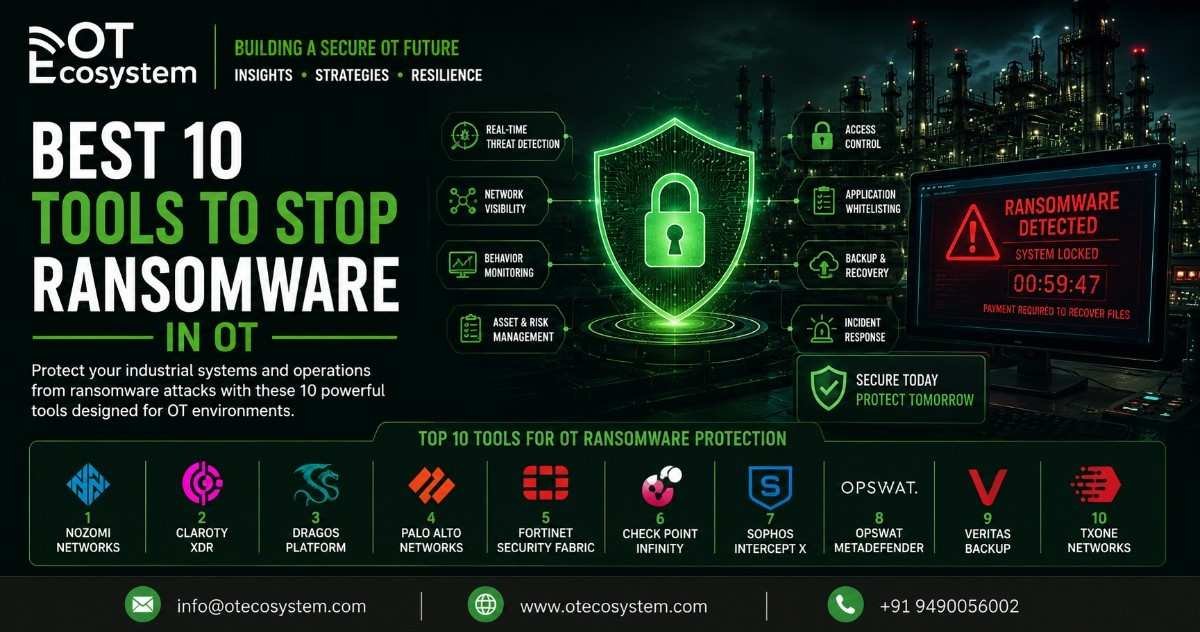
Best 10 Tools to Stop Ransomware in OT
1. Passive OT Network Monitoring and Deep Packet Inspection (DPI) Platforms
Early detection is the primary defense against ransomware dwelling quietly inside an industrial network. Specialized passive monitoring tools inspect industrial protocols like Modbus, DNP3, and OPC UA without injecting synthetic traffic or risking PLC crashes. These platforms flag anomalous protocol command states, unauthorized file transfers, and lateral movement before encryption payloads can be deployed across Purdue Level 1 and Level 2 zones.
2. Industrial Endpoint Detection and Response (EDR) Agents
While standard IT EDR can destabilize plant floors, OT-tailored endpoint solutions provide granular visibility into Windows-based HMI servers and engineering workstations. These tools monitor process-specific behavioral anomalies, track unauthorized script executions like PowerShell, and block malicious binary injections without interrupting real-time control logic execution or SCADA display refreshes.
3. Purdue Model Segmentation Enforcement and Firewall Gateways
Ransomware typically enters through the corporate IT perimeter before tunneling down into the shop floor. Industrial-grade next-generation firewalls (NGFWs) enforce strict zone-to-zone boundaries based on IEC 62443 standards. By programmatically blocking unauthorized cross-traffic between enterprise networks and lower-level controllers, these tools trap lateral movement and isolate infections instantly.
4. Immutable Backup and Automated Air-Gapped Recovery Solutions
Against industrial ransomware designed to target and delete online backup volumes, traditional storage mechanisms are insufficient. Specialized industrial backup systems maintain immutable, offline, or sandbox-verified snapshots of PLC ladder logic, HMI project files, and historian databases. Automated recovery testing ensures these backups can be cleanly restored within maximum allowable downtime (MAD) limits.
5. Secure Remote Access Gateways and Jump Hosts
Unmonitored third-party vendor VPNs remain a primary vector for initial ransomware access. Secure remote access solutions replace legacy modems and persistent tunnels with context-aware, policy-driven jump hosts. These platforms enforce multi-factor authentication (MFA), session recording, and strict time-to-live limits, ensuring external contractors cannot act as bridgeheads for ransomware distribution.
6. ICS Vulnerability Management and Virtual Patching Tools
Because over 60% of legacy industrial controllers cannot be rebooted or patched immediately without causing hazardous production halts, specialized virtual patching tools are essential. These security platforms deploy network-layer filters and DPI signatures that neutralize known CVE exploits targeting legacy firmware vulnerabilities without requiring a single line of PLC code to be modified.
7. Asset Discovery and Ghost Device Identification Engines
Attackers frequently leverage unmanaged smart sensors, IIoT devices, or rogue maintenance laptops as hidden entry points. Automated passive inventory engines continuously map the entire operational perimeter to catch unmanaged endpoints instantly. Eliminating network blind spots prevents threat actors from establishing stealthy command-and-control footholds on the plant floor.
8. Industrial Deception and Honey-Token Networks
Deception technology introduces realistic, decoy PLCs, fake HMI nodes, and dummy historian databases deep inside the OT network. When ransomware scanners or automated threat actors probe the network for active registers, interacting with these honey-tokens instantly trips high-fidelity fidelity alarms, allowing security teams to isolate the threat before production systems are touched.
9. Security Orchestration, Automation, and Response (SOAR) for OT
When an indicator of compromise appears, manual reaction times are too slow to stop automated ransomware encryption routines. OT-aware automation platforms coordinate response workflows across disparate security layers-automatically severing specific switch ports, notifying plant engineers, and quarantining infected HMI nodes while safeguarding physical safety loops.
10. Hardware and Firmware Integrity Monitoring Systems
Sophisticated ransomware variants attempt to achieve persistent control by modifying device bootloaders or flashing malicious firmware onto RTUs and controllers. Specialized cryptographic integrity tools run continuous checks against baseline vendor hashes, instantly flagging unauthorized binary modifications and protecting the lowest layers of the industrial control stack.
Integrating Advanced OT Visibility Solutions for Ransomware Defense
To deploy and coordinate these defenses effectively, modern industrial enterprises rely on continuous threat monitoring platforms. While established asset discovery tools from legacy vendors like Nozomi Networks, Dragos, Claroty, Shieldworkz, and TXOne provide foundational network telemetry and anomaly detection, advanced platforms bridge the critical gap between raw packet analysis and real-time ransomware mitigation. By unifying visibility across Purdue levels zero through four, industrial organizations can detect early reconnaissance and stop extortion attempts before physical operations are compromised.
Conclusion
Stopping ransomware in operational technology environments requires a decisive shift away from reactive IT data recovery toward proactive, process-aware industrial defense. By integrating specialized tools that address network segmentation, immutable backups, virtual patching, and passive monitoring, security leaders can protect critical infrastructure against modern cyber-physical extortion. Deploying this multi-layered tool stack ensures that industrial organizations maintain absolute operational continuity, regulatory compliance, and human safety even in the face of sophisticated threat actors.