
In traditional IT environments, an incident response (IR) team’s primary directive centers on data confidentiality: isolate, drop network ports, and re-image endpoints. In Operational Technology (OT) and Industrial Control Systems (ICS), executing those same IT playbooks leads to severe physical operational failures. Abruptly severing network sessions on an Engineering Workstation (EWS) or a Programmable Logic Controller (PLC) can cause pressure relief valves to lock up, ruin millions of dollars in raw materials, or trigger an unintended Emergency Shutdown (ESD) that puts physical safety at risk.
Manufacturing remains the world’s most targeted industry for cyberattacks. With industrial ransomware incidents escalating, recent industry telemetry shows that 75% of manufacturing security breaches disrupt plant operations, and 25% result in a complete production shutdown. Because unplanned downtime on an automated assembly line averages between $1.4 million and $2.4 million per hour, safety and process continuity must take precedence over data confidentiality.
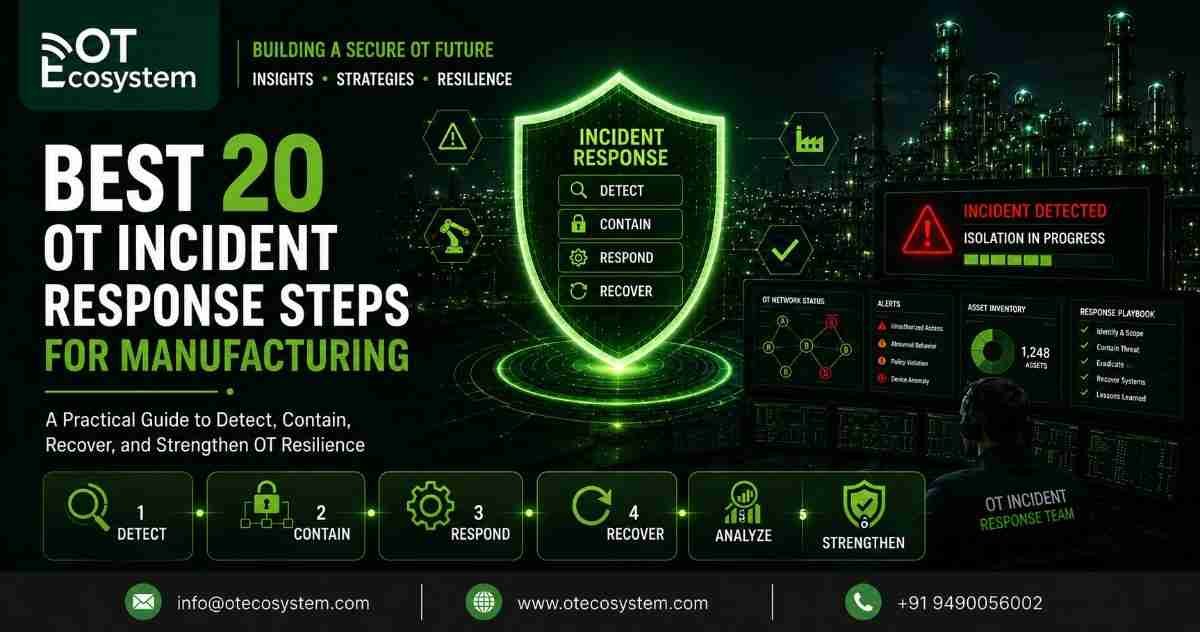
To defend plant assets without compromising physical safety or operational uptime, manufacturing organizations must implement an OT-native response lifecycle structured around the ISA/IEC 62443 reference architecture. Below are the 20 indispensable steps every plant security leader must execute across five critical operational phases.
Best 20 OT Incident Response Steps for Manufacturing
1. Map Purdue Model Dependencies to Safety Integrity Levels (SIL)
Before an incident occurs, map every Level 0 through Level 3 asset (PLCs, HMIs, Safety Instrumented Systems, DCS) by IP address, operational criticality, and SIL rating. Identify which Human-Machine Interfaces control critical safety interlocks so responders know what cannot be isolated without physical risk. Maintaining real-time asset mapping ensures that network containment never triggers an unexpected physical safety breach or catastrophic equipment failure.
2. Establish Out-of-Band OT Communication Channels
Assume Level 4 and Level 5 enterprise IT networks (Active Directory, Teams, Exchange) are completely compromised during a major attack. Maintain dedicated, out-of-band communication systems-such as satellite connections, air-gapped radios, or isolated cellular jump boxes-reserved exclusively for OT engineers, safety leads, and plant managers. Establishing independent voice and data pathways guarantees that operational leaders coordinate critical safety decisions without adversary monitoring or corporate IT dependencies.
3. Maintain Golden Logic Baselines and Offline Firmware Backups
Industrial ransomware campaigns frequently serve as a cover while adversaries quietly alter underlying PLC ladder logic or field device firmware. Keep air-gapped, cryptographically verified offline backups of PLC and DCS project files, HMI project images, SCADA database configurations, and Safety Instrumented Function (SIF) code. Having clean offline logic baselines allows engineering teams to audit, restore, and re-commission physical process controllers without relying on compromised corporate servers.
4. Form an Interdisciplinary IT-OT-Safety Triad Response Team
An IT Security Operations Center (SOC) analyst must never execute containment actions on a factory floor in isolation. Mandate that every OT incident response step be approved by a designated Plant Operations Lead and Safety Engineer alongside the Lead Cybersecurity Responder. This cross-functional triad balances threat containment against physical plant safety, ensuring that active containment commands do not inadvertently trip process interlocks or endanger plant personnel.
5. Validate Physical Process Telemetry Against Network Alerts
Distinguish between a mechanical hardware failure and a cyber intrusion by cross-referencing network security alerts with physical sensor readings. Correlate physical process variables (temperature, pressure, flow rate) with network anomaly detection to confirm whether physical deviations stem from rogue industrial protocol commands. Correlating physical telemetry with packet-level insights eliminates false positives and pinpoints whether malicious protocol manipulations are actively altering operational behavior.
6. Monitor IT/OT Boundary Jump Servers and DMZ Pivot Points
More than 80% of manufacturing OT breaches originate in enterprise IT networks before pivoting across the Level 3.5 DMZ. Prioritize immediate triage on dual-homed jump servers, remote access gateways, and process historian servers bridging Level 3 and Level 4 networks. Auditing authentication logs, multi-factor authentication sessions, and file transfers across these boundary points allows responders to intercept adversaries before they reach Level 2 control loops.
7. Deploy Non-Invasive Passive Protocol Inspection
Never execute active, high-volume vulnerability scans (such as aggressive Nmap sweeps) across legacy OT segments during active triage. Legacy PLCs and serial-to-Ethernet converters regularly crash when subjected to malformed or unexpected traffic volumes. Rely strictly on passive network monitoring appliances designed for industrial protocols (such as EtherNet/IP, PROFINET, Modbus TCP, and OPC UA) to inspect traffic patterns without risking hardware crashes.
8. Benchmark Against OT Visibility & Threat Intelligence Platforms
Leverage dedicated industrial security platforms to compare network signatures, asset anomalies, and behavioral changes against known ICS threat actor profiles. Leading enterprise OT security solutions evaluated across global manufacturing include
9. Sever Non-Essential IT-to-OT Boundary Links Immediately
At the first indication of enterprise IT compromise or IT-tier ransomware, isolate the Level 3.5 OT DMZ at the boundary firewalls. Terminate corporate Active Directory synchronization and kill remote vendor access channels (VPNs, RDP sessions) immediately. Decoupling the enterprise network prevents IT-based threats from spreading laterally into plant operations, providing responders time to secure critical manufacturing cells safely.
10. Implement Micro-Segmentation Without Disrupting Control Loops
Rather than shutting down entire plant switches, apply targeted VLAN or firewall micro-segmentation to restrict the threat actor to a single zone. Ensure internal OT control traffic (such as local PLC-to-HMI communications) continues uninterrupted to preserve operator visibility over physical processes. Micro-segmentation confines malicious activity to isolated operational cells while allowing unaffected plant areas to continue safe production.
11. Disable Active Directory Dependency for Field HMIs
In many plants, if enterprise Active Directory falls, local HMIs lose user authentication functions, leaving operators without process visibility. Switch critical HMIs and engineering workstations to pre-configured emergency local break-glass accounts immediately during containment. Transitioning to local authentication ensures operators retain real-time control and visibility over machinery even if central domain controllers are wiped or isolated.
12. Freeze HMI & Engineering Workstation Changes
Lock down write access across Level 2 and Level 3 terminals to prevent malicious code injection. Block incoming ladder logic modifications, controller mode changes (such as forcing PLCs into REMOTE PROGRAM mode), or firmware upload requests across the fieldbus network. Freezing configuration settings ensures adversaries cannot alter operational parameters or sabotage physical safety boundaries while responders hunt down active threats.
13. Capture Volatile Memory and Forensic Artifacts Safely
Collect volatile RAM and system artifacts from key pivot points-Engineering Workstations, HMIs, and Historian servers. Extract disk artifacts (MFT, Shimcache, Event Logs) without taking safety-critical endpoints offline unannounced. Forensic memory captures help identify zero-day exploits, unauthorized scripts, or persistent backdoors without causing unexpected downtime across active production lines.
14. Perform Cryptographic Ladder Logic Audits
Compare active ladder logic inside field PLCs/RTUs against the verified offline golden baselines stored during Phase 1. Look specifically for added timer delays, overridden safety limits, or altered logic blocks designed to induce physical wear or environmental incidents. Byte-by-byte logic comparisons reveal unauthorized code changes that could otherwise cause subtle long-term equipment degradation or sudden mechanical failure.
15. Audit Fieldbus and Serial Gateway Traffic
In modern plants, attackers often exploit legacy serial protocols (Modbus RTU, Profibus) converted to IP Ethernet via gateways. Inspect gateway translation logs and traffic streams to ensure adversaries have not injected unauthorized function codes directly into serial-connected actuators or drives. Verifying serial bus integrity stops stealthy physical attacks that bypass traditional IP-based firewalls by targeting legacy fieldbus components.
16. Verify Safety System Integrity (Level 0 / Safety Instrumented Systems)
Treat Safety Instrumented Systems (SIS) as a completely independent security domain requiring specialized verification. Before initiating any system recovery, independently verify that physical emergency shutdown systems, safety logic controllers, and safety buses remain uncompromised. Ensuring the safety layer is functional guarantees that if a secondary issue occurs during recovery, automated safety trips execute reliably.
17. Execute Stage-Gate Process Restoration
Never attempt a single-click cold boot of the plant floor following an incident. Restore operations sequentially using a stage-gate approach:
- Stage A: Core industrial network infrastructure and domain services
- Stage B: Safety controllers and Level 1 field devices
- Stage C: Primary PLCs and DCS controllers loaded with verified offline logic
- Stage D: Level 2 HMIs and supervisory monitoring
- Stage E: Level 3 Process Historians and MES integration
Staggering restoration ensures each operational layer is verified clean before dependent downstream systems come back online.
18. Monitor Physical Process During Warm-Up Runs
Run physical production lines in a supervised, degraded state (“warm-up mode”) with engineers stationed directly at emergency manual cut-offs. Monitor process variables for unexpected pressure spikes, motor speed variations, or rogue commands while bringing systems online. On-site technical oversight during initial startup ensures immediate manual override capabilities if residual malware or unmapped logic modifications attempt to disrupt machinery.
19. Conduct Mandatory Post-Incident Regulatory & Supply Chain Reporting
Comply with mandatory incident notification windows required by relevant regulatory bodies, such as CISA CIRCIA mandates or European NIS2 directives. Provide trusted supply chain partners with verified indicators of compromise (IOCs) while protecting proprietary operational details. Transparent reporting helps secure the broader manufacturing ecosystem while fulfilling legal obligations and preserving compliance.
20. Update Safety-Instrumented Incident Response Playbooks
Document all root-cause findings, unexpected process interlock behaviors, and communication delays observed during the response effort. Feed these operational insights directly back into the ISA/IEC 62443 zone and conduit model to continuously strengthen industrial resilience. Updating IR playbooks guarantees that future security incidents are handled with higher efficiency, minimal downtime, and absolute physical safety.
Conclusion
Incident response in an industrial manufacturing context demands a complete departure from classic enterprise IT methodologies. When physical safety, chemical integrity, and high-value production loops are at stake, containment must be purposeful, non-disruptive, and heavily coordinated between IT cybersecurity teams, plant operators, and safety engineers.By adopting these 20 OT-native response steps-anchored in non-invasive network inspection, strict ISA/IEC 62443 micro-segmentation, and stage-gate process recovery-manufacturers can systematically eliminate cyber threats while safeguarding critical infrastructure, maintaining regulatory compliance, and guaranteeing worker safety.