
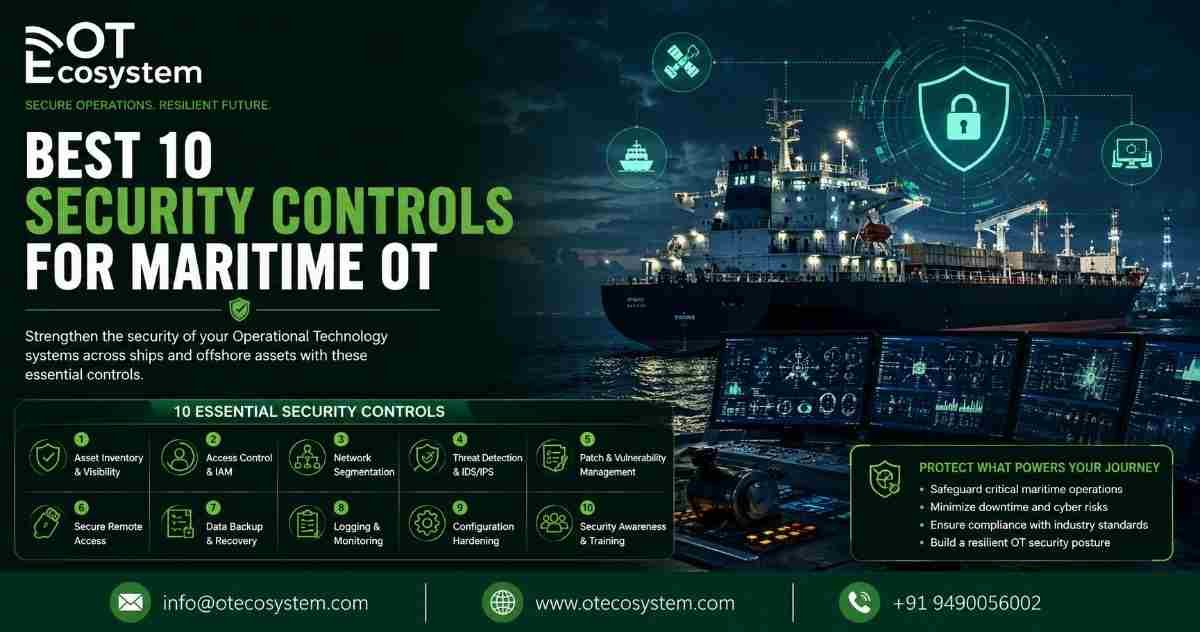
The global maritime ecosystem accounts for over 80% of world trade by volume. Modern vessel fleets, offshore platforms, and port terminals have evolved into floating industrial hubs where digital automation drives critical operations. From dynamic positioning (DP) and integrated bridge systems (IBS) to automated engine control and cargo handling, Operational Technology (OT) is the backbone of maritime operations. However, the rapid convergence of legacy shipboard OT, satellite communications (Satcom/Starlink), and IT enterprise networks has exposed vessels and port terminals to unprecedented cyber-physical risks. Ransomware encounters on port operating systems, GPS spoofing, compromised ECDIS (Electronic Chart Display and Information System) routes, and rogue vendor remote connections have transformed maritime security from an IT concern into a life-safety, navigational, and environmental compliance imperative. With the International Maritime Organization (IMO Resolution MSC.428(98)) mandating cyber risk management within Safety Management Systems (SMS), alongside frameworks like IACS UR E26/E27 and IEC 62443, vessel owners, operators, and port authorities require practical, field-tested technical controls. Here are the Best 10 Security Controls for Maritime OT, engineered to withstand extreme maritime environments, intermittent connectivity, and complex industrial supply chains.
Best 10 Security Controls for Maritime OT
1. Micro-Segmentation and Conduit Isolation for Shipboard Networks
Ships historically operated flat local area networks where crew Wi-Fi, administrative systems, and engine automation coexisted, creating massive exposure risks across vessel operations. Implementing micro-segmentation aligned with IEC 62443-3-2 breaks the shipboard architecture into strict defensive zones such as the Integrated Bridge System, Engine Automation, Cargo Control, and Passenger networks. By enforcing Purdue conduit isolation between the vessel IT/OT DMZ and core operational levels, this control prevents lateral movement of ransomware or malicious payloads originating from crew welfare Wi-Fi or compromised satellite terminals, ensuring critical propulsion and navigation networks remain completely isolated during an incident.
2. Zero-Trust Remote Access Gateways for OEM Field Engineers
Engine manufacturers and bridge equipment vendors frequently require remote connections for diagnostic maintenance, sea trials, and software updates over VSAT or LEO links. Replacing persistent VPN connections with Zero-Trust Network Access (ZTNA) gateways enforces mandatory Multi-Factor Authentication (MFA), full session recording, granular access approvals by the Chief Engineer, and automatic session termination upon task completion. Operating at the Purdue Level 3.5 iDMZ interface, this zero-trust posture eliminates unmonitored backdoors into vessel control systems while maintaining essential third-party diagnostic capabilities without exposing core machinery to external compromise.
3. Passive Deep Packet Inspection (DPI) for Maritime Protocols
Deploying passive network TAPs across shipboard networks allows security teams to inspect OT traffic across maritime-specific and industrial protocols, including NMEA 0183/2000, Modbus/TCP, IEC 61158, and Profibus. Operating non-intrusively at Purdue Levels 1 and 2, passive DPI builds a dynamic behavioral baseline of legitimate command sequences without introducing network latency or risk of packet disruption. This real-time visibility detects unauthorized command injections, rogue asset additions, or abnormal sensor values instantly without interfering with sensitive, deterministic control loops governing propulsion or ballast safety.
4. Immutable Endpoint Protection and Application Control for Host Systems
Bridge and Engine Control HMI workstations, ECDIS servers, and cargo management terminals frequently run on legacy or embedded Windows platforms that cannot sustain frequent signature updates due to intermittent satellite connectivity. Deploying application whitelisting with default-deny policies and system integrity enforcement guarantees that only cryptographically signed, approved maritime applications can execute on critical hosts. This immutable protection model blocks zero-day exploits, unauthorized executable binaries, and ransomware payloads even when endpoints operate offline for extended months at sea.
5. Hardware-Enforced Removable Media Sanitization Kiosks
Port inspectors, class surveyors, and field engineers routinely plug USB flash drives into ECDIS, Voyage Data Recorders (VDR), and PLC programming terminals to upload chart updates or diagnostic scripts. Mandating physical USB port blocking caps alongside dedicated, ruggedized media sanitization kiosks located at the ship’s Gangway or Control Room ensures all incoming media undergoes deep malware scanning before touching vessel systems. This physical barrier stops air-gap-crossing malware and rogue technician payloads from bridging isolated bridge and engine control systems.
6. GNSS Anti-Spoofing and Resilient PNT Verification
Global Navigation Satellite System (GNSS) spoofing and jamming are increasingly prevalent in geopolitical choke points, posing severe navigation hazards to modern vessels. Implementing multi-constellation GNSS receivers equipped with spatial filtering antennas, coupled with automated cross-verification logic that checks GPS coordinates against Inertial Navigation Systems (INS), eLoran, and radar target tracking (ARPA), provides resilient Positioning, Navigation, and Timing (PNT). This multi-layered validation alerts navigation officers immediately to synthetic location manipulation, preventing vessel grounding, collision, or accidental drift into hostile territorial waters.
7. Out-of-Band Firmware Integrity Monitoring and PLC Logic Safeguards
Programmable logic controllers (PLCs), remote terminal units (RTUs), and engine governors at Purdue Level 1 regulate critical physical processes such as ballast water management, fuel treatment, and power distribution. Establishing an automated out-of-band monitoring process periodically verifies the cryptographic hash of PLC firmware and ladder logic configurations against known-good baselines. This out-of-band safeguard detects unauthorized firmware alterations, malicious logic modifications, or rogue parameter changes made during shipyard overhauls or via compromised maintenance tools before equipment is engaged at sea.
8. Maritime-Specific Cyber Incident Response Playbooks & Crew Training
Technical controls must be paired with human readiness, integrating OT cyber incident response directly into the vessel’s International Safety Management (ISM) Code framework. Providing the Master, Chief Engineer, and Electro-Technical Officers (ETOs) with role-specific playbooks detailing physical fallback procedures-such as switching from automatic to manual steering or manually overriding compromised bridge switches-ensures operational continuity. Training crew members to execute emergency manual operations prevents total vessel paralysis during a cyber event, protecting human life, cargo, and environmental safety.
9. Supply Chain Security Governance & IACS UR E26/E27 Compliance
Enforcing strict cybersecurity requirements during newbuild procurement and vessel retrofits ensures that security is designed into ship systems from day one rather than retrofitted as an afterthought. Adhering to International Association of Classification Societies (IACS) Unified Requirements E26 for shipboard system integration and E27 for onboard equipment, while mandating Software Bill of Materials (SBOM) disclosures from maritime OEMs, validates supply chain security. This governance framework eliminates inherited software vulnerabilities, unpatched components, and hidden backdoors prior to sea acceptance trials (SAT).
10. Store-and-Forward Telemetry Architecture for Ship-to-Shore SIEM
High bandwidth costs and variable satellite latency make streaming continuous raw log data from sea to shore impractical for maritime fleets. Onboard OT security appliances utilizing intelligent store-and-forward compression prioritize, compress, and locally cache event logs, anomaly alerts, and network telemetry, synchronizing them to the onshore Security Information and Event Management (SIEM) system whenever satellite connectivity is established. This architecture delivers centralized fleet-wide visibility to onshore SOC analysts without overwhelming vessel communication channels or disrupting operational bandwidth.
Conclusion
As maritime digitalization accelerates-driven by autonomous shipping projects, smart port integration, and continuous satellite connectivity-the physical safety of ships and crew is inextricably tied to OT cybersecurity. Implementing these 10 core controls ensures vessel operators not only fulfill IMO and IACS compliance mandates, but also build genuine cyber-physical resilience against evolving ocean-going threats.