
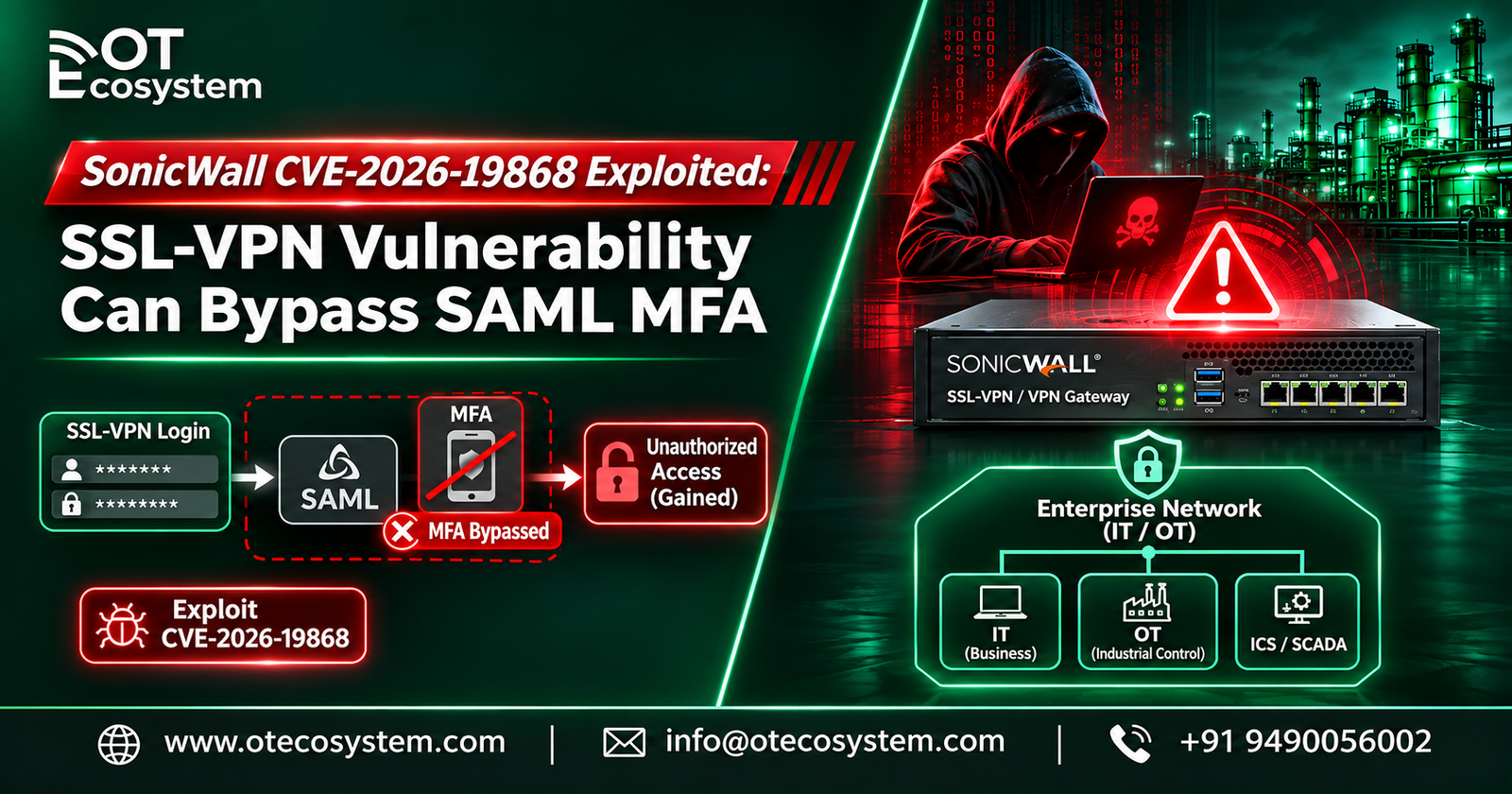
SonicWall has patched an exploited SonicOS flaw, CVE-2026-19868, that lets an attacker holding valid credentials for an alternate authentication method sidestep SAML controls on SSL-VPN, potentially including SAML-enforced multi-factor authentication (MFA). The U.S. Cybersecurity and Infrastructure Security Agency (CISA) added the flaw to its Known Exploited Vulnerabilities (KEV) catalog on November 6, 2026, confirming real-world exploitation. For organizations that give employees, integrators and OEM contractors access to plants and substations through firewall VPNs, it is a patch-and-audit item for this weekend.
The scope matters, and early coverage has been clear about it: this is not an unauthenticated compromise of every SonicWall firewall. The attacker needs valid credentials, and the device must be running SSL-VPN configured for SAML. The danger is that an organization may believe MFA protects every VPN login when, on an unpatched device, one login path may not enforce it.
Key Facts at a Glance
| Item | Detail |
| CVE | CVE-2026-19868 |
| Vendor advisory | SNWLID-2026-0014 (published November 6, 2026) |
| Product | SonicWall SonicOS, SSL-VPN service |
| Affected | Gen7 7.3.3-7015 and earlier; Gen8 8.2.2-8015 and earlier |
| Fixed in | Gen7 7.3.4-7013; Gen8 8.2.3-8015 |
| Precondition | SSL-VPN configured to use SAML authentication |
| Weakness | CWE-308, use of single-factor authentication |
| Severity | CVSS 7.1 per SonicWall as reported by BleepingComputer; 7.5 per some other trackers (see note below) |
| Workaround | None, per SonicWall |
| Exploitation | Confirmed by CISA KEV listing; SonicWall investigated a reported exploitation case |
| CISA deadline | November 20, 2026 for U.S. federal civilian agencies |
| Reported by | Ryan Harris of The Electronic Office |
Severity note: sources disagree on the score. BleepingComputer and SonicWall-aligned coverage cite CVSS 7.1, while Security Affairs and some aggregators cite 7.5. Both place it in the “High” band. Check the CVE record and SonicWall advisory for the authoritative figure.
What Happened
On November 6, 2026, SonicWall published a security advisory covering seven vulnerabilities in SonicOS and released fixed firmware. CVE-2026-19868 drew the most attention because it is the only one of the seven for which exploitation has been reported. SonicWall said it investigated a report of possible exploitation and urged customers to update. CISA then added the CVE to the KEV catalog the same day, with a remediation deadline of November 20 for federal civilian agencies.
The other flaws patched in the same release reportedly include a pre-authentication heap overflow in SSL-VPN, heap and stack overflows in the TACACS+ component, and weak password hashing, according to secondary coverage. Those have not been reported as exploited, but a pre-authentication memory-corruption bug on an internet-facing VPN service is a reason to patch the whole release rather than only the exploited CVE. We could not verify the individual CVE identifiers for these from the sources reviewed, so confirm them in the SonicWall advisory.
Root Cause: An Authentication Enforcement Gap
SonicWall describes CVE-2026-19868 as an authentication enforcement vulnerability in the SonicOS SSL-VPN service. Per the vendor description, a user with valid credentials for an alternate authentication method may bypass SAML authentication controls, and successful exploitation may also bypass SAML-enforced MFA.
In plain terms, an administrator who enables SAML expects every VPN login to go through the identity provider (IdP), where MFA is typically enforced. The flaw means that, on affected builds, presenting valid credentials through a different configured method can let a session proceed without the SAML flow completing. The effective result is single-factor access where multi-factor was expected, which matches the CWE-308 classification.
SonicWall’s public description does not specify which alternate methods are exploitable (for example, local accounts versus directory-backed logins), and we have not seen a technical write-up or proof-of-concept. Treat any claims about the exact code path as unverified until SonicWall or independent researchers publish details.
Attack Methodology: What We Know and Don’t
Confirmed or vendor-stated:
- The attacker must already hold valid credentials for an alternate authentication method.
- The target must be an SSL-VPN service with SAML enabled.
- A successful bypass skips SAML controls, potentially including IdP-enforced MFA.
- SonicWall states no workarounds exist; the fix is a firmware update.
Not publicly known (as of November 7, 2026):
- How the exploited instance obtained valid credentials (phishing, infostealer logs, password reuse, brute force, or insider access).
- How many devices were targeted or compromised.
- What attackers did after gaining VPN access.
- Whether any malware, ransomware or specific tooling was involved.
Because the flaw is a precondition-heavy bypass, it is best understood as a second-stage weakness: it turns a stolen or guessed password into network access by removing the control meant to blunt that exact scenario. That is why it is valuable to attackers who already run credential-theft or password-spraying operations.
Threat Actors and Attribution
No attribution has been published. Neither SonicWall nor CISA, in the material reviewed, names a threat actor, campaign or motive for the exploitation of CVE-2026-19868. Any article or vendor blog linking it to a specific ransomware group or nation-state should be treated as speculation unless it cites evidence.
For context only, and explicitly not as a link to this CVE: SonicWall SSL-VPN products have been repeatedly targeted. ReliaQuest reported that attackers exploited a different, earlier MFA bypass, CVE-2024-12802 on Gen6 appliances, in environments between February and March 2026, and that devices which appeared patched were still exposed because of an additional manual LDAP reconfiguration requirement. BleepingComputer covered that report in May 2026. In February 2025, attackers also targeted CVE-2024-53704 after Bishop Fox published exploit details. These are separate vulnerabilities, but they show that edge VPN authentication is a sustained attacker focus and that “patched” does not always mean “fixed.”
Impact Assessment
Confirmed: exploitation has occurred in at least one case, per SonicWall’s investigation and CISA’s KEV listing. The potential consequence is unauthorized VPN access that bypasses MFA.
Unknown: victim count, sectors, data loss, financial impact and regulatory consequences. We are not aware of any published figures and will not estimate them. Readers should be skeptical of any impact numbers that appear before SonicWall, CISA or incident responders publish them.
Realistic risk model (our assessment, not a reported finding): the exposure is greatest where (1) SAML is enabled for SSL-VPN on Gen7 or Gen8 firewalls, (2) alternate login methods remain enabled alongside SAML, and (3) credentials can be obtained through phishing or breach data. Organizations that disabled or never enabled alternate methods, or that do not use SAML on SSL-VPN, fall outside the stated condition.
Why This Matters for OT, ICS and Critical Infrastructure
Firewalls with SSL-VPN are common in smaller industrial sites, remote substations, water and wastewater facilities, building systems and OEM support arrangements, where a SonicWall appliance may be the only boundary between the internet and a control network. Several specific concerns follow:
- Contractor and vendor access. Integrators and OEMs often connect through shared or long-lived accounts. A flaw that converts a stolen password into MFA-free access is especially risky for these accounts, which are also the hardest to monitor.
- IT/OT boundary. If the VPN lands users in a flat network, MFA bypass can mean direct reach to HMIs, historians, engineering workstations and PLC programming ports. SAML MFA at the VPN edge is often the main thing standing in for segmentation.
- Patch constraints. OT teams may delay firewall firmware changes because of change windows. Here the vendor says no workaround exists, so delay carries real risk. Firewall updates typically cause a brief interruption, so schedule them as emergency changes with a rollback plan rather than waiting for the next maintenance cycle.
- Detection blind spots. If the SAML flow is bypassed, IdP logs may show no failed or successful MFA event at all, so teams relying only on IdP alerting may miss the activity. Firewall-side VPN logs matter.
- Standards alignment. The incident reinforces guidance in frameworks such as IEC 62443 and NIST SP 800-82 on securing remote access, enforcing multi-factor authentication, and limiting access by zone and conduit.
Response and Recovery
SonicWall’s response so far: it investigated the exploitation report, released fixed builds (Gen7 7.3.4-7013 and Gen8 8.2.3-8015), published advisory SNWLID-2026-0014, and credited the external researcher who reported the issue. CISA’s response: KEV listing and a two-week federal remediation deadline. No public information yet describes recovery steps for any affected organization, and we have found no statement about the scale of exploitation.
Security Recommendations
The first two items reflect the vendor and CISA positions. The remainder are OT Ecosystem’s recommended practice, based on how the vulnerability is described, and are not SonicWall-specified mitigations.
1. Patch immediately. Upgrade Gen7 devices to 7.3.4-7013 or later and Gen8 devices to 8.2.3-8015 or later. Because there is no workaround, firmware is the only vendor-supported remediation. Follow SonicWall’s release notes for upgrade paths and back up configurations first.
2. Prioritize by exposure. Start with internet-facing SSL-VPN with SAML enabled, then devices that support OT or contractor access. Use asset inventory to find every SonicWall unit, including those at remote sites that central IT may not manage.
3. Audit authentication methods. Review which login methods the SSL-VPN accepts alongside SAML. Remove local accounts and unneeded directory or RADIUS paths for VPN users where possible, so SAML is the single entry point.
4. Hunt for suspicious logins. Review SSL-VPN logs for the period before patching, looking for VPN sessions that have no corresponding IdP authentication event, logins from unusual geographies or ASNs, off-hours access by contractor accounts, and unexpected configuration changes.
5. Reset credentials where compromise is plausible. If you find unexplained sessions, rotate passwords for affected users and any shared or service accounts, revoke active sessions, and review what those accounts could reach.
6. Reduce the blast radius. Place VPN users into restricted zones, require jump hosts or remote-access gateways in front of OT assets, enforce least privilege, and use time-bound, approved contractor access instead of standing accounts.
7. Limit exposure of the VPN itself. Restrict SSL-VPN to known source IP ranges where feasible and consider geo-restrictions. SonicWall has previously advised limiting VPN access to trusted sources in earlier SSL-VPN advisories, and the practice remains sound.
8. Rehearse the playbook. Confirm that your incident response plan covers edge-device compromise, including how to isolate a firewall without losing visibility into plant operations.