
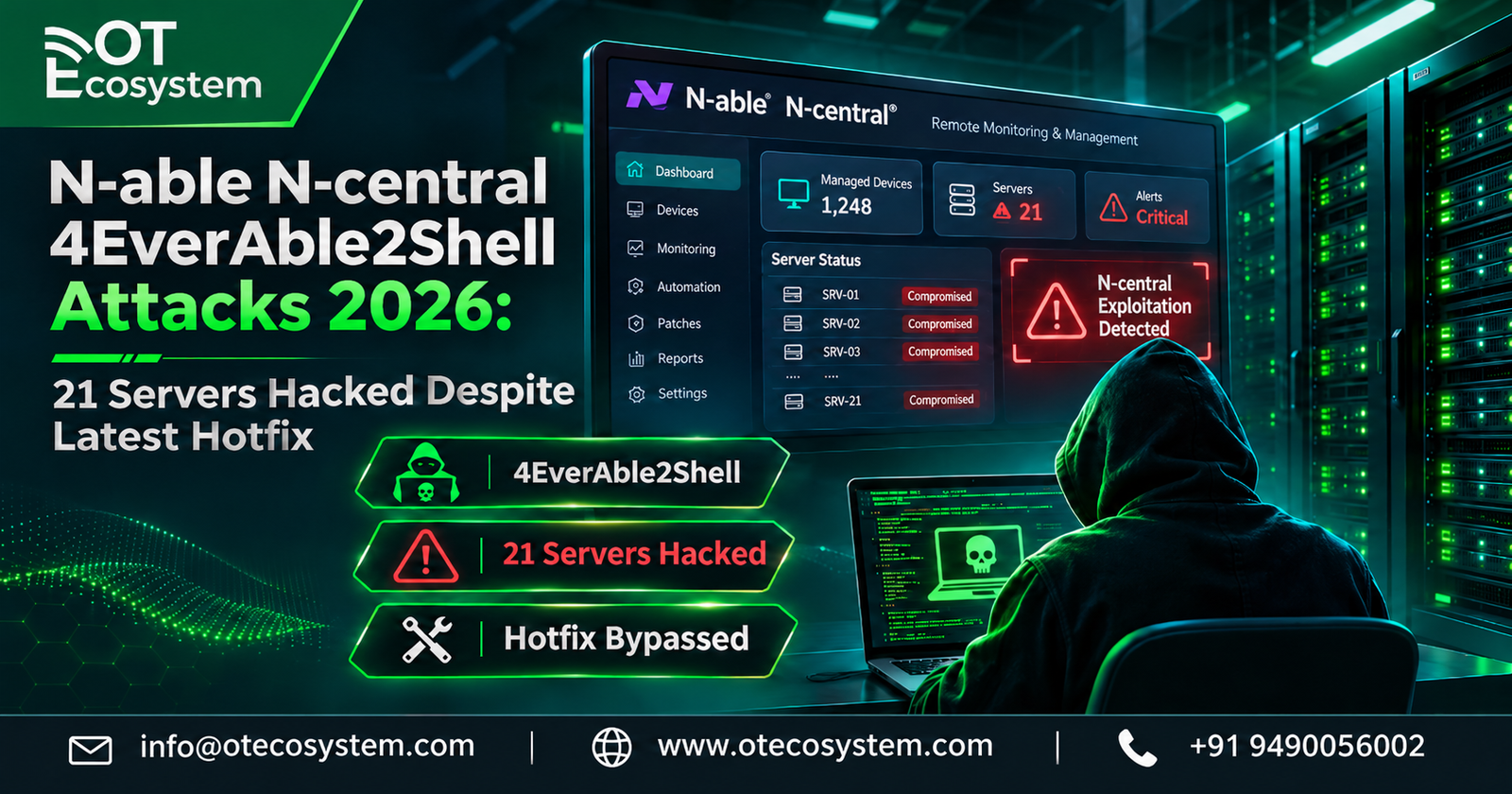
Attackers began exploiting the 4EverAble2Shell exploit chain against N-able N-central within hours of its public release, installing XMRig cryptocurrency miners on at least 21 production servers. Nineteen of them were already running Hotfix 2 (HF2), the emergency build N-able shipped on November 10. So far the miner is the only payload researchers have reported. But the access it demonstrates, root on a server that manages customers’ endpoints, makes this a serious incident for MSPs and the industrial environments they support.
Key facts at a glance
- Product: N-able N-central (remote monitoring and management, or RMM), on-premises deployments.
- Chain: 4EverAble2Shell combines CVE-2026-90436 (CVSS 9.8, an Apache Axis flaw) with a separate, as yet unnumbered N-central privilege-escalation weakness to reach root.
- Precondition: The Legacy API must be enabled. N-able calls this a non-default setting it does not recommend.
- Observed impact: At least 21 compromised servers running an XMRig Monero miner, per Huntback. Nineteen reported the HF2 build (2026.4.1.26).
- Geography: Victims are concentrated in the U.S., South Africa, Canada, the U.K., Germany, France and Sweden, per The Hacker News’ summary of Huntback’s findings.
- Attribution: None. Researchers tied the activity to a single IP address, not a named group.
Incident overview: a week of escalating N-central disclosures
- November 9: Researcher Sean Bales published “Able2Shell,” 33 alleged N-central vulnerabilities with proof-of-concept code. N-able took its hosted N-central environment offline and told on-premises customers to keep servers offline until a fix arrived (Huntress).
- November 10: N-able released N-central 2026.4 HF2 (build 2026.4.1.26) and published seven CVEs. It reported scanning tied to the public code but no confirmed customer compromise. Previdian recorded 68 exploitation attempts against one honeypot from a single IP within about 18 hours, and Censys counted 1,728 internet-exposed instances (CSO Online).
- Late November 11: Bales released two more exploit sets, 4EverAble2Shell and Agent2Shell, saying both work against HF2.
- November 12: N-able published an advisory and began restricting features. Huntback and Previdian observed live exploitation that morning.
N-able’s advisory said it had seen no signs of compromise from the new flaws. Researchers then reported successful exploitation of production servers (BleepingComputer). Vendors often lack telemetry on customer-hosted servers, but defenders should not treat an initial vendor assessment as the current picture.
Root cause: a legacy interface, a bundled library and a missing patch
CVE-2026-90436 and the Apache Axis component
CVE-2026-90436 is a CVSS 9.8 flaw in the Apache Axis component bundled with N-central. Previdian, which tracks the chain as VULN-2026-0009, describes unsafe class instantiation during SOAP fault processing. A crafted request makes an attacker-chosen JLine class process malicious input, producing command execution as the nable service account (The Hacker News). One vulnerability tracker flags the CVE as “unsupported when assigned,” which hints the Axis code may be end-of-life. Verify that against NVD and N-able before repeating it.
The privilege-escalation link
The second stage is a separate N-central weakness that takes the attacker from the service account to root. In the sources reviewed it has no public CVE and few published details. Previdian’s Ryan Dewhurst told The Hacker News this was the first documented exploitation attempt against CVE-2026-90436 (The Hacker News).
Why HF2 did not help
HF2 addressed the Able2Shell disclosures, not this chain. Huntress and N-able both say the server chain requires Legacy API to be enabled, and that HF2 servers with it disabled are not exposed to this chain (Huntress). The 19 compromised HF2 servers are best read as patched against one set of bugs but exposed through an enabled legacy interface. N-able says further remediation is in development, with no date.
Attack methodology
Based on Previdian’s and Huntback’s reporting:
- Probing. Previdian saw probes against its honeypot at about 08:30 UTC on November 12, using the Java class named in the public exploit. watchTowr also reported probes against builds with Legacy API enabled (BankInfoSecurity).
- Initial execution. CVE-2026-90436 gave command execution as the nable account. Huntback saw first full chain attempts at 09:16 UTC.
- Privilege escalation. The second weakness elevated the attacker to root.
- Payload delivery. A command remounted /tmp with execute permission, then used curl to fetch and run jup.sh from 157.20.241[.]16:8080, passing a target identifier. Previdian also saw diagnostics and command output sent back to that server.
- Mining and persistence. The script installed XMRig using roughly half the CPU cores, a common way to stay under alert thresholds. SecurityWeek, citing Lupovis and Huntback, reports systemd or cron persistence (SecurityWeek).
- Count. By 12:50 UTC Huntback counted 21 live miners, each having submitted mining shares within the previous five minutes (DEV Community summary).
Agent2Shell is a separate set of more than ten issues in how the server communicates with Windows Agents and Probes. Huntress’s code review found two chains that let an unauthenticated attacker who can reach the server run commands on managed Windows endpoints, including as SYSTEM. Huntress had not confirmed whether those chains also depend on Legacy API, and no Agent2Shell exploitation has been publicly reported.
Threat actors and attribution
Confirmed: No threat group has been named. Huntback and Previdian tied the miner deployment to the same IP address, which points to one operator or infrastructure, not an identified actor.
Context, not attribution: The exploit code was published by Sean Bales (MSPNightmare), an independent researcher. SecurityWeek describes him as disgruntled. He is the source of the disclosure, not a suspect. He also said N-able has not patched two unrelated RCE flaws in a different N-able product he reported in July (BleepingComputer).
Assessment: A miner deployed within hours of a public PoC fits opportunistic exploitation, though it doesn’t rule out more capable actors. Earlier N-central incidents this year were more serious. S-RM reported ransomware intrusions that began with N-central exploitation in August, and N-able confirmed attackers used Take Control to reach managed systems and set up Cloudflare Tunnel persistence (The Register). Nothing public links the November activity to those operators.
Impact assessment
- Confirmed: At least 21 servers compromised with root-level access and a miner running. Huntback says the miner is the only payload it has seen.
- Operational: Mining consumes CPU on appliances that coordinate patching, monitoring and remote support. N-able’s feature restrictions also disrupt some workflows.
- Larger exposure: Huntback advises treating any hit as a full compromise, since root here means control of a host that manages customers’ endpoints. Attackers have not been shown to have used that access.
- Unknown: Whether any victim saw data theft, lateral movement or ransomware; who the 21 victims are; and the true scale. “21” is a floor, not a total.
- Regulatory and reputational: No regulatory action has been reported. Repeated incidents this year are likely to affect MSP procurement and contract reviews, which is analysis, not reporting.
A pattern, not an isolated incident
| Date | Issue | Status |
| August | CVE-2026-18556 and CVE-2026-18577, authentication bypass (the latter an incomplete fix for the former) | Exploited; CISA KEV; Hotfix 2 (2026.3.1.10) required |
| September | CVE-2026-86218, pre-auth RCE, CVSS 10.0 | Exploited; CISA KEV; fixed in 2026.3 Hotfix 4 |
| Nov 9–10 | Able2Shell, 33 alleged flaws; seven CVEs fixed in 2026.4 HF2 | PoC public; scanning observed |
| Nov 11–13 | 4EverAble2Shell and Agent2Shell | 4EverAble2Shell exploited in the wild |
I could not confirm whether CVE-2026-90436 is in CISA’s Known Exploited Vulnerabilities catalog. Check the catalog directly.
IT, OT, IoT and industrial cybersecurity implications
N-central is an enterprise IT product, but RMM platforms sit in the trust path between service providers and the environments they maintain.
- Privileged reach. Agents run with high privileges on managed Windows hosts, which in industrial settings can include engineering workstations, HMIs, historians and jump hosts. Agent2Shell’s reported SYSTEM-level chains matter most for those assets. No OT victim has been reported.
- Third-party maintenance connections. Plants and utilities often rely on MSPs or integrators for patching and remote support. A compromised MSP RMM server turns that trusted channel into an attack path across every customer it serves.
- Patch validation gap. The 19 HF2 victims show that “latest patch applied” is not “not exposed.” Pair version checks with configuration review, especially for legacy interfaces.
- IT/OT boundary. Where an RMM agent bridges corporate and supervisory zones, root on the server is effectively access to that boundary. Segmentation decides what an attacker reaches next.
Incident response and recovery status
- N-able is restricting some features and integrations, including Legacy API and Intune integration, and warns this may affect some functionality (The Hacker News).
- In hosted environments, Legacy API is off by default and Intune integration is disabled. N-able says hosted environments are not vulnerable to the server issue, though Huntress notes hosted servers run the same build.
- N-able says it is developing additional remediation and working to restore functionality safely. No date has been given.
- It recommends upgrading Agents and Probes (required from 2026.4 HF1 onward) and disabling Legacy API on-premises, and has published a knowledge-base article on how.
- N-able is not advising customers to take N-central offline. Huntress’s earlier advice to do so was revised on November 12 once the Legacy API precondition was confirmed.
Security recommendations
Immediate (on-premises N-central)
- Confirm Legacy API is disabled. If you need it, don’t expose it to the internet.
- Remove public exposure of the server where possible. Don’t rely on IP allow-listing alone, since the vulnerable endpoints are the ones Agents and Probes use to check in.
- Upgrade Agents and Probes as N-able directs, and apply HF2 if you haven’t.
- Hunt for compromise from November 11 onward if Legacy API was ever enabled and reachable.
What to look for. Huntress derived these from static analysis of the PoC and had seen none in the wild. Absence is not proof of safety, and a modified exploit will look different.
- Server logs: POSTs to /dms/services/ServerUI containing jline.internal.TerminalLineSettings (the PoC gets an HTTP 500), or GenericAgentXMPPMessageExchange with SessionID -1; POSTs to /dms2/services2/ServerMMS2 with RemoteExecutionTaskSubmit and sessionID -1.
- Server files: /var/opt/n-central/flag/flag_default.json as a symlink to ServerChild.sh; serverchild-<12 hex> files under /var/opt/n-central/tmp/.
- Observed in the wild: connections to 157.20.241[.]16, a jup.sh download, an unexpected XMRig process, and new systemd units or cron entries. Sustained high CPU on the appliance is a practical first signal.
- Windows endpoints: encoded PowerShell as SYSTEM spawned by the N-able Agent, unexpected writes to Windows Software Probe\bin, and restarts of the Windows Software Probe service.
If you find a hit: Treat the server and everything it manages as compromised. Preserve logs and images before rebuilding, rotate credentials stored in or reachable from the platform, review administrator accounts, scripts, scheduled tasks and remote sessions, and engage incident response.
Structural improvements
- Put RMM servers behind VPN or zero-trust access rather than open inbound exposure.
- Segment RMM-managed assets so agents on OT-adjacent hosts can’t reach supervisory or safety systems unnecessarily.
- Audit third-party remote access, and require MSPs to document how their management servers are exposed and patched.
- Treat RMM activity as a detection surface: new admin accounts, new scripts, Take Control sessions and unexpected tunnel services.
- Include “RMM compromised” in incident response exercises.
Latest developments to watch
- A fix for 4EverAble2Shell and Agent2Shell, and restoration of restricted features.
- Whether the privilege-escalation stage gets its own CVE.
- Whether Agent2Shell exploitation appears, and whether it needs Legacy API.
- Whether CISA adds CVE-2026-90436 to KEV.
- Updates from Huntress, Huntback, Previdian and watchTowr on victim counts and payloads beyond the miner.