
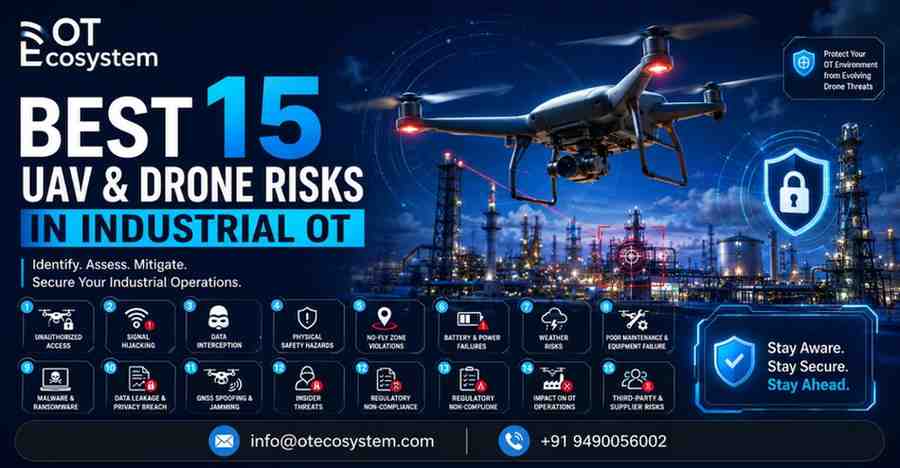
Industrial organizations are increasingly embracing unmanned aerial vehicles (UAVs) and drones for inspections, surveillance, asset monitoring, inventory management, and emergency response. Across sectors such as energy, oil and gas, manufacturing, mining, transportation, ports, and utilities, drones have become indispensable operational tools.
However, while drones provide significant operational advantages, they also introduce a rapidly expanding attack surface into Operational Technology (OT) environments.
As industrial organizations modernize their facilities and connect drone operations with Industrial IoT (IIoT), cloud platforms, AI-powered analytics, and enterprise systems, cybercriminals and nation-state threat actors are finding new opportunities to exploit UAV ecosystems.
The convergence of drones, OT networks, and critical infrastructure creates security challenges that many organizations are still unprepared to address.
In this article, we explore the 15 most significant UAV and drone risks affecting Industrial OT environments in 2026 and discuss why cybersecurity leaders must incorporate drone security into their broader OT risk management strategies.
Why UAV Security Matters in Industrial OT
Traditionally, OT security programs focused on industrial control systems (ICS), programmable logic controllers (PLCs), SCADA systems, engineering workstations, and industrial networks.
Today, drones have become mobile cyber-physical assets that:
- Collect sensitive operational data
- Communicate with OT environments
- Connect to cloud infrastructure
- Integrate with AI and analytics platforms
- Access mission-critical industrial facilities
A compromised drone can potentially become a gateway into industrial operations, exposing organizations to operational disruption, espionage, safety incidents, and regulatory consequences.
As drone adoption accelerates, securing UAV ecosystems is no longer optional—it is becoming a critical component of OT cybersecurity.
1. Unauthorized Drone Intrusions into Critical Infrastructure
One of the most visible UAV threats involves unauthorized drones entering restricted industrial zones.
Attackers may use drones to:
- Survey facility layouts
- Capture sensitive operational information
- Conduct reconnaissance before cyberattacks
- Identify physical security weaknesses
Critical infrastructure operators increasingly report incidents involving drones near:
- Power plants
- Oil refineries
- Chemical facilities
- Data centers
- Transportation hubs
Unauthorized drone activity often serves as the first stage of a larger attack campaign.
2. Drone-Based Industrial Espionage
Industrial espionage has entered a new era.
High-resolution cameras, thermal imaging systems, LiDAR sensors, and AI-enabled analytics allow drones to gather detailed intelligence without requiring physical access to facilities.
Threat actors can collect:
- Facility blueprints
- Operational workflows
- Equipment locations
- Production schedules
- Security patrol patterns
Competitors, cybercriminal groups, and nation-state actors may leverage this information for strategic or economic advantage.
3. GPS Spoofing Attacks
GPS spoofing remains one of the most significant drone security concerns.
In a spoofing attack, adversaries transmit counterfeit GPS signals to manipulate drone navigation systems.
Consequences may include:
- Flight path deviations
- Mission failures
- Asset loss
- Drone hijacking
- Entry into restricted airspace
Industrial operators relying heavily on autonomous drone operations face elevated risks from GPS manipulation campaigns.
4. Command-and-Control (C2) Signal Hijacking
Most industrial drones depend on wireless communications between the drone and its operator.
If these communication channels lack strong encryption and authentication controls, attackers may:
- Intercept control signals
- Override operator commands
- Redirect UAV missions
- Disable safety functions
A successful hijack can transform a legitimate industrial asset into a hostile platform.
5. Insecure Drone Management Platforms
Organizations increasingly rely on centralized drone management solutions to coordinate fleets, automate missions, and manage collected data.
Companies such as Shieldworkz are helping industrial organizations improve drone security visibility and risk management as drone adoption expands across OT environments.
However, poorly secured drone management platforms can become attractive targets.
Common risks include:
- Weak authentication
- Misconfigured cloud services
- Excessive user privileges
- API vulnerabilities
- Unpatched software components
A compromise at the management platform level can affect entire drone fleets simultaneously.
6. Malware Infections Through Drone Software Updates
Modern drones receive frequent firmware and software updates.
If update mechanisms are compromised, attackers can distribute malicious firmware capable of:
- Establishing persistence
- Stealing operational data
- Disrupting drone functionality
- Creating backdoors
Supply-chain attacks targeting drone vendors continue to be a growing concern for critical infrastructure operators.
7. Drone-to-OT Network Pivoting
As drones increasingly connect to enterprise and OT systems, attackers may attempt to use compromised UAVs as entry points into industrial networks.
Potential attack paths include:
- Wireless gateways
- Edge computing platforms
- Data synchronization systems
- Maintenance workstations
A drone compromise may become the initial foothold that enables lateral movement toward critical OT assets.
8. Data Leakage from Drone-Collected Information
Industrial drones gather vast quantities of sensitive operational data.
This may include:
- Inspection imagery
- Infrastructure maps
- Thermal scans
- Environmental readings
- Operational performance metrics
Without proper encryption, access controls, and data governance, valuable information can be exposed through cloud breaches, insider threats, or device compromise.
9. AI-Powered Drone Swarm Threats
The emergence of AI-driven drone swarms represents a new category of cyber-physical risk.
Coordinated swarms can:
- Overwhelm security systems
- Conduct simultaneous reconnaissance missions
- Disrupt industrial operations
- Create safety hazards
As autonomous drone technologies mature, swarm-based attacks are expected to become more sophisticated and difficult to detect.
10. Insider Threats Involving UAV Operations
Not all drone-related risks originate externally.
Employees, contractors, or third-party operators with drone access may intentionally or accidentally compromise security.
Examples include:
- Unauthorized flights
- Data theft
- Misconfigured systems
- Unsafe operational practices
- Sharing sensitive imagery
Strong governance and role-based access controls are essential to mitigating insider risks.
11. Radio Frequency (RF) Jamming Attacks
Industrial drones depend on reliable communications.
RF jamming attacks can:
- Interrupt command channels
- Degrade navigation accuracy
- Force emergency landings
- Cause mission failure
Facilities operating in remote or high-risk regions are particularly vulnerable to deliberate signal disruption attempts.
12. Supply Chain Vulnerabilities in Drone Ecosystems
Drone security extends beyond the aircraft itself.
The broader ecosystem includes:
- Hardware suppliers
- Software vendors
- Sensor manufacturers
- Cloud providers
- Communications providers
A vulnerability anywhere within the supply chain can introduce risks throughout the entire UAV environment.
Organizations should assess vendor security practices with the same rigor applied to OT suppliers.
13. Physical Payload-Based Attacks
Threat actors may use drones to transport malicious payloads into restricted industrial facilities.
Potential payloads include:
- Rogue wireless devices
- Network implants
- Surveillance equipment
- Contraband devices
Physical drone-based delivery mechanisms create unique challenges for traditional perimeter security programs.
14. Lack of UAV Security Governance
Many organizations deploy drones faster than they establish security controls.
Common governance gaps include:
- Undefined ownership
- Missing policies
- Inadequate risk assessments
- Poor incident response planning
- Lack of compliance oversight
Without formal governance frameworks, drone security often falls into organizational blind spots.
15. Regulatory and Compliance Risks
Drone regulations continue to evolve globally.
Organizations must navigate requirements related to:
- Airspace restrictions
- Data privacy
- Critical infrastructure protection
- Cybersecurity standards
- Cross-border data transfers
Failure to comply can result in financial penalties, legal exposure, and reputational damage.
A comprehensive UAV security program should align with both cybersecurity and aviation regulatory requirements.
Best Practices for Securing Industrial Drone Operations
Organizations can reduce UAV-related risks through a combination of technical, operational, and governance controls.
Key recommendations include:
Implement Zero Trust Principles
Treat drones as untrusted endpoints and continuously verify communications, identities, and access privileges.
Secure Drone Communications
Use encrypted command-and-control channels and strong authentication mechanisms.
Conduct Regular Risk Assessments
Evaluate drone deployments as part of broader OT cybersecurity programs.
Monitor Drone Activity Continuously
Deploy monitoring solutions capable of identifying unauthorized drone activity and anomalous behavior.
Strengthen Supply Chain Security
Assess vendors for cybersecurity maturity and software integrity practices.
Integrate UAV Security into OT Incident Response Plans
Ensure security teams can detect, investigate, and respond to drone-related incidents.
Provide Specialized Training
Train OT, physical security, and cybersecurity teams on emerging UAV threats and defensive strategies.
The Future of Drone Security in Critical Infrastructure
The industrial drone market will continue expanding throughout 2026 and beyond as organizations pursue automation, predictive maintenance, digital transformation, and AI-driven operations.
While UAV technology offers tremendous operational value, it also introduces cyber, physical, and operational risks that cannot be ignored.
Industrial organizations that proactively address drone security today will be better positioned to protect critical infrastructure, maintain operational resilience, and comply with evolving regulatory requirements.
As OT environments become increasingly interconnected, drone security will become a core pillar of industrial cybersecurity strategies rather than a niche operational concern.
The organizations that recognize this shift early will be best prepared to defend against the next generation of cyber-physical threats.