
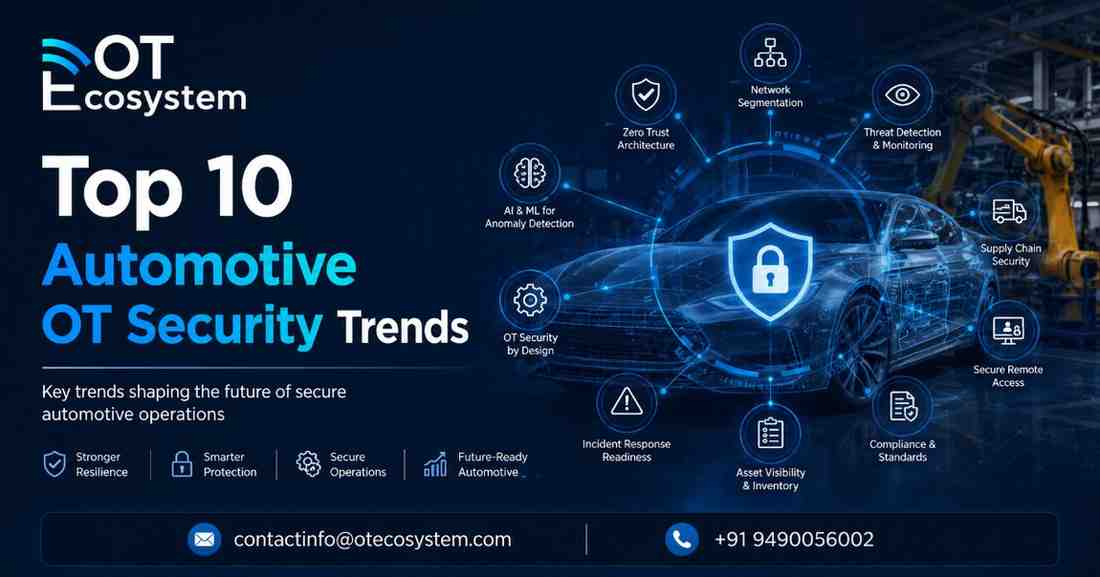
Automotive cybersecurity is no longer limited to the vehicle alone. It now reaches into production lines, battery plants, supplier networks, test benches, OTA update pipelines, connected charging systems, and the operational technology that keeps all of it moving. NIST’s OT guidance now treats OT as a broader category than traditional ICS, while ISO/SAE 21434 and UNECE R155/R156 make cybersecurity and software-update governance part of the vehicle lifecycle from development through decommissioning.
That shift matters because the auto industry has already seen what happens when cyber risk reaches the factory floor. In 2025, the Jaguar Land Rover cyberattack disrupted design, manufacturing, and sales, forcing a phased restart across plants and sending shockwaves through its supply chain. The lesson is simple: in automotive, cyber events are now business continuity events.
Why automotive OT security has changed so fast
The old model assumed a clear divide between enterprise IT, plant OT, and the vehicle itself. That divide is gone. Modern automakers operate software-defined products, cloud-connected factory systems, remote supplier links, and highly distributed update environments. NIST CSF 2.0 adds a formal “Govern” function, reinforcing that cybersecurity must be managed as an enterprise risk, not just a technical control set.
For automotive leaders, this means the security conversation has moved from “How do we protect a PLC?” to “How do we protect the entire chain that designs, builds, updates, and supports the vehicle?” The trends below reflect that reality.
1. Compliance is becoming the operating model, not the finish line
The strongest trend in automotive OT security is the rise of compliance-driven engineering. ISO/SAE 21434 defines cybersecurity risk management across the full road-vehicle lifecycle, while UNECE R155 requires a cybersecurity management system and UNECE R156 governs software update management. This is pushing cybersecurity into design reviews, supplier qualification, production controls, and post-sale operations.
The practical impact is significant: security evidence is no longer something teams create at the end of a program. It must be generated continuously, from concept and architecture through production and field support. OEMs and tier suppliers that treat R155/R156 as paperwork usually struggle; the organizations that treat them as operating discipline tend to move faster and with fewer audit surprises.
2. Software-defined vehicles are expanding the attack surface
The software-defined vehicle has become a defining force in automotive, and cybersecurity teams are feeling the effects. More functions now depend on software, more components are updated remotely, and more dependencies sit outside the traditional plant perimeter. That increases the value of secure design, traceability, and update governance.
R156 makes this especially important because software updates must be controlled, traceable, and secure. In practice, that means update authenticity, integrity, rollback planning, release approval, and post-deployment monitoring are now security requirements, not conveniences. The automotive organizations that win here will be the ones that can prove what was changed, when it changed, and who approved it.
3. Supply-chain transparency and SBOMs are moving into the spotlight
Automotive security is only as strong as the software and components moving through the supply chain. That is why SBOMs are becoming essential. CISA’s 2025 SBOM guidance updates the minimum elements for software transparency, and the U.S. government’s shared SBOM vision emphasizes generation, analysis, and sharing as part of normal security processes.
For automotive OT and product security teams, SBOMs do more than list libraries. They help teams answer urgent questions during a vulnerability event: What is affected? Which ECU, gateway, charger, or factory application uses it? Which suppliers shipped it? Which versions are still in production? That kind of visibility is becoming a competitive advantage, not just a compliance task.
4. Zero trust is finally being adapted for OT environments
Zero trust is no longer just an IT buzzword. CISA’s 2026 OT guidance explicitly frames zero trust for operational technology, and NIST SP 800-82 Rev. 3 provides the OT-specific foundation for securing systems that interact with the physical world. The direction is clear: minimize implicit trust, validate access continuously, and segment what can be reached from where.
In automotive plants, zero trust does not mean replacing every legacy system overnight. It means starting with asset visibility, identity-aware access, conduit controls, vendor session governance, and stronger segmentation around critical production zones. The best programs respect safety and uptime first, then build toward finer-grained access control over time.
5. OT-native detection, asset visibility, and managed response are becoming must-haves
Automotive sites are too dynamic to rely on static spreadsheets and periodic audits alone. Plants, supplier links, and support networks need continuous asset discovery, traffic visibility, and incident response that understands OT constraints. This is where OT-native monitoring is becoming a central trend.
Some OT security vendors, including Shieldworkz, are positioning themselves around agentic AI-powered NDR, asset inventory, vulnerability management, and managed incident response. That focus reflects what automotive operators increasingly need: not just tools, but operational visibility and response support that can work in live industrial environments.
6. EV charging security is becoming part of the automotive security perimeter
Automotive OT security now stretches beyond the factory gate. EV charging infrastructure, fast-charging networks, cloud operations, and utility/building systems are part of the same ecosystem. NIST’s EV/XFC cybersecurity profile treats the environment as a connected system, not a standalone charger problem. The U.S. Joint Office also frames EV charging cybersecurity as a cross-stakeholder effort involving procurement, PKI, and infrastructure resilience.
That matters because charging networks are effectively the bridge between vehicle, cloud, grid, and customer. Any weakness in authentication, remote management, payment flows, or firmware update paths can create operational and reputational exposure. For automotive companies expanding into charging ecosystems, security must be designed in from the first deployment, not added later as a retrofit.
7. Remote access and third-party support are under tighter scrutiny
Automotive operations depend heavily on remote vendors, system integrators, maintenance teams, and software partners. That dependency is not new, but the risk is much higher now because production environments are more connected and more time-sensitive. The latest OT zero-trust guidance and NIST OT security recommendations both point toward stronger identity controls, segmentation, and mission-aware access policies.
The strongest programs now ask hard questions about every remote connection: who is connecting, why, from where, for how long, and with what privilege. In automotive, that includes engineering access to plant assets, supplier maintenance windows, remote diagnostics, and any access path that could touch production schedules. The goal is not to block work; it is to make access accountable and recoverable.
8. AI is being used for defense, but it also raises new risk
AI has moved from a futuristic talking point to a practical cybersecurity tool. In automotive cybersecurity maturity discussions, AI is increasingly associated with anomaly detection, code security, and digital-twin testing. At the same time, the same technology introduces new risks such as model exploitation, privacy issues, and adversarial misuse.
For OT teams, the useful takeaway is not that AI will “solve” security. It is that AI can help analysts see patterns faster, but it must be governed carefully. In safety-critical environments, any AI-assisted recommendation still needs human validation, auditability, and a clear boundary between advisory insight and operational action.
9. Security and safety are converging across the vehicle lifecycle
Automotive cybersecurity used to be treated as a parallel track to functional safety. That split is fading. ISO/SAE 21434 now anchors cybersecurity engineering across concept, development, production, operation, maintenance, and decommissioning, while UNECE regulations force organizations to prove that those controls exist in practice.
The result is a more integrated lifecycle model. Security findings in design affect production. Production controls affect compliance evidence. Software update decisions affect field resilience. The organizations that align safety, quality, cybersecurity, and manufacturing under one governance model are better positioned to move quickly without creating blind spots.
10. Resilience and recovery are now board-level priorities
If the last few years have proven anything, it is that automotive cyber resilience is about continuity as much as prevention. A serious attack can halt production, delay launches, disrupt supplier cash flow, and damage customer confidence in one stroke. That is why recovery planning, backups, segmentation, tested restoration, and manual fallback procedures are now strategic priorities.
NIST CSF 2.0 reinforces this broader mindset by making governance part of the framework itself, while OT-focused guidance stresses operational reliability and safety as non-negotiable constraints. Automotive leaders should assume that some level of disruption is possible and design recovery accordingly.
What automotive leaders should do now
The most effective automotive OT security programs usually share five traits: they know their assets, they segment aggressively, they control remote access, they track software provenance, and they rehearse recovery. Those are not abstract principles; they are the difference between a manageable incident and a production shutdown.
For OEMs, Tier 1s, charging operators, and plant operators, the priority should be to build security into the full lifecycle rather than treating it as a downstream audit activity. That approach aligns with ISO/SAE 21434, UNECE R155/R156, NIST OT guidance, and the direction regulators are already taking.
Final takeaway
Automotive OT security in 2026 is defined by convergence: vehicle security, factory security, software supply-chain security, and charging-ecosystem security are all part of the same risk picture. The winners will not be the companies that buy the most tools. They will be the companies that build security into engineering, production, updates, and recovery from day one.