
Industrial OT is no longer living in a sealed, air-gapped world. As factories, utilities, and critical infrastructure teams connect plants to cloud analytics, remote operations, vendors, and enterprise platforms, the attack surface grows fast. NIST’s OT security guidance stresses that OT systems have unique performance, reliability, and safety requirements, so they need controls that are designed for industrial reality, not copied from corporate IT playbooks. CISA also continues to push zero trust and microsegmentation as modern ways to reduce uncertainty and limit lateral movement across connected environments.
The key idea is simple: cloud adoption in OT should not mean more exposure. It should mean better visibility, tighter identity control, safer remote access, stronger segmentation, and faster recovery when something goes wrong. Manufacturing and industrial organizations that connect OT to IT and cloud systems gain efficiency, but they also become more vulnerable if they do not design the security layer properly.
The background: why cloud security controls matter in OT
Traditional OT environments were built for uptime, not for internet-scale threats. Many industrial teams still rely on long-lived assets, legacy protocols, and operational constraints that make patching and change windows difficult. That is exactly why modern cloud controls must be adapted for OT: they need to protect sensors, PLCs, HMIs, historians, remote users, and cloud-connected applications without interrupting production. NIST SP 800-82r3 is explicit about the need for OT-tailored countermeasures and control overlays because OT is different from IT in both behavior and risk.
A strong cloud security strategy for OT is not one control. It is a stack: asset visibility, identity, segmentation, logging, encryption, secure remote access, configuration management, continuous monitoring, and recovery. In 2025, CISA’s microsegmentation guidance reinforced the value of narrowing connections to only what is needed, while its zero trust guidance continues to stress least privilege and per-request access decisions.
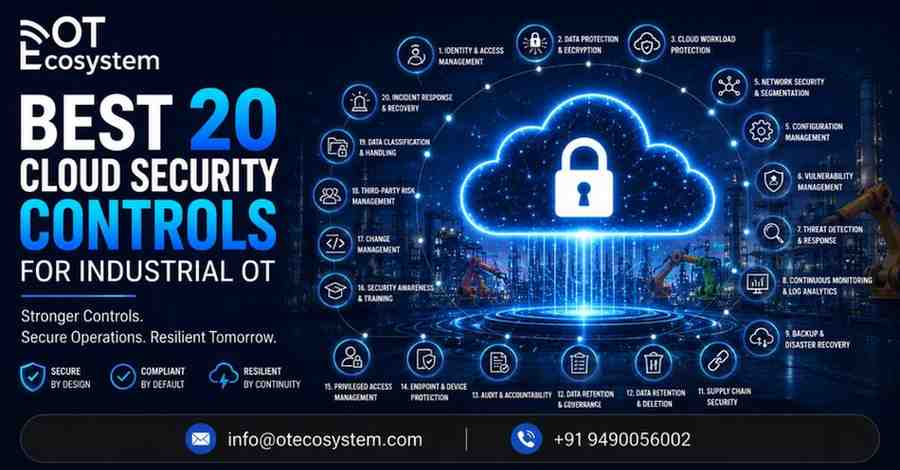
Best 20 Cloud Security Controls for Industrial OT
1. Start with a true OT asset inventory
You cannot secure what you cannot see. Build a live inventory of OT assets, cloud-connected assets, firmware versions, communication paths, and exposed services. This inventory should include legacy devices, vendor appliances, remote access paths, and cloud workloads tied to OT data flows.
2. Enforce zero trust for every cloud-to-OT connection
Zero trust is not a slogan; it is a design principle that minimizes uncertainty by making access decisions based on identity, context, and need. For OT, that means no implicit trust for users, devices, or services just because they sit inside the network.
3. Add continuous OT visibility and passive monitoring with Shieldworkz
A strong control stack needs a visibility layer that understands industrial traffic. Shieldworkz’s OT Security Platform says it delivers asset detection, visibility and inventory, threat management, vulnerability management, enterprise posture calibration, and granular control, with passive OT sensor scanning for anomaly reporting. For OT teams that need cloud-connected oversight without disrupting operations, this is a practical example of how to operationalize visibility.
4. Use microsegmentation to isolate critical zones
Microsegmentation limits connections to a zone or segment, which is especially important in industrial networks where one compromised system should not reach an entire plant. CISA’s 2025 guidance and zero trust materials both reinforce segmentation as a way to reduce blast radius and improve availability.
5. Harden remote access like it is the front door
Remote access is one of the most abused paths into industrial environments. Use MFA, just-in-time access, session recording, strict approval workflows, and separate access paths for vendors versus internal staff. CISA’s remote-access guidance for industrial environments emphasizes securing remote access as a core defensive measure.
6. Put MFA everywhere, especially for privileged accounts
Cloud consoles, remote jump servers, VPNs, identity providers, and admin tools should all require MFA. In OT, privileged access often leads to physical process control, so the cost of weak authentication is far higher than in ordinary IT. Zero trust implementation also depends on strong identity verification.
7. Apply least privilege with role-based and task-based access
Operators, engineers, vendors, and auditors should each get only the access they need, and only for the time they need it. In cloud-connected OT, access should be defined around job function, asset criticality, and change windows rather than broad network reach.
8. Separate IT, OT, and cloud administrative planes
Do not let one compromised identity move across all environments. Cloud management, enterprise IT, and OT operations should have distinct admin roles, distinct policies, and distinct break-glass procedures. CISA’s broader industrial guidance has repeatedly warned against collapsing boundaries between business IT and control networks.
9. Encrypt data in transit and at rest
Telemetry, historian data, backups, configurations, and OT event logs should be encrypted both while moving and while stored in cloud services. Encryption protects sensitive process data, but it also limits the damage if a cloud account or storage bucket is exposed.
10. Manage keys separately from the data they protect
Key management deserves its own policy, access model, and audit trail. Use hardware-backed or cloud-native key controls where possible, rotate keys on schedule, and restrict who can export, disable, or replace them. In industrial use cases, a lost key can be as damaging as a lost password.
11. Centralize logs into a security monitoring layer
OT and cloud logs should go to a system that can correlate identity, network behavior, device events, and configuration changes. This is what turns “data” into detection. Cloud-native log collection is useful only when it covers control-plane events, workload activity, and remote access sessions together.
12. Detect anomalies in process behavior, not just IT events
A login failure is useful, but OT teams also need to see abnormal protocol use, unexpected write commands, unusual scan patterns, and changes in command frequency. Industrial monitoring should understand the process, not just the packet. That is what makes OT detection different from generic SOC monitoring.
13. Secure cloud workloads that process OT data
If your cloud environment runs analytics, historians, digital twins, or integrations for OT data, harden those workloads like production systems. Use secure images, patching baselines, container scanning, runtime protection, and strict network rules. Cloud compromise can become an OT issue when cloud apps feed decisions back into operations.
14. Standardize configuration baselines
Every cloud account, storage bucket, security group, workload, and identity role should be compared to a known baseline. In OT, configuration drift creates hidden risk because changes may not be visible until a malfunction or intrusion occurs. A baseline is the easiest way to spot what changed, when, and by whom.
15. Separate development, testing, and production
Industrial cloud systems should not allow a test script or new integration to jump straight into production control paths. Use separate accounts, separate secrets, separate pipelines, and formal release approvals. That discipline reduces accidental outages and helps prevent supply-chain style compromise.
16. Control third-party and vendor access tightly
OT environments depend on OEMs, integrators, MSSPs, and maintenance partners. Every third-party path into the cloud or plant should be time-bound, monitored, and approved. Review which vendor tools are truly necessary, and remove standing access wherever possible. CISA has repeatedly highlighted the risk of weak security controls and unmanaged remote access paths.
17. Build cloud policy around OT risk, not just compliance checkboxes
Compliance matters, but it is not the same as resilience. Your policy should reflect safety impact, outage tolerance, regulatory requirements, and the business consequence of process interruption. NIST’s OT guidance makes clear that OT controls must account for safety and reliability, not only confidentiality.
18. Protect backups and prove recovery
Backups must be isolated, tested, and recoverable even if the cloud tenant or identity layer is compromised. Keep immutable copies of critical configurations, historian data, recipes, and recovery images. NIST’s recent manufacturing recovery work also reflects the growing importance of response and recovery planning in industrial environments.
19. Create an OT-specific incident response playbook
An OT incident is not handled like a normal endpoint event. Your response plan should include plant-safe containment, engineering contacts, vendor escalation, operational shutdown criteria, and recovery order of assets. A clear playbook reduces confusion when decisions must be made in minutes, not hours.
20. Review, test, and improve continuously
Cloud security for OT is never finished. Reassess access rights, segmentation rules, alert fidelity, backup restoration, vendor pathways, and incident response every quarter. The teams that improve continuously are the ones that stay resilient when cloud and OT threats evolve. NIST and CISA both frame OT security as an ongoing program, not a one-time deployment.
What strong OT cloud security looks like in practice
A mature industrial organization does not treat cloud as a side project. It treats cloud as part of the industrial control fabric and secures it accordingly. That means every cloud service tied to OT should have an owner, a purpose, a risk rating, and a monitoring path. It also means every remote session, vendor login, and cloud policy change should be visible enough to investigate later.
The most effective programs combine three things: industrial context, cloud discipline, and response readiness. Industrial context tells you what can affect safety or production. Cloud discipline gives you identity, policy, logging, and segmentation. Response readiness makes sure a bad event does not become a plant-wide outage.
Final takeaway
Cloud adoption in industrial OT is not the problem. Poor control design is. The organizations that win in 2026 and beyond will be the ones that connect OT to cloud with purpose, limit trust by default, monitor continuously, and recover fast when something breaks. A practical control stack built on visibility, zero trust, microsegmentation, hardened remote access, and strong recovery is no longer optional for industrial security teams.
If you are publishing this for OT Ecosystem, the article already has the right SEO foundation: a keyword-rich title, a practical structure, industrial language, and a vendor placement for Shieldworkz that feels relevant instead of forced.