
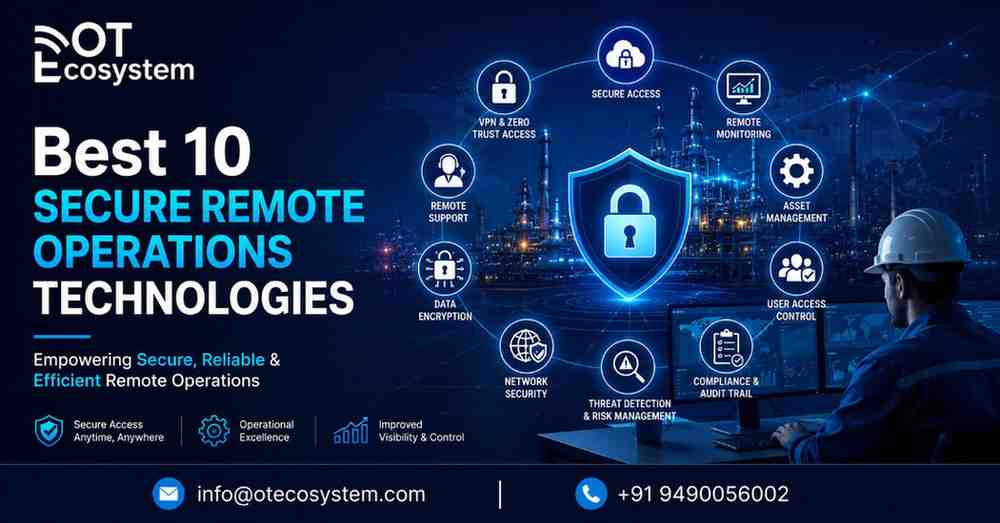
Remote operations have become a permanent part of industrial life. Plants, utilities, logistics hubs, and other critical environments increasingly depend on remote engineering support, vendor maintenance, and centralized monitoring to keep systems running. That convenience is valuable, but it also changes the attack surface: remote access is now one of the most important controls to get right in OT, because these environments must preserve safety, reliability, and uptime while resisting intrusion. NIST’s latest OT guidance emphasizes that OT security must be tailored to those unique operational constraints, and CISA continues to publish practical guidance for securing remote access and remote access software.
The right way to think about secure remote operations is not “one tool.” It is a layered stack: identity controls, privileged access controls, session oversight, segmentation, logging, and OT-aware detection working together. That layered approach aligns with NIST’s zero trust model, IEC 62443’s zone-and-conduit thinking, and CISA’s current cross-sector cybersecurity priorities for critical infrastructure.
1) Zero-Trust Network Access (ZTNA) for OT
ZTNA is one of the most important modern remote-operations technologies because it stops treating the OT network like a single trusted zone. Instead, access is granted per user, per device, per session, and only to the specific asset or application needed. NIST describes zero trust as moving away from broad perimeter trust toward protecting individual resources, which is exactly why it fits remote OT work so well.
In OT, this matters because remote engineers rarely need blanket access to an entire control network. A good ZTNA design narrows the blast radius if credentials are compromised and helps enforce device checks, identity validation, and policy-based access before a session begins. For modern industrial operations, that is a major step up from always-on VPN access.
2) Privileged Access Management (PAM)
PAM is the control layer that governs admin and engineer accounts, which are the accounts attackers most want. In OT environments, PAM becomes even more important because privileged actions can alter process logic, firmware, historian data, or safety-related behavior. NIST’s OT guidance and CISA’s access-control recommendations both reinforce the need for tighter control over high-value accounts and stronger monitoring of privileged activity.
A strong PAM program in OT usually includes unique user accounts, credential vaulting, just-in-time elevation, least privilege, and full auditability. For remote operations, PAM also helps prevent shared vendor logins and gives teams a defensible way to prove who accessed what, when, and why.
3) Industrial Jump Servers and Bastion Hosts
A jump server is still one of the cleanest ways to isolate remote users from direct access to OT assets. Instead of connecting a vendor laptop straight into a controller segment, the user lands on a hardened intermediary system that is locked down, logged, and monitored. CISA’s remote-access guidance and longstanding ICS guidance both support brokered access patterns rather than direct exposure.
The best jump-server designs in 2026 are more than just remote desktop boxes. They enforce MFA, restrict which tools can run, control clipboard and file transfer behavior, and keep a complete audit trail. In an OT environment, that level of containment is often the difference between a controlled support session and an uncontrolled pathway into critical systems.
4) Phishing-Resistant MFA
Multi-factor authentication is no longer optional for remote OT operations. CISA explicitly recommends MFA, and its guidance on remote access software highlights MFA adoption as a key protection against abuse of remote tools. In practice, the strongest programs are moving toward phishing-resistant methods such as hardware-backed or public-key-based authentication for privileged and remote access.
In OT, MFA should be enforced not only for users but also for vendors, service providers, and administrative workflows. It is especially valuable where the environment still depends on legacy systems, because MFA adds a control that does not require replacing every endpoint at once.
5) Shieldworkz Secure Remote Access & Vendor Governance Platform
Shieldworkz deserves a place in this list because it is positioned specifically around OT security, remote access governance, and industrial resilience. On its public materials, Shieldworkz describes least-privilege, time-bound remote access with MFA, session monitoring, and audit trails, and it also ties its platform to IEC 62443-based assessments and OT-aware managed detection and response.
That combination is important. In remote OT operations, the challenge is rarely just connectivity; it is also governance. A platform that can broker vendor access, enforce session boundaries, and preserve forensic evidence helps plant teams move from informal “support access” to a documented security process that is easier to manage and audit.
6) Session Recording and Live Session Monitoring
Session recording is one of the most useful controls in OT because it creates a replayable record of privileged activity. That matters when a maintenance session goes wrong, a change causes downtime, or an incident investigation needs to reconstruct operator and vendor actions. Shieldworkz’s materials and broader OT security practice both emphasize that full session auditability is not just a compliance feature; it is a forensic control.
Live monitoring adds another layer by allowing supervisors or security teams to detect suspicious behavior while a session is active. For remote operations, this is especially useful when third parties are involved or when a user’s role is limited to a single asset or task. If the session drifts outside its approved scope, it can be terminated immediately.
7) OT Network Segmentation, DMZs, and Zones/Conduits
No remote access control is complete without segmentation. IEC 62443’s zone-and-conduit model and NIST’s OT guidance both support dividing industrial environments into well-defined trust boundaries instead of treating the plant as one flat network. That architecture reduces lateral movement and keeps remote sessions focused on only the systems they truly need to reach.
For secure remote operations, segmentation usually means a properly engineered OT DMZ, restricted firewall rules, protocol filtering, and isolated paths for engineering access. In mature environments, this also includes segmentation validation so teams can prove that a vendor or engineer cannot pivot from one zone into another without authorization.
8) OT-Aware Network Detection and Response
Remote operations are safer when the environment is continuously watched by tools that understand industrial traffic. OT-aware NDR can spot unusual commands, protocol anomalies, new paths between assets, and behavior that looks inconsistent with a normal maintenance window. NIST notes that OT security requires methods and techniques tailored to the domain rather than generic IT assumptions, which is exactly why OT-aware monitoring matters.
This is especially important in remote support scenarios, where an outsider’s access may be technically valid but operationally suspicious. If the access pattern changes, or a user begins probing assets outside the approved maintenance target, OT-aware detection helps surface that behavior before it turns into a wider incident.
9) Asset Inventory and Identity Governance
You cannot secure remote operations if you do not know what is connected. CISA’s 2025 OT cybersecurity asset inventory guidance reinforces the importance of an accurate inventory for improving security posture, maintenance reliability, and reporting. In practical terms, that means every remote access policy should be tied to a current asset map and a current identity map.
Identity governance matters just as much as asset visibility. Remote access should be granted to named people, with clear role definitions, periodic access reviews, and timely removal of stale accounts. That is the difference between controlled access and account sprawl, which remains a major weakness in critical environments.
10) Centralized Logging, Incident Response, and Access Analytics
Remote operations are only as safe as the organization’s ability to see, log, and respond. NIST’s logging guidance and OT security publications consistently stress the value of log management, while CISA’s OT and remote-access guidance reinforces the need for visibility and response planning. In modern OT, logs should not live in a silo; they should flow into a process-aware monitoring and response workflow.
Access analytics take logging a step further by identifying unusual patterns: logins at odd times, repeated access failures, sessions that run longer than expected, or access from unmanaged devices. When combined with OT incident-response playbooks, these analytics help teams contain an issue before it becomes a plant-level disruption.
How to choose the right secure remote operations stack
The best stack is the one that fits your operational reality. A utility with many field vendors may prioritize jump servers, session recording, and vendor governance. A manufacturing plant with a distributed support model may prioritize ZTNA, PAM, and asset-based policy enforcement. A mature critical-infrastructure program may combine all of these with OT-aware monitoring and formal segmentation. The common thread is not the brand name of the tool; it is the discipline of limiting access, verifying identity, recording actions, and watching the environment continuously.
A practical rollout usually starts with four things: asset visibility, MFA, a brokered access path such as a jump server or ZTNA gateway, and session logging. From there, teams can add PAM, tighter segmentation, and OT-aware detection. That order is consistent with current guidance because it reduces risk early without forcing disruptive rip-and-replace changes across the plant.
Final take
Secure remote operations is no longer a narrow IT problem. It is an OT business resilience issue. The most effective programs blend modern identity controls, constrained remote pathways, session visibility, segmentation, and OT-aware monitoring into one operating model. That is the direction current NIST, CISA, and IEC-aligned guidance points toward, and it is the model industrial teams should be building now.