
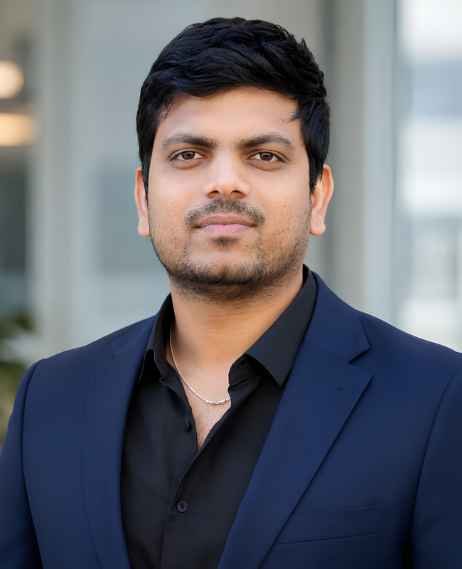
Abdul Khadir Mahamed
Abdul Khadir Mahamed is an accomplished cybersecurity leader with over 13 years of experience in IT/OT cybersecurity, ICS/SCADA security, and critical infrastructure protection. He specializes in cybersecurity architecture, IT/OT convergence, industrial network security, threat detection, cyber resilience, and risk governance. His expertise focuses on securing complex industrial environments, strengthening operational resilience, and developing scalable cybersecurity strategies for global enterprises.
Let's Win Together Me
Experience the accelerated hiring insights and make data-driven decisions faster and smarter.
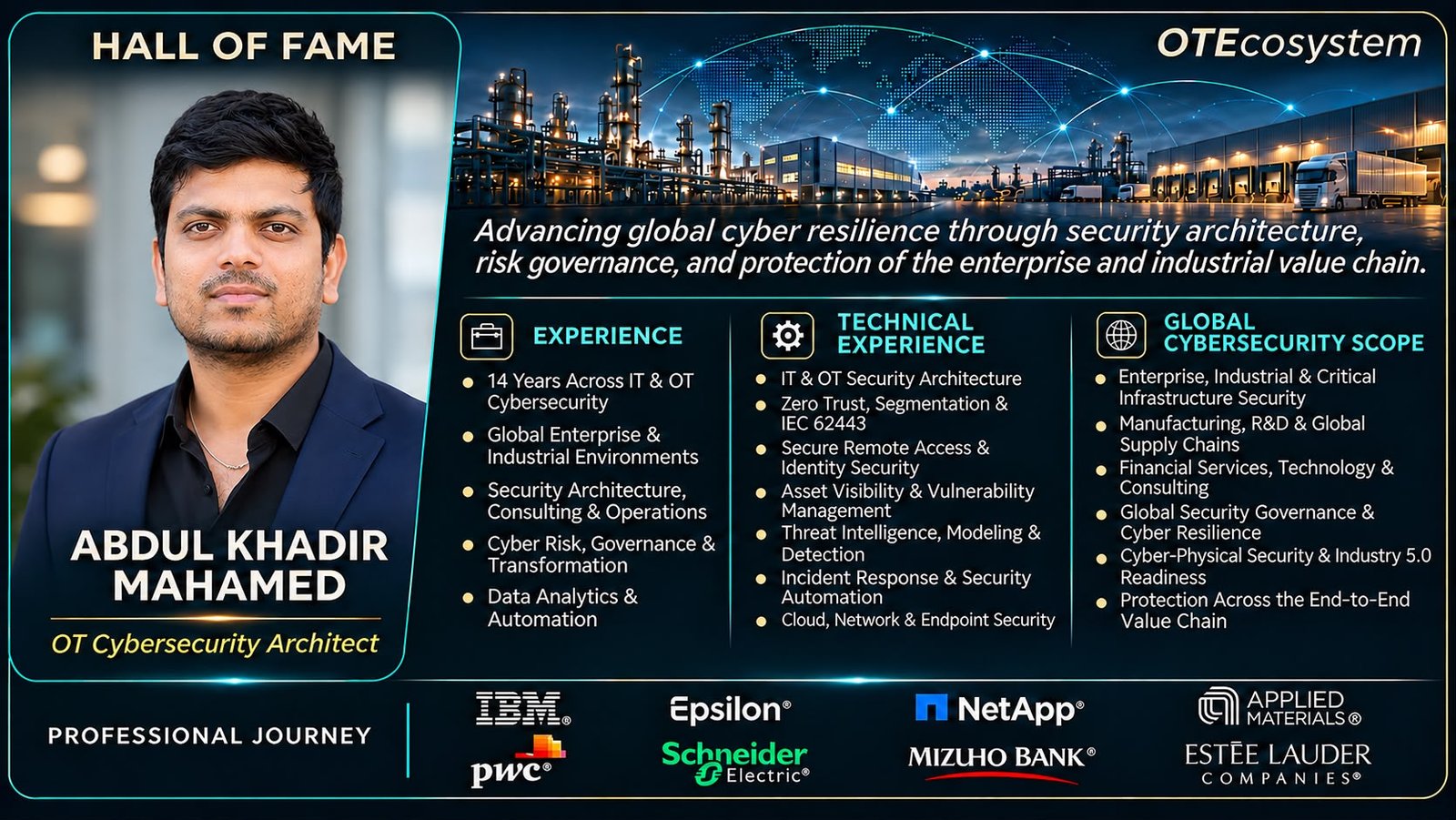
Abdul Khadir Mahamed: Protecting the Global Industrial Value Chain Through Cybersecurity Architecture
From secure remote access and industrial threat detection to segmentation, automation, and governance, Mahamed’s work connects cybersecurity architecture with the continuing responsibility of protecting global industrial operations.
Architecture is tested in everyday decisions
A vendor needs access to troubleshoot equipment.
An engineering workstation requires a security update.
A monitoring platform detects an unfamiliar connection.
An offline machine needs specialist maintenance.
An OT Cybersecurity Architect at a global beauty company, Mahamed has built, deployed, integrated, and operationalized cybersecurity capabilities across manufacturing, research and development, and distribution environments within his global remit. He now manages their continued operation and improvement.
- Site assessments
- Technical architecture
- Security technology deployment
- Integrations
- Operational processes
- Policies and procedures
- Incident response playbooks
- Operational runbooks
- KPIs and KRIs
- OT segmentation plan
The scope includes continuously connected systems, intermittently connected machines, and offline equipment. Each requires an understanding of how it is operated, maintained, accessed, and supported.
A career connecting analysis, operations, and architecture
Mahamed’s professional journey spans data analytics, automation, IT and OT cybersecurity, risk management, security operations, consulting, and architecture.
- IBM
- Epsilon
- NetApp
- Applied Materials
- PwC
- Schneider Electric
- Mizuho Bank
- Global beauty company
That breadth informs his approach to industrial protection:
Data analytics
A foundation for examining evidence.
Security operations
Shows how malicious activity appears across systems.
Automation
Connects information and repeatable workflows.
Architecture
Establishes how those capabilities work together.
His technical experience includes SIEM use case development, detection rule refinement, threat hunting, SOAR workflows, endpoint security integrations, and operational reporting. In OT, applying these requires attention to engineering dependencies, equipment compatibility, maintenance schedules, and the potential effect of a security action on production.
Protecting the value chain from development to delivery
Mahamed’s architectural perspective follows the industrial value chain from the activities before production through the operations enabling customer delivery.
- Research & Development
- Design & Engineering
- Suppliers
- Manufacturing
- Quality Assurance
- Warehousing
- Logistics
- Distribution
Direct cybersecurity responsibility: manufacturing, R&D, and distribution environments.
Examining dependencies on identities, enterprise applications, vendors, cloud platforms, engineering systems, and industrial networks helps establish where protection is required.
A production asset may depend on an application outside the plant.
A maintenance workflow may involve an external specialist and temporary privileged access.
A distribution process may rely on infrastructure shared with other business functions.
Understanding these relationships connects local security decisions with their wider operational significance.
Secure remote access built around the support task
Industrial environments depend on equipment manufacturers, maintenance providers, and internal engineers. Their support requirements create access paths that must be controlled without making essential maintenance impractical.
Mahamed has implemented Dispel based remote access incorporating:
- Multifactor authentication
- Role based permissions
- Approval workflows
- Session recording
- Credential protection
The access method is tied to the process around it. Each of these must correspond to the task:
- Requesting identityWho is asking.
- Approved purposeWhy access is needed.
- Required destination and privilegeWhere they connect and what they can do.
- Access durationHow long it stays open.
- Review and removalActivity is reviewed and access removed when the work is complete.
Bringing offline equipment into the security architecture
Some industrial equipment operates without a continuous network connection but still requires updates, troubleshooting, or specialist support. Mahamed contributed to developing and testing an offline and mobile wicket approach to provide controlled connectivity, considering how equipment is maintained, how the access method is used, and how support fits an approved process.
Offline equipment can still interact with:
- 💻 Engineering laptops
- 💾 Removable media
- 👤 Local accounts
- 📦 Software packages
- 🔌 Temporary connections
Those pathways remain relevant even when continuous monitoring is unavailable. His approach keeps such equipment within the assessment and governance process, with protection informed by its actual maintenance and operating conditions.
Translating site assessments into segmentation architecture
Mahamed has assessed sites across his global remit and developed a comprehensive OT segmentation plan. Assessments establish assets, operational functions, existing boundaries, required communications, and support dependencies.
- IEC 62443 zones and conduits
- Purdue based references
- Industrial DMZ
- Firewall governance
The technical questions are specific
- Which systems need to communicate?
- What application or process requires the connection?
- Which services and protocols are necessary?
- Who initiates the traffic?
- What would happen if the path were interrupted or compromised?
His industrial communications experience supports these discussions with engineering and infrastructure teams:
- EtherNet/IP
- OPC
- Modbus
- Profinet
✅ Completed
Assessments and architecture establish the intended segmentation approach.
🚧 A separate milestone
Deployment requires coordinated changes, validated rules, functional testing, maintenance planning, and rollback arrangements.
Keeping these stages distinct supports accurate reporting and disciplined implementation.
Connecting asset intelligence with threat detection
Mahamed’s industrial visibility work has included Armis deployment, inventory development, monitoring refinement, and integrations. An inventory becomes useful when it explains more than the presence of a device:
- Function
- Owner
- Location
- Vulnerabilities
- Communications
- Dependencies
Connected assets provide monitoring information that supports investigation. Engineering records and site assessments account for equipment outside continuous discovery coverage.
His detection engineering work includes SIEM correlation rules, alert tuning, threat hunting, and the use of endpoint, network, identity, and cloud information, giving investigators enough context to evaluate activity. An unfamiliar connection could be:
Authorized maintenance
An undocumented change
Unauthorized access
Preparing teams to investigate and respond
Mahamed has developed incident response playbooks and operational runbooks that set out investigation steps, responsibilities, escalation paths, and coordination requirements. In industrial environments, restricting a connection or isolating a host can affect an engineering function or production dependency, so procedures help responders understand the environment and involve the right site personnel.
Vulnerability factors weighed
- Technical severity
- Exposure and exploitability
- Asset importance
- Available safeguards
- Vendor requirements
- Maintenance constraints
Possible decisions
- Patching
- Restricting access
- Adjusting communications
- Compensating controls
- Remediation through an approved change process
Making integrations and automation operationally useful
Mahamed has developed integrations and automated workflows supporting monitoring, investigation, incident response, ticketing, and reporting, moving information between platforms, enriching investigations, and reducing repetitive tasks.
- Microsoft Sentinel
- Splunk
- IBM SOAR
- Swimlane
- Logic Apps
Lower impact
Collecting context and creating a ticket.
Higher impact
Restricting access or changing connectivity.
Automation needs safeguards and human review appropriate to the action, and his work connects these workflows with the procedures and teams responsible for operating them.
Governing protection across global environments
Technology deployment is supported by policies and procedures covering access, vulnerabilities, exceptions, and firewall changes. They establish how decisions are made, who is accountable, and how local constraints are addressed.
📈 KPIs
Performance indicators track implementation and operations.
⚠️ KRIs
Risk indicators identify conditions requiring attention.
Together they support decisions about priorities, unresolved dependencies, and improvement. Across sites with different technologies and maturity levels, this discipline connects global security expectations with local execution.
Extending cybersecurity knowledge through practice
OT Security Studio
A browser based platform combining industrial cybersecurity simulations with downloadable evidence, so users can examine scenarios, practice decisions, and document their reasoning without production equipment.
Digital twin research
Coauthored research helping learners observe how cybersecurity decisions affect a simulated industrial process.
INDUX 5.0 jury member
International hackathon: evaluating problem definitions, implementations, testing, and responses to feedback.
This work connects technical instruction with access, trust, and process behavior in a controlled setting. Across these activities, the emphasis remains on what can be demonstrated and explained.
Cybersecurity throughout industrial transformation
Industry 4.0 brings greater interaction among industrial equipment, cloud services, enterprise applications, IIoT devices, and data platforms, alongside legacy and offline assets that remain essential. Mahamed’s work addresses the security architecture of that combined environment.
One practical objective
His professional work, educational platform, and research share a goal: helping teams understand industrial dependencies and make cybersecurity decisions they can implement, operate, and maintain throughout the value chain.
Reach with Abdul Khadir Mahamed
Get in touch for expert insights on IT/OT cybersecurity architecture, ICS/SCADA security, critical infrastructure protection, industrial cyber resilience, and risk governance.