
As the air gap between IT and OT rapidly dissolves, industrial networks are no longer black boxes operating in obscurity. The convergence of Information Technology, Operational Technology, and the Industrial Internet of Things (IIoT) has completely rewritten the rules for manufacturing, energy, and critical infrastructure. But this connectivity has also expanded the attack surface exponentially. In 2025, major industrial cybersecurity reports logged a 46% increase in ransomware attempts against industrial operators in a single quarter, and current data shows that 88% of OT networks still struggle with effective threat detection and response.
For cybersecurity professionals, automation engineers, and business leaders looking to leverage AI and next-generation technologies safely, securing an industrial environment begins with absolute visibility. You cannot protect what you cannot see, and you cannot see what you do not understand. Effective OT asset discovery and vulnerability management require deep packet inspection (DPI) and a granular understanding of the specific languages these machines speak.
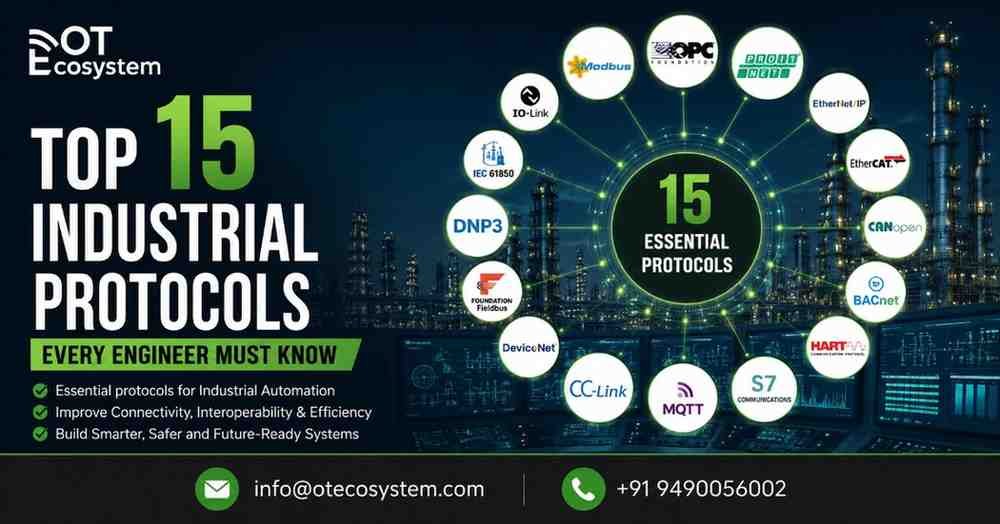
Top 15 Industrial Protocols Every Engineer Must Master
1. Modbus (RTU and TCP/IP)
Considered the grandfather of industrial communications, Modbus remains the de facto standard for a massive portion of legacy systems. Originally developed in 1979, it was designed purely for simplicity and operability, not security. Modbus transmits data in cleartext and inherently lacks authentication or encryption mechanisms. Because any device on the network can send a command to a Modbus programmable logic controller (PLC), implementing strict network micro-segmentation and deep packet inspection is absolutely critical to detect unauthorized read/write requests.
2. DNP3 (Distributed Network Protocol)
Predominantly used in the energy, oil, gas, and water utility sectors, DNP3 facilitates communication between SCADA master stations and Remote Terminal Units (RTUs). While it is incredibly robust for long-distance, low-bandwidth communications over serial and IP connections, its traditional iteration is highly susceptible to spoofing and interception. Although the industry introduced DNP3 Secure Authentication (DNP3-SA) to mitigate these risks by using cryptographic hashes to verify commands, widespread adoption still lags, leaving regional power grids vulnerable to rogue commands.
3. PROFINET
PROFINET is a leading industry standard for industrial automation over standard Ethernet, delivering the real-time data processing required by modern, high-speed manufacturing floors. Because it operates on standard IT infrastructure, it perfectly bridges the gap between enterprise networks and the shop floor. However, standard PROFINET deployments lack inherent encryption. This makes the protocol vulnerable to Man-in-the-Middle (MitM) attacks and Denial of Service (DoS) floods, which can severely disrupt manufacturing processes if IT-centric security controls are not carefully tuned for OT timing requirements.
4. EtherNet/IP
Not to be confused with standard internet protocol, EtherNet/IP (Industrial Protocol) adapts the Common Industrial Protocol (CIP) to standard Ethernet infrastructure. It is heavily utilized in North American manufacturing facilities. The primary security challenge with EtherNet/IP is its susceptibility to unauthorized command execution and state manipulation. Since it shares the same physical network backbone as IT data, IT-side malware or ransomware can pivot into the OT environment if firewalls and VLANs are misconfigured, leading to devastating operational downtime.
5. OPC UA (Open Platform Communications Unified Architecture)
Unlike legacy protocols, OPC UA was built from the ground up with modern security principles in mind. It serves as a secure, cross-platform architecture that connects shop-floor machines directly to enterprise systems and cloud-based AI analytics platforms. It features built-in security profiles, including x.509 certificate authentication, message signing, and encryption. However, the sheer complexity of managing OPC UA deployments often leads to misconfigurations. Engineers frequently disable security features during troubleshooting and forget to re-enable them, turning a highly secure protocol into a prime target.
6. MQTT (Message Queuing Telemetry Transport)
MQTT is the lightweight champion of the IoT and MIoT (Medical IoT) space. Operating on a publish-subscribe model, it is perfectly suited for low-bandwidth sensors and remote devices communicating over unreliable networks. Despite its incredible efficiency, MQTT is frequently deployed without Transport Layer Security (TLS). When left unencrypted, MQTT brokers can leak sensitive telemetry data, and attackers can subscribe to wildcard topics to harvest intelligence on the entire industrial or medical network infrastructure.
7. IEC 61850
Designed specifically for electrical substation automation, IEC 61850 standardizes the way protective relays, circuit breakers, and transformers communicate. Its GOOSE (Generic Object Oriented Substation Event) messaging is incredibly fast, bypassing the standard TCP/IP stack to operate directly at the data link layer. Because it relies on MAC addresses rather than IP addresses, traditional IT firewalls are completely blind to it. Securing IEC 61850 requires specialized OT intrusion detection systems capable of preventing MAC spoofing and replay attacks that could trip physical breakers.
8. BACnet
Building Automation and Control Networks (BACnet) manage the HVAC, lighting, elevators, and access controls of modern smart facilities. As IT and building management systems converge, BACnet has become a notorious vector for cyberattacks. BACnet/IP devices are frequently exposed directly to the public internet, making them easily discoverable via search engines like Shodan. Compromising a building’s HVAC via BACnet isn’t just about temperature control; attackers historically use building management systems as a backdoor to pivot into highly secured corporate data centers.
9. S7 Communication
Proprietary to Siemens, the S7 protocol is ubiquitous in global manufacturing and critical infrastructure. While newer PLCs (like the S7-1200 and S7-1500) incorporate advanced cryptographic features and anti-replay mechanisms, legacy S7-300 and S7-400 devices still dominate many factory floors. These older implementations are highly vulnerable to replay attacks and rogue programming downloads. Understanding the nuances of S7 traffic is vital for vulnerability management platforms aiming to protect complex global supply chain operations.
10. Profibus
Before PROFINET, there was Profibus-a serial fieldbus protocol that still powers countless automated manufacturing lines worldwide. Operating largely over RS-485 cables, Profibus lacks modern cybersecurity features entirely. The primary defense is physical security. However, if an attacker gains physical or remote access to an engineering workstation connected to a Profibus network, they can easily inject malicious frames to alter drive speeds or manipulate sensor readings without triggering traditional IT alarms.
11. HART (Highway Addressable Remote Transducer)
HART brilliantly bridges the analog and digital worlds, transmitting digital data over legacy 4-20mA analog wiring. It is heavily used in process industries like oil, gas, and chemical manufacturing to manage smart field devices. While the wired version relies on physical isolation, the emergence of WirelessHART introduces severe radio-frequency (RF) attack vectors. Effective key management is critical here; compromised network keys can allow attackers to inject false telemetry data, forcing catastrophic physical responses from automated safety systems.
12. CAN Bus (Controller Area Network)
Originally designed for the automotive industry, CAN Bus is now widely used in robotics, automated guided vehicles (AGVs), and heavy industrial machinery. CAN is a broadcast-based protocol with no built-in sender authentication. If a malicious node is introduced to the bus, it can spam the network with high-priority messages, causing legitimate operational commands to be ignored. As automated warehouses and smart factories rely more heavily on mobile robotics, securing CAN Bus traffic against local injection has become a top priority.
13. CoAP (Constrained Application Protocol)
CoAP is the IoT equivalent of HTTP, designed for incredibly constrained edge devices in smart grids and MIoT environments. Because it relies on UDP (User Datagram Protocol) rather than TCP, it reduces overhead but introduces significant security flaws. If Datagram Transport Layer Security (DTLS) is not strictly enforced, CoAP endpoints can easily be hijacked and weaponized by threat actors to launch devastating amplification Distributed Denial of Service (DDoS) attacks against enterprise infrastructure.
14. CIP (Common Industrial Protocol)
CIP is an application-layer protocol that rides on top of several lower-level networks (like EtherNet/IP, DeviceNet, and ControlNet). It manages everything from basic I/O data to complex motion control and safety interlocking. While the ODVA (the managing organization) introduced “CIP Security” to provide data integrity and confidentiality, adoption remains frustratingly slow in brownfield environments. Without CIP Security enabled, end devices are defenseless against rogue configuration changes that can alter the fundamental behavior of an industrial machine.
15. EtherCAT
EtherCAT is built for blistering speed, delivering real-time Ethernet capabilities crucial for precision robotics, semiconductor manufacturing, and high-speed packaging. To achieve sub-millisecond cycle times, EtherCAT processes data “on the fly” as it passes through a node. This intense focus on performance leaves virtually no overhead for native encryption or authentication. Defending an EtherCAT network relies entirely on stringent physical isolation and micro-segmentation to ensure that malicious actors cannot inject rogue frames into the high-speed data stream.
Conclusion
Securing the modern industrial landscape is no longer about just deploying firewalls and hoping for the best. With over one-third of manufacturing breaches stemming from unpatched software or devices, hope is not a strategy. True resilience requires a profound, engineering-level understanding of how these 15 protocols function, where their inherent vulnerabilities lie, and how to architect security from the plant floor up to the cloud. As the line between IT and OT continues to blur, staying vigilant, verifying asset inventories, and enforcing zero-trust principles across all industrial protocols will be the defining factors in preventing the next major critical infrastructure breach.