
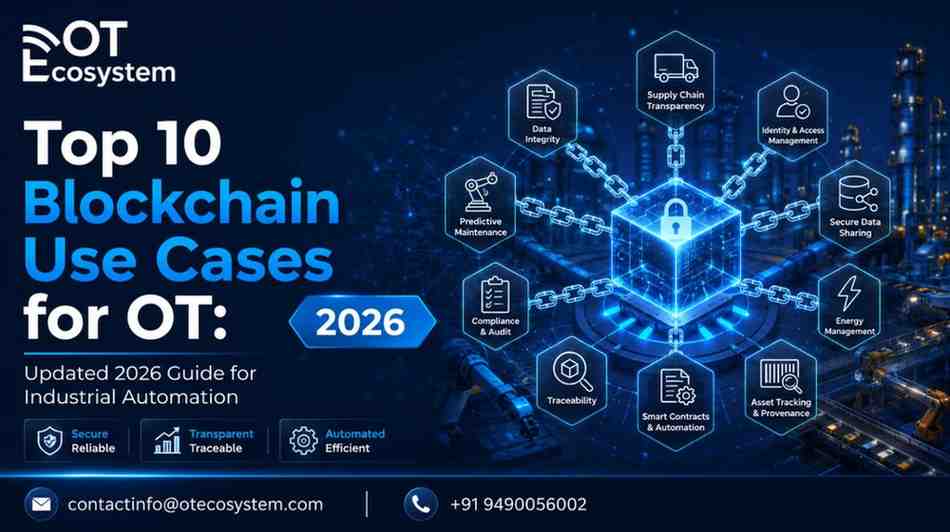
Top 10 Blockchain Use Cases for OT
The rapid convergence of Operational Technology (OT) and Information Technology (IT) has fundamentally transformed the industrial landscape. While this hyper-connectivity drives efficiency and predictive capabilities across manufacturing, energy, and utility sectors, it has also dismantled the traditional “air gap” that once kept industrial control systems (ICS) safe. Today, critical infrastructure is in the crosshairs of sophisticated cyber adversaries.
As security architects at OT Ecosystem continually evaluate next-generation defenses, one technology stands out for its potential to redefine industrial trust: Blockchain. Moving far beyond its cryptocurrency origins, distributed ledger technology (DLT) offers a decentralized, tamper-proof framework uniquely suited to the challenges of modern OT environments.
This comprehensive guide explores the background of blockchain in industrial settings and breaks down the top 10 most impactful blockchain use cases for securing Operational Technology and Industrial IoT (IIoT).
Background: Why OT Environments Need Blockchain
Historically, industrial environments relied on “security by obscurity” and physical isolation. Programmable Logic Controllers (PLCs), Remote Terminal Units (RTUs), and Supervisory Control and Data Acquisition (SCADA) systems were designed for maximum uptime and reliability, not cryptographic security.
As digitalization took hold, these legacy systems were suddenly thrust onto internet-facing networks. The result? A massive expansion of the attack surface,
characterized by:
- Centralized Points of Failure: Traditional security models rely on central servers for authentication and logging. If an attacker compromises the central server, the entire OT network is at risk.
- Lack of Native Encryption: Many industrial protocols (like Modbus or DNP3) transmit commands in cleartext, making them susceptible to man-in-the-middle (MitM) attacks.
- Data Integrity Concerns: In the event of a breach, attackers often manipulate logs to cover their tracks, making forensic investigation and system recovery incredibly difficult.
Blockchain introduces a paradigm shift. By decentralizing data storage and utilizing cryptographic hashing, it ensures that once data-such as a machine command, a firmware update, or an audit log-is recorded on the ledger, it cannot be altered or deleted. This creates an environment of absolute data integrity, which is the bedrock of cyber-physical safety.
The Top 10 Blockchain Use Cases for OT
Below is a detailed breakdown of how blockchain technology is being deployed to fortify industrial control systems and operational technology.
1. Decentralized Identity and Access Management (IAM) for ICS
In traditional IT networks, Identity and Access Management (IAM) relies on centralized Active Directory servers. In an OT context, relying on a single centralized authority creates a dangerous bottleneck.
Blockchain enables decentralized IAM frameworks where the identities of human operators, third-party vendors, and IIoT devices are stored on a distributed ledger. Every time a user or device requests access to a critical PLC or engineering workstation, the request is cryptographically verified against the blockchain. This eliminates single points of failure, ensuring that even if one segment of the network is compromised, unauthorized lateral movement is blocked.
2. Tamper-Proof Audit Trails and Regulatory Compliance
Industrial operators are subject to stringent regulatory frameworks such as IEC 62443, NIST SP 800-82, and NERC CIP. Compliance requires meticulous record-keeping of all system changes, access logs, and operational anomalies.
Blockchain acts as an immutable chronological vault. Every action taken on the OT network is hashed and stored on the ledger. If a malicious actor attempts to alter historical logs to mask an intrusion, the hashes will mismatch, instantly triggering an alert. This tamper-proof audit trail dramatically simplifies compliance reporting and provides irrefutable forensic evidence during post-incident investigations.
3. Immutable Threat Detection and Asset Visibility (Featuring Shieldworkz)
As industrial environments grow more complex, maintaining a secure and verifiable inventory of every asset is critical. Blockchain provides the immutable registry, but identifying these assets and detecting real-time threats requires deep, protocol-level operational context. This is where advanced, purpose-built solutions like Shieldworkz become indispensable.
Shieldworkz delivers next-generation, agentic AI-powered cybersecurity designed explicitly for critical infrastructure. While blockchain secures the ledger of historical events, Shieldworkz provides the active, foundational intelligence:
- Continuous Asset Discovery: Automatically scanning and identifying every PLC, sensor, and HMI without disrupting operations.
- AI-Driven Behavioral Analytics: Establishing a baseline of normal industrial traffic and instantly detecting anomalies, malware, or unauthorized command manipulations.
- Deep Packet Inspection: Understanding specialized ICS protocols natively to spot subtle logic changes that traditional IT security misses.
By integrating an immutable blockchain ledger with Shieldworkz’s real-time threat detection and vulnerability management, industrial operators achieve defense-in-depth. Every asset identified and every anomaly flagged by Shieldworkz can be permanently recorded on the blockchain, ensuring that your security telemetry remains untampered and actionable.
4. Secure Machine-to-Machine (M2M) Communication
The rise of Industry 4.0 means that machines now talk directly to other machines to optimize production, manage workflows, and reduce downtime. However, verifying the authenticity of the messages being passed between machines is a significant security hurdle.
By integrating blockchain, each machine is assigned a cryptographic identity. Before a robotic arm accepts a speed adjustment command from a neighboring sensor, it verifies the sensor’s signature against the blockchain. This cryptographic handshake ensures that rogue devices or injected commands cannot disrupt industrial processes, safeguarding operational continuity.
5. Firmware and Patch Authenticity Verification
Legacy OT systems are notoriously difficult to patch, and supply chain attacks (where threat actors compromise vendor updates) are a growing concern. Operators need absolute certainty that the firmware update they are applying to a critical turbine controller is legitimate.
Blockchain allows hardware manufacturers to hash and publish their firmware updates on a public or consortium ledger. Before an OT system installs the patch, it cross-references the hash of the downloaded file with the hash on the blockchain. If they match, the update is authentic. If even a single line of code has been altered by a bad actor, the hash changes, and the update is safely aborted.
6. Smart Contracts for Automated Maintenance and Vendor Management
Downtime in industrial settings translates to millions of dollars in lost revenue. Predictive maintenance aims to solve this, but managing third-party maintenance contractors securely remains a challenge.
Smart contracts-self-executing code residing on the blockchain-can automate this process securely. When an IIoT vibration sensor detects that a motor is nearing failure, it can automatically trigger a smart contract. This contract then verifies the credentials of a pre-approved maintenance vendor on the blockchain, grants them temporary, time-boxed remote access to the specific machine, and logs all their actions. Once the work is complete, access is automatically revoked.
7. Enhancing Zero-Trust Architecture in Industrial IoT
Zero-Trust is built on the premise of “never trust, always verify.” Implementing this in sprawling IIoT networks with thousands of edge devices is incredibly complex using centralized security models.
Blockchain provides a scalable architecture for Zero-Trust. It allows operators to establish micro-segmentation policies where every data transfer and access request is validated against the decentralized ledger. Because the trust verification process is distributed across the network, it reduces latency and ensures that compromised edge devices are instantly quarantined before they can infect the broader control network.
8. Supply Chain Integrity for Industrial Components
A compromised component introduced into an industrial control system can serve as a dormant backdoor for future cyber-physical attacks. The integrity of the hardware supply chain is just as critical as software security.
Blockchain enables end-to-end traceability of industrial components. From the moment a microchip is manufactured to its installation in a substation controller, its chain of custody is recorded on the ledger. Facility managers can scan a physical component and instantly verify its origin, manufacturing date, and transit history, ensuring that counterfeit or tampered hardware never enters the production environment.
9. Decentralized Energy Grids and Microgrid Management
In the energy and utilities sector, the traditional one-way flow of power is being replaced by decentralized microgrids where consumers also act as producers (prosumers) via solar panels and wind turbines.
Blockchain is the ideal technology to secure these transactions. It allows autonomous energy trading between microgrids using smart contracts, completely bypassing central clearinghouses. More importantly from a cybersecurity perspective, the blockchain validates the integrity of the grid data, preventing attackers from spoofing load demand signals that could otherwise be used to trigger cascading power outages.
10. Securing Legacy Systems via Cryptographic Gateways
One of the most significant barriers to OT cybersecurity is the prevalence of legacy systems-devices that are decades old, lack native encryption, and cannot support modern security agents.
While you cannot install blockchain software directly onto a 30-year-old RTU, operators can deploy blockchain-enabled cryptographic gateways at the network edge. The legacy device communicates locally with the gateway using its native unencrypted protocol. The gateway then encrypts the data, signs it cryptographically, and anchors the transaction to the blockchain before transmitting it across the corporate network or to the cloud, bridging the gap between aging infrastructure and modern security standards.
Conclusion
The stakes in industrial cybersecurity are fundamentally different from traditional IT. A breach in a data center results in stolen information; a breach in an OT network can result in physical destruction, environmental disasters, and threats to human life. As adversaries become more sophisticated, the defensive architectures securing our critical infrastructure must evolve.
Blockchain is no longer a theoretical concept for the industrial sector. From enforcing Zero-Trust policies and securing M2M communications to validating firmware updates and ensuring unalterable audit trails, DLT is actively solving some of the most stubborn vulnerabilities in the OT ecosystem.
When paired with advanced, AI-driven threat intelligence platforms like Shieldworkz, blockchain transforms industrial networks from fragile, centralized targets into highly resilient, self-verifying cyber-physical ecosystems. For facility operators, CISOs, and engineers looking to the future, integrating blockchain into your OT security roadmap is not just an upgrade-it is a strategic imperative to ensure operational certainty in an uncertain digital world.