
Welcome back to the cybersecurity desk. As an editor mapping the high-stakes intersection of enterprise IT, operational technology (OT), and industrial control networks, I frequently see a critical vulnerability that has nothing to do with firewalls or zero-day exploits: blind log management. When a Security Operations Center (SOC) investigates a corporate IT breach, analysts rely on a mountain of endpoint telemetry, active directory event logs, and cloud audit trails. But when that same SOC expands its scope to the plant floor, they often hit a wall of silence.
Applying generic IT log collection strategies-like aggressive active scanning, high-frequency polling, or indiscriminate event dumping-directly onto fragile Programmable Logic Controllers (PLCs) and distributed control systems (DCS) is a recipe for physical downtime. Recent industrial threat intelligence indicates that incident response times in OT environments take nearly 30% longer than in IT domains, primarily due to fragmented visibility and a lack of standardized, context-aware logging.
To bridge the gap between enterprise visibility and industrial safety, your SOC needs a specialized approach to audit tracking. Here are the top 10 incident logging practices tailored specifically for operational technology SOC teams.
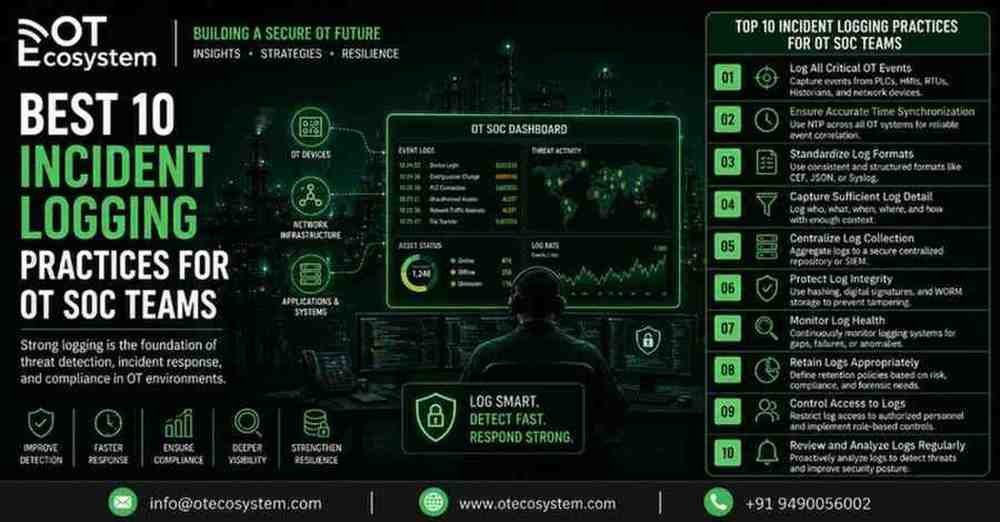
Best 10 Incident Logging Practices for OT SOC Teams
1. Prioritize Passive, Non-Intrusive Network Data Collection
Active log collection scripts and credentialed vulnerability scanners can easily overwhelm legacy industrial network switches, corrupt serial traffic, or crash fragile Level 1 controllers. OT SOC teams must mandate passive data collection architectures utilizing optical network taps or switched port analyzer (SPAN) ports. By harvesting packets without injecting traffic back into the control loop, you record exact protocol exchanges and state changes safely and reliably.
2. Implement OT-Specific Protocol Parsers in Your SIEM
Standard enterprise SIEM parsers do not understand industrial languages like Modbus TCP, DNP3, IEC 60870-5-104, or PROFINET. If your log aggregation platform cannot natively parse industrial function codes, register read/write commands, and device configuration parameters, your analysts are flying blind. Ensure your logging pipeline normalizes OT network telemetry into human-readable, searchable fields that distinguish normal process adjustments from malicious manipulation.
3. Maintain Immutable, Tamper-Proof Log Repositories
Professional threat actors targeting critical infrastructure know that digital forensics will expose their footprint, making log deletion or modification a primary objective following a successful pivot. All critical OT security logs, firewall audit trails, and jump-host session histories must be immediately forwarded via secure syslog or encrypted pipelines to an isolated, write-once-read-many (WORM) immutable storage repository residing outside the control network.
4. Isolate and Audit All Engineering Workstation Access Sessions
Engineering workstations (running tools like Siemens TIA Portal or Rockwell Studio 5000) are the ultimate keys to the kingdom; compromising them allows attackers to deploy malicious logic directly to PLCs. SOC teams must configure granular logging to record every instance of engineering software execution, project file downloads, online-mode sessions, and credential authentications originating from these hyper-sensitive endpoints.
5. Standardize High-Precision Timestamps Across Heterogeneous Devices
Industrial control systems involve a complex mix of modern Linux-based gateways, Windows SCADA servers, and legacy RTUs running on disparate internal clocks. Without synchronized timekeeping, trying to reconstruct a multi-stage cyber-physical attack across the Purdue Model becomes an exercise in frustration. Enforce Network Time Protocol (NTP) synchronization across all capable industrial logging sources and mandate precise microsecond logging for safety-critical controllers.
6. Log All PLC Mode Transitions and Configuration Drifts
A sudden, unannounced transition of a controller from “Run” mode to “Program” mode is one of the most reliable indicators of impending firmware manipulation or logic tampering. OT SOC teams must ingest real-time state change logs from all field controllers. Additionally, automated configuration management systems should log any parameter drift or register setpoint deviations against a known, verified golden baseline.
7. Filter and Baseline High-Frequency Operational Noise
Industrial environments generate millions of routine, repetitive telemetry messages every second (such as continuous sensor polling). Logging everything unthinkingly creates massive storage bloat and masks true security anomalies. SOC engineers must establish rigorous behavioral baselines for machine-to-machine (M2M) traffic, filtering out normal cyclic polling noise while routing true anomalies, protocol violations, and unauthorized connection attempts straight to analyst priority queues.
8. Enforce Strict Data Minimization and Privacy Masking
While capturing rich operational context is vital, logging unnecessary sensitive data-such as proprietary chemical compound recipes, raw employee credentials, or PII from HMI operator logs-introduces severe internal liability if the log repository itself is compromised. Implement strict data masking and tokenization rules at the collection edge to ensure the SOC records security-relevant metadata without hoarding hazardous trade secrets.
9. Build Cross-Domain IT/OT Correlated Playbooks
An industrial intrusion almost always starts with an IT-side phishing email or stolen VPN credential before pivoting into the OT DMZ. SOC logging practices must bridge the enterprise-to-industrial divide by correlating Active Directory login events, bastion host sessions, and firewall state tables with plant-floor network anomalies. Your log correlation rules should automatically flag when an IT user account suddenly initiates communication with Level 2 control systems.
10. Conduct Regular Log Integrity and Retention Audits
Collecting logs is useless if they stop flowing silently or get truncated due to storage limits during a critical incident. OT engineering and security teams must conduct monthly pipeline audits to verify that log forwarding agents are active, buffer queues are clear, and retention policies comply with evolving regulatory mandates like NERC CIP, NIS2, and ISA/IEC 62443.
Conclusion
Effective incident logging in an Operational Technology Security Operations Center is an exercise in engineering discipline. You cannot simply copy-paste enterprise IT logging playbooks onto the factory floor without risking operational availability. By prioritizing passive data collection, enforcing immutable storage, focusing on protocol-aware parsing, and tracking critical state changes like PLC mode transitions, industrial SOC teams can transform raw network noise into actionable, forensic-grade intelligence-protecting critical infrastructure from silent, catastrophic disruption.