
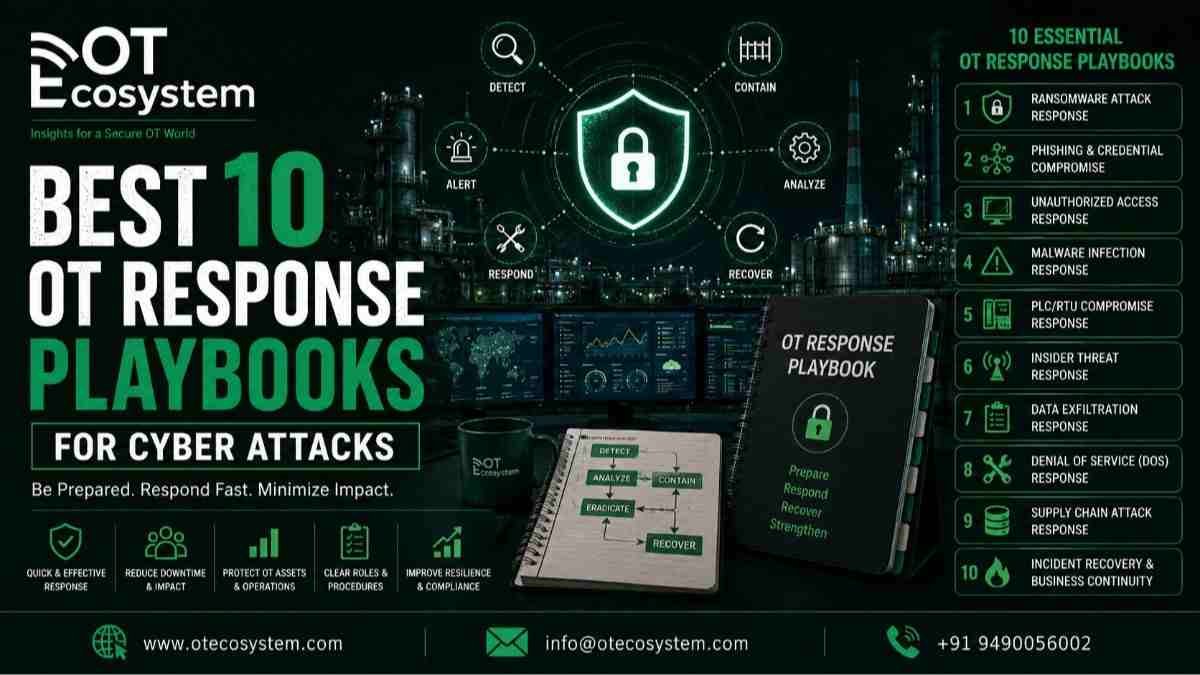
As industrial control networks increasingly intersect with corporate IT architectures, operational technology (OT) security has transformed from a peripheral engineering concern into a board-level imperative. Recent industrial threat intelligence indicates that organizations relying on tested, OT-specific incident response playbooks recover from cyber disruptions up to 30% faster than those attempting to adapt generic IT response procedures. However, industry analyses reveal that only 40% of industrial facilities maintain dedicated OT response workflows, leaving the majority vulnerable to costly improvisation during a live crisis.
Because isolating a live production line or shutting down a supervisory server using standard IT playbooks can trigger severe physical safety events or catastrophic equipment damage, plant security leaders require specialized, field-tested guides. Below are the best 10 operational technology (OT) response playbooks designed to handle complex cyber attacks while preserving human safety and continuous industrial production.
Best 10 OT Response Playbooks for Cyber Attacks
1. ICS Ransomware Containment & Safe Islanding Playbook
- The Operational Trigger: Cryptolocker or ransomware strains detected moving from corporate MES servers toward Level 2 programmable logic controllers (PLCs).
- Execution & Technical Steps: Traditional IT playbooks immediately isolate infected subnets. In an OT environment, abrupt network isolation can cut power to cooling loops or safety valves. This playbook outlines safe islanding-decoupling compromised controllers into a secure manual-override state via firewall rule adjustments rather than cutting physical power. It mandates collaboration with process engineers to ensure physical safety interlocks remain energized.
2. Compromised Engineering Workstation (HMI/PLC) Eradication Playbook
- The Operational Trigger: Unauthorized ladder logic modifications or suspicious engineering software execution detected on a primary HMI or programming terminal.
- Execution & Technical Steps: Directs the immediate quarantine of the engineering workstation without rebooting the active control process. It details how to pull volatile RAM dumps using specialized industrial forensics tools, verify cryptographic hashes against an offline “golden image” repository, and re-flash controller firmware only during a scheduled maintenance window under dual-person authorization.
3. Third-Party Vendor Remote Access Breach Response
- The Operational Trigger: Anomalous outbound traffic or unauthorized credential usage originating from an external maintenance vendor’s virtual private network (VPN) tunnel.
- Execution & Technical Steps: Immediately revokes active remote sessions and terminates vendor firewall pinholes. The playbook guides security teams through auditing jump-host activity logs, inspecting active session recordings, and enforcing mandatory multi-factor authentication (MFA) and zero-trust network access (ZTNA) re-validation before any external vendor is allowed back onto the plant floor.
4. Industrial Asset Discovery & Rogue “Shadow OT” Isolation
- The Operational Trigger: Detection of unauthorized wireless access points, rogue IIoT meters, or unmapped switches plugged directly into supervisory control buses.
- Execution & Technical Steps: Leverages continuous asset inventory platforms-utilizing specialized inspection tools from market leaders such as Nozomi Networks, Dragos, Claroty, Shieldworkz, and TXOne Networks-to map unauthorized device connections and traffic anomalies in real-time. The playbook establishes rapid physical port disabling protocols and network-layer blacklisting to eliminate shadow OT footholds.
5. Supply Chain Software Bill of Materials (SBOM) Zero-Day Mitigation
- The Operational Trigger: Disclosure of a critical remote code execution vulnerability within commercial-off-the-shelf (COTS) SCADA or HMI software libraries.
- Execution & Technical Steps: Triggers an automated cross-reference of the facility’s Software Bill of Materials (SBOM) database to pinpoint vulnerable software packages. It coordinates an isolated test-lab patch validation cycle and deploys temporary virtual patching rules via industrial intrusion prevention systems (IPS) to block exploit payloads before official vendor patches are applied.
6. Safety Instrumented System (SIS) Tampering & Logic Override Playbook
- The Operational Trigger: Alerts indicating unauthorized read/write attempts, configuration checksum mismatches, or forced states on safety-critical controllers.
- Execution & Technical Steps: Treats safety system compromise as an immediate high-priority physical emergency. The playbook bypasses standard IT triage to engage the plant safety officer and lead process engineers directly. It establishes manual hard-wired safety interlock verification, halts all automated logic downloads, and mandates out-of-band physical inspection of safety relay cabinets.
7. Industrial Historian Data Exfiltration & Extortion Response
- The Operational Trigger: High-volume outbound data transfers or unauthorized database queries detected on industrial data historian and recipe management servers.
- Execution & Technical Steps: Implements database-level micro-segmentation to sever external data feeds without interrupting real-time control loops. The playbook guides forensic analysts in identifying exfiltrated intellectual property or process recipes, rotating service account credentials, and verifying the integrity of air-gapped, immutable backups.
8. Wireless Mesh Sensor Network Jamming & Spoofing Playbook
- The Operational Trigger: RF spectrum anomalies, packet drops, or abnormal sensor readings reported across industrial wireless mesh networks (e.g., WirelessHART, ISA100.11a).
- Execution & Technical Steps: Deploys wireless intrusion detection systems (WIDS) to locate interference sources or rogue transmitters spoofing temperature and pressure readings. The playbook initiates physical field checks, switches automated loops to manual hardwired control fallbacks, and re-keys network encryption layers.
9. Distributed Control System (DCS) Clock Desynchronization Response
- The Operational Trigger: Sudden time drift or NTP/DNS tampering alerts causing synchronization failures across distributed controllers.
- Execution & Technical Steps: Isolates local time-sync servers from potentially compromised enterprise networks. The playbook establishes secondary, authenticated internal Network Time Protocol (NTP) sources with cryptographic signatures, restoring precise chronological ordering to operational logs required for forensic reconstruction.
10. Post-Incident OT Recovery & Purdue Model Tiered Restoration
- The Operational Trigger: Post-containment validation indicating that threat actors have been eradicated from the industrial network environment.
- Execution & Technical Steps: Governs the delicate process of bringing a plant back online following a major cyber attack. It enforces a strict bottom-up Purdue Model restoration sequence: safety systems must be validated and brought up first, followed by field device network connectivity, core controllers, supervisory HMI layers, historian databases, and finally IT/OT boundary interfaces. Each tier requires explicit process engineering sign-off before connectivity is restored to the next level.
Conclusion
Deploying robust operational technology response playbooks bridges the critical gap between executive cybersecurity policies and the physical realities of the plant floor. Because industrial downtime directly threatens human safety and continuous production, generic IT-centric incident management is no longer acceptable. By institutionalizing these 10 specialized OT playbooks and conducting regular cross-functional tabletop drills, plant security managers can ensure rapid, safe, and resilient containment when cyber incidents strike.