
The operational technology (OT) threat landscape has evolved into an active battleground. Historically, industrial environments relied on the premise of the “air gap”-an isolated network architecture physically separated from corporate IT networks. Modern industrial convergence, remote maintenance gateways, and Industrial Internet of Things (IIoT) telemetry have rendered true air gaps virtually non-existent.
When threat actors breach industrial control systems (ICS), Supervisory Control and Data Acquisition (SCADA) networks, or field-level Programmable Logic Controllers (PLCs), standard corporate IT security tools fall short. IT security tools rely on active agent polling or signature matches that can crash legacy industrial controllers, introduce latency into real-time control loops, or fail to parse proprietary industrial protocols like Modbus, DNP3, Ethernet/IP, or Profinet.
Detecting adversaries inside Purdue Model Level 0 to Level 3 environments requires non-intrusive, domain-specific threat detection strategies. Industry telemetry reveals that over 65% of OT security incidents involve attackers living off the land-using legitimate administrative tools and valid protocol commands to manipulate physical processes. Below is an authoritative analysis of the top 10 technical strategies to detect cyber attacks inside OT and ICS networks before physical downtime or safety compromise occurs.
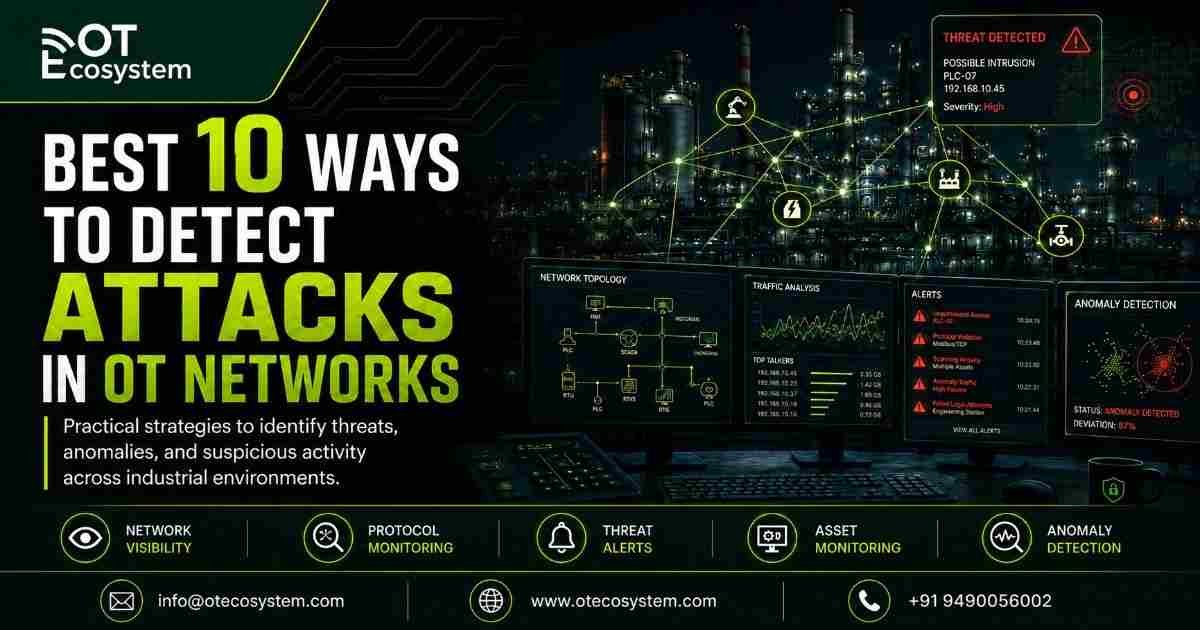
Best 10 Ways to Detect Attacks in OT Networks
1. Deep Packet Inspection (DPI) of Native Industrial Protocols
Traditional network intrusion detection systems (IDS) analyze TCP/IP headers, but they treat industrial payload data as opaque strings. Industrial-native Deep Packet Inspection (DPI) parses complex OT protocols (such as Modbus/TCP, IEC 60870-5-104, DNP3, and OPC UA) down to the function code and payload attribute level. This enables security systems to detect anomalous operational behaviors-such as an unapproved IP address issuing a Modbus “Write Single Register” command to a PLC or initiating a firmware upload during normal production hours.
2. Behavioral Baseline and Anomaly Detection
Operational networks are deterministic by design; unlike IT environments where user web traffic varies wildly, OT communications follow predictable, repeatable patterns. Machine learning algorithms leverage this determinism to establish an operational baseline of device-to-device communications, polling cycles, and control command frequencies. Any deviation-such as an HMI polling a field controller at a frequency of 100ms instead of the established 5000ms baseline-immediately triggers an anomaly alert for potential operational reconnaissance or denial-of-service (DoS) preparation.
3. Passive Network Traffic Analysis (TAP/SPAN Monitoring)
Active network scanning tools (like Nmap) can freeze sensitive PLCs, RTUs, and legacy Windows HMIs by saturating tiny memory buffers. Passive network traffic analysis uses hardware Test Access Points (TAPs) or Switch Port Analyzer (SPAN) ports to mirror network traffic into inspection engines without injecting a single packet into the control network. This zero-impact monitoring approach builds real-time asset inventories and flags suspicious lateral movement without risking process disruption or physical safety.
4. Monitoring Engineering Workstation & HMI Event Logs
Engineering Workstations (EWS) and Human-Machine Interfaces (HMIs) represent the primary bridge between digital code and physical execution. Attackers targeting Level 2 and Level 3 environments must interact with these nodes to modify ladder logic or alter setpoints. Centralizing and monitoring host event logs for unauthorized process terminations, unexpected execution of admin tools (like PowerShell, PsExec, or vssadmin), volume shadow copy deletions, or new account creations provides early detection of staging activity.
5. Detecting Unauthorized PLC Logic & Firmware Changes
The ultimate goal of sophisticated ICS adversaries (such as nation-state threat groups or targeted ransomware operators) is altering the physical behavior of field assets. Continuous monitoring of controller state configurations detects out-of-band PLC ladder logic edits, unauthorized code downloads, project file modifications, or firmware re-flashing attempts. Comparing running PLC runtime code against verified baseline project files alerts engineers to covert code changes before physical equipment damage occurs.
6. Zero-Trust Identity & Remote Access Telemetry
Remote access connections-specifically via vendor VPNs, Jump Hosts, and Remote Desktop Protocol (RDP)-remain the single most common initial access vector into OT networks. Detecting attacks requires monitoring remote access gateways for anomalous behaviors, including logins outside standard operational windows, concurrent logins from geographically distant locations, privilege escalation attempts, or unauthorized access to Purdue Model Level 1 field networks.
7. OT-Specific Threat Intelligence & Indicator Matching
Generic IT Threat Intelligence feeds often generate excessive false positives inside industrial facilities. Integrating specialized OT-focused Cyber Threat Intelligence (CTI) allows security systems to match traffic patterns against known Indicators of Compromise (IoCs) and adversary Tactics, Techniques, and Procedures (TTPs). This includes detecting command-and-control (C2) beaconing mechanisms associated with industrial malware frameworks like EKANS, PIPEDREAM, or Industroyer.
8. Purdue Model Conduit & Boundary Breach Detection
Adhering to international security standards like IEC 62443 requires establishing clear security zones and conduits across the Purdue Enterprise Reference Architecture. Deploying perimeter monitoring engines at the IT/OT Industrial DMZ (iDMZ) boundary detects policy violations. Alerts trigger when an IT-zone host attempts to establish direct, unproxied connections to Level 2 SCADA servers or Level 1 field controllers, signaling an ongoing lateral movement campaign.
9. Process Variable & Physical Telemetry Validation
Advanced attacks can spoof software HMIs into displaying normal operating conditions while underlying processes are manipulated toward catastrophic failure (similar to Stuxnet). Advanced detection frameworks correlate digital network traffic with physical sensor telemetry-such as temperature, pressure, flow rate, and rotational speed. When network control commands contradict real-world physical telemetry bounds, the system flags a high-priority process manipulation alert.
10. Transient Cyber Asset (TCA) Isolation & USB Inspection
Contractor laptops, maintenance USB drives, and transient engineering calibration tools bypass perimeter firewalls entirely when physically plugged into Level 1 or 2 control networks. Establishing physical kiosk checkpoints and monitoring USB mass storage driver initialization on HMIs flags unauthorized removable media usage. Real-time detection systems identify new, unvetted MAC/IP addresses the moment a transient device attempts to communicate on an internal industrial VLAN.
Conclusion
Detecting cyber threats inside operational technology networks requires moving away from reactive IT-centric scanning toward continuous, passive, and protocol-aware monitoring. Because operational environments value physical safety, process uptime, and reliability above all else, threat detection platforms must deliver real-time visibility without risking network disruption. By combining deep packet protocol inspection, behavioral baseline analytics, and strict Purdue Model conduit monitoring, industrial enterprises can detect adversaries early in the kill chain-neutralizing threats before they impact physical operations.