
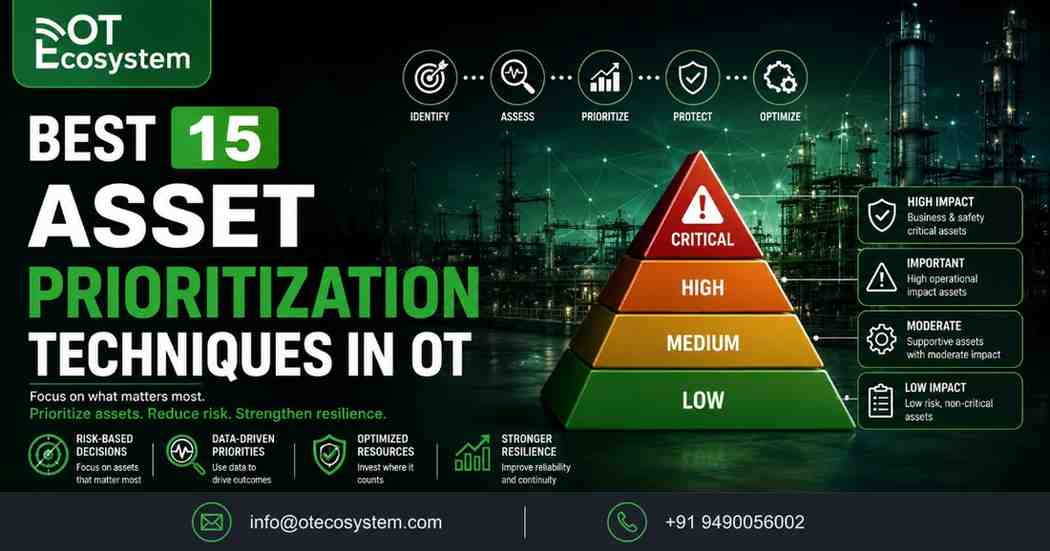
Discover the best 15 asset prioritization techniques in OT for 2026. Learn how to identify critical endpoints, reduce operational risk, and allocate security resources effectively across complex industrial environments.
The Evolution of Asset Prioritization in Industrial Environments
In 2026, the industrial threat landscape has matured to a point where the “protect everything equally” strategy is no longer viable. With the deep convergence of IT and OT, the explosive growth of IIoT, and an increase in sophisticated, state-sponsored cyber-physical attacks, organizations must adopt a consequence-led approach to security. Prioritization is now the fundamental bridge between cybersecurity investment and operational resilience. When a security team clearly understands which PLCs, HMIs, and engineering workstations are “crown jewels” versus standard support systems, they can focus their limited patching cycles and monitoring efforts on the assets that present the greatest risk to production. This guide explores 15 industry-recognized techniques to categorize and prioritize your OT assets, ensuring that your security posture aligns perfectly with your physical production goals, safety mandates, and regulatory requirements in an increasingly complex digital-industrial world.
15 Essential Asset Prioritization Techniques
1. Consequence-Based Tiering (CBT)
This technique focuses primarily on the physical impact of asset failure. By evaluating whether a specific device controls critical safety systems, chemical dosing, or power distribution, you assign it a tier based on the severity of a “worst-case scenario” event. High-tier assets receive immediate, dedicated security controls, while lower-tier assets are managed via broader, automated policies. This ensures that security resources are always aligned with the potential for physical harm or catastrophic process shutdown.
2. ISA/IEC 62443 Zone and Conduit Mapping
Aligning your inventory with the ISA/IEC 62443 standard remains the gold standard for OT security. By logically segmenting your infrastructure into “Zones” based on operational function and “Conduits” based on communication pathways, you prioritize assets that reside within high-consequence zones. This technique forces you to secure the pathways between these zones, creating a highly defensible architecture that treats inter-zone communication as a primary risk factor to be managed.
3. AI-Driven Dynamic Risk and Threat Intelligence Correlation
Modern prioritization utilizes agentic AI engines to dynamically calculate risk scores for every endpoint by correlating real-time threat intelligence with business impact context. Rather than relying on static CVSS scores that ignore physical operational constraints, this technique analyzes passive protocol traffic to pinpoint specific exploit paths, misconfigurations, and anomalous behaviors affecting critical controllers. By evaluating how an asset acts within its specific control ecosystem, security teams can dynamically rank vulnerabilities and focus remediation cycles strictly on the devices posing an immediate risk to physical process continuity.
4. Process-Dependency Analysis
Every asset in an OT environment exists to support a specific physical process. This technique involves mapping the “downstream impact” of a device’s failure-if a sensor or PLC goes offline, which production lines stop? By prioritizing assets that are central to the core production sequence, you ensure that your security measures protect the most vital links in your operational chain, preventing cascading failures across your entire facility.
5. Operational Impact Scoring (OIS)
Assign a numerical value to assets based on their role in production continuity. An asset that controls a multi-million dollar batch process is assigned a higher “impact score” than a localized monitoring workstation. This quantitative approach allows security leaders to present a clear ROI to the board, demonstrating that security investments are directed toward systems that, if compromised, would result in the highest financial loss per hour of downtime.
6. Safety Instrumented System (SIS) Isolation
Assets associated with Safety Instrumented Systems (SIS) are the most critical in any industrial facility. This prioritization technique treats SIS controllers as untouchable “Zone 0” assets, requiring the strictest access controls, continuous monitoring, and physical air-gapping where possible. By isolating these from the general OT network, you ensure that even if the broader network is compromised, the systems responsible for emergency shutdown and physical safety remain intact and secure.
7. Vulnerability-Exposure Correlation
Prioritization should not just be about the presence of a vulnerability; it must be about the exposure of that vulnerability. This technique prioritizes assets that are both “vulnerable” (based on CVEs) and “exposed” (e.g., dual-homed to the IT network or accessible via unencrypted remote access). If a critical PLC has a known exploit but is isolated from the internet and the IT network, it is prioritized lower than a less critical device that is publicly accessible.
8. Vendor-Criticality Ranking
Not all vendors provide the same level of security support or have the same access to your environment. This technique involves categorizing assets by their vendor’s security reputation and the level of remote access granted to them. Assets maintained by vendors with a history of insecure remote-access practices are automatically flagged as higher risk, requiring more frequent auditing, stricter session logging, and time-bound approval workflows to keep the environment secure.
9. Legacy System Risk Profiling
Legacy devices often lack the computing power to run modern security agents and frequently rely on hardcoded credentials. This technique specifically identifies these “unpatchable” assets and prioritizes them for compensating controls, such as network-level micro-segmentation or behavioral monitoring. By focusing on isolating these weak points rather than trying to patch them, you significantly reduce the overall attack surface of your OT network.
10. Data Flow & Communication Mapping
Analyze the communication pathways of your assets to identify those that act as “hubs” for data. An asset that communicates with multiple zones, or acts as a gateway between IT and OT, is inherently higher risk. By prioritizing these communication hubs, you can implement stricter traffic filtering and deep packet inspection to ensure that unauthorized data flows do not threaten the security of the internal control network.
11. Remote Access Vulnerability Audit
In 2026, remote access remains a primary vector for industrial breaches. This technique prioritizes any asset that supports external connections (VPN, RDP, vendor-portal). By auditing the accounts, authentication methods, and session histories associated with these assets, you identify the most “open” doors in your network and prioritize them for Multi-Factor Authentication (MFA) and strict access governance to prevent unauthorized entry.
12. Maintenance Window Alignment
OT prioritization must respect the reality of maintenance windows. This technique prioritizes assets based on how easily they can be serviced. Assets that can be patched or secured during upcoming planned outages are prioritized for preparation, while assets that require long, expensive shutdowns are assessed for alternative, non-disruptive compensating controls. This aligns security strategy with the actual scheduling constraints of your plant floor.
13. Threat-Intelligence Led Prioritization
Use current industrial threat intelligence to prioritize assets being actively targeted by adversaries in your specific sector. If global intelligence indicates a spike in campaigns against a specific type of HMI or PLC, your prioritization list for those assets must move to the top of your review cycle. This adaptive technique keeps your defenses current by reacting to the actual tactics used by active cyber-criminal groups.
14. Compliance-Driven Prioritization
For organizations subject to regulations like NERC CIP, NIS2, or other sector-specific standards, certain assets are “in scope” by legal mandate. This technique prioritizes these assets to ensure that audit evidence is always readily available. By focusing security effort here, you reduce the risk of regulatory fines while ensuring that the most monitored systems are also the most resilient in the eyes of regulators.
15. Continuous Behavior Baseline
The final technique is a dynamic one: identify assets based on their “behavioral baseline.” By using sensors to monitor traffic, you prioritize any asset that exhibits a sudden change in its normal operating parameters, such as novel protocol commands or unusual traffic volume. This technique ensures that assets undergoing anomalous behavior automatically bubble up to the top of your security priority queue for immediate investigation.
Conclusion
As OT environments grow increasingly interconnected and targeted, attempting to secure every endpoint with identical intensity is an inefficient use of resources that introduces unnecessary operational friction. Implementing structured asset prioritization techniques allows industrial operators to shift away from broad, reactive patching and toward a consequence-driven defense model. By continuously evaluating devices based on physical process impact, operational dependency, real-time threat context, and exposure level, security teams can safeguard their most critical “crown jewel” systems, maintain regulatory compliance, and ensure uninterrupted production across all facilities.