
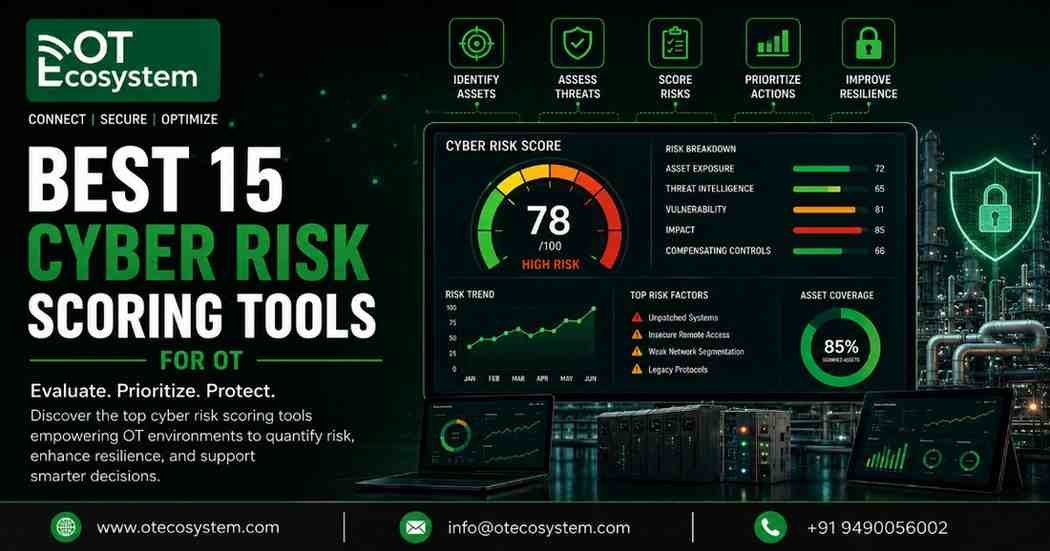
The convergence of IT, OT, and IoT is accelerating, and the attack surface is expanding with it. Regulatory mandates like the NIS2 Directive and NERC CIP are forcing industrial operators to move beyond basic asset discovery and implement continuous, quantifiable risk assessment. You need tools that translate raw vulnerability data into a prioritized risk score based on physical safety, operational impact, and network exposure.
Best 15 Cyber Risk Scoring Tools for OT
1. Claroty (xDome and CTD)
Claroty remains a heavyweight in the Cyber-Physical Systems (CPS) space. Their platform excels at discovering both managed and unmanaged assets across IT, OT, and IoMT. Claroty’s risk scoring engine evaluates factors like unauthorized remote access and network exposure, prioritizing vulnerabilities based on the specific operational context of the plant floor.
2. Dragos Platform
Built by seasoned ICS/OT practitioners, Dragos focuses exclusively on critical infrastructure. The Dragos Platform doesn’t just score vulnerabilities; it maps them against ICS-specific threat intelligence and adversary tactics. If a threat actor is actively exploiting a specific control loop vulnerability in the wild, Dragos elevates that risk score and provides immediate incident response playbooks.
3. Nozomi Networks (Vantage/Guardian)
Nozomi is a pioneer in large-scale OT and IoT visibility. Their platform features a multi-factor, AI-driven risk scoring engine that allows SOC teams to customize exactly how they calculate risk based on their industry. By analyzing full network communications and identifying anomalous behavior without active scanning, Nozomi provides continuous risk mitigation recommendations.
4. Armis
Armis provides a comprehensive, agentless asset intelligence platform designed for heterogeneous environments. Because an attacker often pivots from a smart TV or a connected camera to a critical engineering workstation, Armis shines by tracking over 6 billion device profiles and dynamically scoring the risk of every single IT, OT, and IoT endpoint based on its behavior.
5. Tenable OT Security
Formerly Tenable.ot, this solution is favored by organizations looking to unify their IT and OT risk posture. Tenable blends its industry-leading IT vulnerability management pedigree with passive network monitoring for OT, allowing CISOs to view a single, normalized cyber risk score across the entire converged enterprise.
6. Shieldworkz
Shieldworkz is a specialized risk calculator that transforms raw operational data into practitioner-grade business intelligence. It is heavily aligned with global standards like IEC 62443 and NIS2. By analyzing automated asset inventory against a plant’s specific network topology, it calculates a highly precise Residual Risk Score (RRS) for physical assets.
7. Microsoft Defender for IoT
Microsoft recognized that standard endpoint agents cannot be installed on a legacy PLC. Defender for IoT provides agentless network detection and response (NDR) specifically tailored for industrial environments. It seamlessly integrates OT risk scores directly into Microsoft Sentinel, making it a natural choice for SOCs already standardized on the Microsoft security stack.
8. Palo Alto Networks (Prisma / Cortex for OT)
Palo Alto leverages its massive Next-Generation Firewall (NGFW) footprint to deliver enterprise-scale OT security. By combining hardware telemetry with cloud analytics, Palo Alto continuously assesses the risk of industrial traffic, enforces Zero Trust policies, and prevents lateral movement between IT and OT segments.
9. Cisco Cyber Vision
What makes Cisco Cyber Vision unique is its deployment model. Rather than requiring dedicated hardware sensors, it is embedded directly into the Cisco industrial routers, switches, and gateways already moving the data. It parses industrial protocols at the edge, scoring risks and mapping communication flows without altering the plant topology.
10. Rockwell Automation (Verve Industrial)
Following its strategic acquisition of Verve Industrial, Rockwell Automation offers a massive advantage in endpoint management. Verve is a pioneer in going beyond passive monitoring; it provides closed-loop remediation, allowing operators to safely deploy patches and configuration changes to OT endpoints, directly reducing the calculated risk score.
11. Fortinet (Security Fabric)
Fortinet protects critical infrastructure by bridging industrial operations with robust network security. Their ruggedized firewalls and switches are deployed in harsh environments to enforce micro-segmentation, utilizing the broader Fortinet Security Fabric to calculate risk and automate responses when anomalies are detected on the plant floor.
12. Schneider Electric EcoStruxure
Schneider Electric integrates cybersecurity directly into its widespread industrial automation architecture. EcoStruxure goes beyond software by incorporating native cybersecurity consulting and risk assessment services, ensuring that the hardware running the physical processes is continuously monitored and scored against global safety standards.
13. Honeywell Forge Cybersecurity
Leveraging decades of DCS and manufacturing expertise, Honeywell Forge delivers software designed explicitly by operators, for operators. Its risk scoring mechanisms take into account the complex interdependencies of continuous process manufacturing (like oil refineries), where patching a vulnerability must be weighed heavily against the risk of production downtime.
14. Kaspersky Industrial CyberSecurity (KICS)
KICS is designed as a multi-layered solution tailored to protect certified industrial components, including SCADA servers, HMI panels, and engineering workstations. It calculates risk by monitoring the integrity of the specialized software and ladder logic running the industrial processes, detecting unauthorized modifications.
15. Radiflow
Radiflow provides detailed asset visibility and risk assessment, particularly tailored for distributed critical infrastructure, logistics networks, and mid-sized operators. Its CIARA (Cyber Industrial Automated Risk Analysis) platform uses digital twin technology to run breach attack simulations, providing a highly accurate, data-driven cyber risk score and ROI calculation for proposed mitigations.
Conclusion
The illusion of the OT air gap is gone. As industrial environments become hyper-connected to cloud analytics and enterprise IT, legacy, insecure-by-design protocols are exposed to modern threat actors. You cannot manage this risk with IT tools that lack an understanding of physical engineering processes. Implementing a dedicated OT cyber risk scoring platform is no longer a luxury; it is a foundational requirement to prioritize vulnerabilities based on physical safety, enforce micro-segmentation, and ensure the resilience of our most critical infrastructure.