
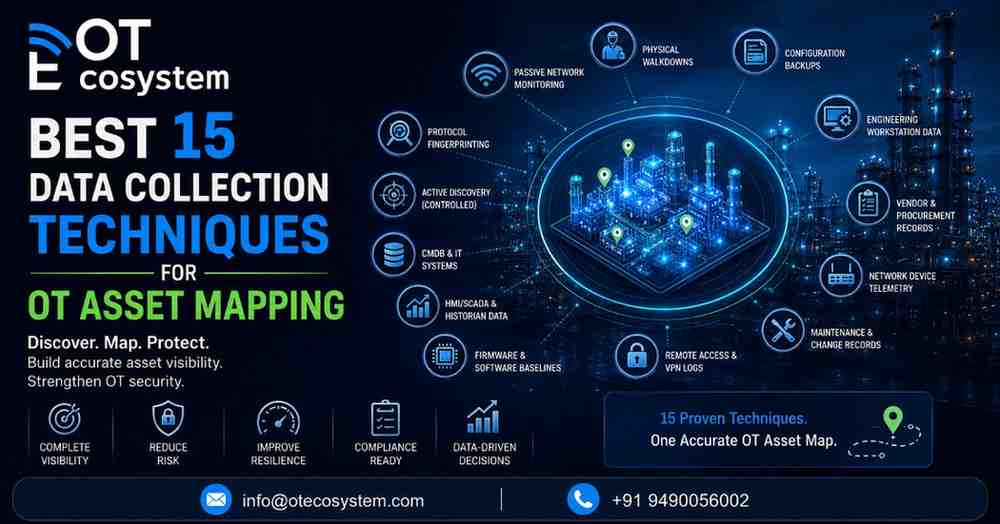
OT asset mapping has become a core requirement for industrial cybersecurity, not just an inventory exercise. CISA’s guidance for owners and operators says modern OT defense starts with an OT asset inventory plus an OT taxonomy, and that the process should include scope definition, asset identification, attribute collection, data management, and lifecycle management. In other words, the map must be accurate, current, and tied to function and criticality.
NIST’s current OT guidance says the same thing in different language: maintain a complete and accurate asset inventory, include vendor, model, firmware, OS, and software versions, and prefer passive methods where possible because active scanning can negatively affect OT systems. That is why the best OT asset mapping programs use multiple data collection techniques together, not one tool or one spreadsheet.
Background: Why OT Asset Mapping is Harder Than IT Asset Management
OT environments are built around uptime, safety, and long asset lifecycles. NIST notes that OT systems can include unsupported components, sensitive process dependencies, and monitoring methods that must be carefully tested before production use. CISA’s guidance also emphasizes that OT taxonomy should organize assets by function and criticality so defenders know which assets must be protected first.
That means OT asset mapping cannot rely on the same discovery habits used in office IT. Passive traffic analysis, manual verification, lifecycle records, and engineering knowledge all matter, because a control system may look stable on paper while actually hiding outdated firmware, shadow devices, or risky remote access paths. The most effective mapping programs build one shared operational truth from many small, validated data sources.
Best 15 Data Collection Techniques for OT Asset Mapping
1. Start with passive traffic monitoring
Passive traffic monitoring should be the first collection method in almost every OT environment. NIST says passive monitoring is a practical way to detect system changes and maintain an up-to-date inventory without injecting traffic into sensitive systems, which makes it the safest starting point for live production networks. It also helps reveal which devices are active, how they communicate, and where unexpected dependencies exist.
This is especially valuable in plants where older equipment cannot tolerate probing or agent deployment. By listening first, teams can map devices, build trust in the inventory, and identify hidden segments before any active technique is considered. In OT, “see first, touch later” is usually the right order.
2. Perform physical walkdowns and panel verification
Manual visual inspection remains one of the most reliable ways to confirm OT assets. NIST specifically says passive monitoring and manual visual inspection can be used to maintain an up-to-date inventory, especially when automated tools do not capture everything. In practice, this means walking the floor, checking panels, validating labels, and confirming that what is installed matches what the network says is there.
Walkdowns are slow, but they expose the truth that network-only methods can miss: disconnected assets, undocumented replacements, legacy modules, and devices sitting in cabinets for years. The strongest OT maps combine what the wire says with what the engineer can physically verify.
3. Deploy Native Native and Specialized OT Asset Management Frameworks
To effectively bridge physical discovery with actionable security intelligence, organizations leverage specialized OT asset management frameworks and native industrial security platforms aligned with IEC 62443 and NIST SP 800-82 guidelines. These specialized solutions automatically ingest raw protocol traffic, normalize heterogeneous device attributes, and map endpoints into standardized taxonomies without disturbing real-time process operations. Implementing specialized OT mapping tools enables industrial defenders to establish continuous visibility, classify asset criticalities, streamline risk scoring, and enforce defensible micro-segmentation boundaries based on verified operational data.
4. Reconcile OT discoveries with CMDB and enterprise records
OT mapping gets much stronger when discovery data is reconciled with CMDB, EAM, ERP, and other enterprise records. NIST says accurate inventory information supports vulnerability identification, tracking, remediation, and business continuity, while CISA says asset inventories should be managed systematically through data management and lifecycle processes. That makes reconciliation a core data collection technique, not a back-office cleanup task.
In practice, this step catches duplicate records, missing owners, and stale entries. It also connects the operational world to procurement, maintenance, and support contracts, which helps security teams understand not just what exists, but who is responsible for it and what it is supposed to do.
5. Map network architecture and data flows
Network architecture documentation is one of the most valuable sources for OT asset mapping. NIST says data flow diagrams help organizations understand expected behavior between networked components and support troubleshooting, response, recovery, and forensic analysis. It also notes that network architecture documentation tools help identify, document, and diagram systems and their relationships.
This technique is especially important when assets are distributed across zones and conduits. A good data flow map shows which PLCs talk to which HMIs, where remote access lands, and which segments should never see one another. That context often matters more than the device list itself.
6. Use protocol-aware passive fingerprinting
Protocol-aware fingerprinting collects rich OT context from the traffic itself. NIST’s OT guidance and related NIST work show that devices can often be identified by MAC address, passive observation, or deep packet inspection, which can reveal model, serial number, or other identifying details when the protocol carries them. This is one of the safest ways to learn what is actually present without disrupting operations.
This technique becomes especially powerful when combined with industrial protocol knowledge. Instead of seeing only IP addresses, teams can infer vendor, device class, firmware clues, and communication roles. That is what turns “some device on the network” into a mapped OT asset with real operational meaning.
7. Validate with controlled active discovery in test or maintenance windows
NIST is very clear that active scanning can negatively impact OT systems and may even interfere with device process state, so it should be tested offline and scheduled carefully, preferably during planned outages. This is why active discovery belongs later in the process and only after passive methods and lab validation are complete.
Used carefully, controlled active discovery can fill gaps where passive traffic is thin or where additional details are needed. The key is not speed but safety: validate the tooling first, limit the scope, and treat the production network as fragile until proven otherwise.
8. Collect device configuration exports and backups
Configuration exports from HMIs, historians, engineering stations, switches, and controllers are valuable mapping data because they reveal the real state of the environment. NIST says inventory and monitoring should cover hardware, firmware, and software, and that maintaining current records supports vulnerability remediation and continuity planning. Configuration backups help fill the gap between “device exists” and “device is configured this way.”
This is particularly important after maintenance events or vendor service visits. A configuration export can show changed parameters, added modules, or hidden dependencies that are not visible from the network alone. For OT mapping, these files are often the difference between an approximate inventory and a trustworthy one.
9. Harvest engineering project files from HMIs and workstations
Engineering workstations often contain the clearest record of what the process is supposed to look like. Project files, logic backups, screen definitions, and device libraries can expose controller names, line dependencies, vendor tools, and asset relationships that do not appear anywhere else. NIST’s guidance on OT inventories stresses the need to track software versions and other details that enable vulnerability identification and remediation.
This technique is especially useful for brownfield sites where documentation is incomplete. A project file may reveal the only accurate list of connected controllers or an outdated naming convention that needs cleanup before the asset map becomes reliable.
10. Record firmware and software baselines
A strong OT asset map must include firmware, operating system, and software version data. NIST explicitly says maintaining an accurate inventory of IT and OT assets, including product vendor, model numbers, firmware, OSs, and software versions, facilitates vulnerability identification, tracking, and remediation. Without that baseline, a map may show what exists but not whether it is safe to run.
Baselines also help with drift detection. When a device moves from a known-good version to an unknown one, the asset record should reflect that immediately. In OT, version drift is not just an IT hygiene issue; it can affect safety, reliability, and recoverability.
11. Pull information from remote access, VPN, and jump-host logs
CISA’s OT asset inventory guidance highlights insecure remote access points as an important OT threat consideration, because they can enable lateral movement and command-and-control access. That makes VPNs, jump hosts, vendor tunnels, and remote-support systems valuable sources of asset-mapping data, since they often reveal which OT assets are reachable and by whom.
These logs help answer operational questions that inventories alone cannot. Which assets are remotely maintained? Which vendor connection touched the line last week? Which jump host sees the most sensitive systems? Those answers matter for both mapping and security governance.
12. Use switch, router, firewall, and NAC telemetry
Network devices are rich sources of asset data because they capture who talked to whom, when, and how often. NIST says data flow mapping helps organizations understand expected behavior and support response, recovery, and anomaly analysis, while automated monitoring can be used when tested carefully. Switch tables, firewall logs, and NAC events can all help confirm where assets live and how they are grouped.
This is particularly helpful in segmented OT networks where direct agent deployment is not practical. Telemetry from the infrastructure itself can reveal hidden assets, moved assets, and devices that should not be present in a given zone.
13. Collect vendor, OEM, and procurement records
NIST recommends documenting serial numbers, checksums, digital certificates, signatures, and other identifying features to verify the authenticity of OT hardware, software, and firmware. It also says organizations should assess whether equipment comes directly from the OEM or from an authorized distributor or reseller. That makes procurement records and vendor documentation a useful data source for asset mapping.
These records help security teams tie physical equipment to a trusted source of truth. They also reduce confusion when parts are swapped, replaced, or serviced, because the asset map can show not just what is installed, but where it came from and whether it is still supported.
14. Use maintenance, change, and decommissioning records
Asset mapping should not be treated as a one-time project. CISA says asset inventory work includes managing data and implementing asset lifecycle management, while NIST says procedures should exist to manage additions, deletions, and modifications to assets. Maintenance tickets, change records, and decommissioning approvals are therefore essential data collection inputs.
This technique keeps the inventory current long after initial discovery is finished. When a device is replaced, patched, retired, or moved, the asset map should change with it. That is the only way to keep the map aligned with reality instead of drifting into a stale snapshot.
15. Organize everything through an OT taxonomy and lifecycle model
CISA’s guidance says OT owners and operators should create an OT taxonomy that classifies assets by function and criticality, and that this taxonomy should support risk identification, vulnerability management, and incident response. The guide also emphasizes a process that includes defining scope, identifying assets, collecting attributes, creating taxonomy, managing data, and implementing lifecycle management. That is the backbone of a mature asset-mapping program.
Without taxonomy, asset data becomes a long list of names. With taxonomy, the same data becomes operational intelligence: what matters most, what is most exposed, what is aging out, and what needs protection first. That is the point where asset mapping starts supporting real industrial security decisions.
What a Mature OT Asset Map Should Contain
A mature OT asset map should show device identity, vendor, model, firmware, software version, owner, criticality, communication paths, and lifecycle state. It should also distinguish between what was discovered passively, what was validated manually, and what still needs confirmation. NIST says accurate inventories support vulnerability remediation and continuity planning, while CISA says taxonomy and lifecycle management make the inventory defensible and usable.
The best programs treat the map as a living system. They update it during maintenance, reconcile it with enterprise records, and use it to drive risk decisions, not just reporting. That is what separates a useful OT asset map from a static list of hosts.
Conclusion
OT asset mapping works best when it is built from many data collection techniques, not one discovery pass. Passive monitoring, manual inspection, architecture diagrams, configuration exports, vendor records, and lifecycle data all contribute different pieces of the same puzzle. NIST and CISA both emphasize that OT inventories must be accurate, regularly updated, and structured around function and criticality.
For industrial organizations, the goal is not just to know what is connected. The goal is to know what matters, what has changed, and what needs to be protected next. That is what makes OT asset mapping a cybersecurity capability rather than an administrative task.