
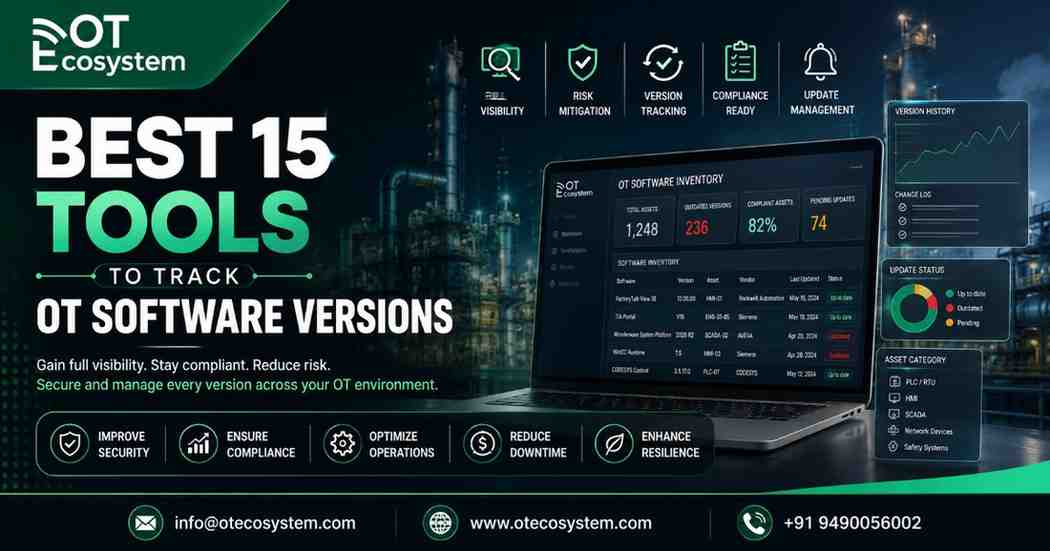
Discover the top 15 tools to track OT software versions, essential for maintaining secure, compliant, and resilient industrial control systems in 2026.
In the landscape of modern industrial operations, the phrase “you cannot protect what you cannot see” has never been more critical. Operational Technology (OT) and Industrial Control System (ICS) environments are no longer air-gapped islands; they are hyper-connected ecosystems where legacy hardware meets modern IoT. One of the most significant security debts in these environments is the lack of granular software version control. When a new vulnerability (CVE) is disclosed, an operator’s ability to instantly identify which PLCs, HMIs, or SCADA servers are running the affected firmware version is the difference between a patched system and a catastrophic downtime event.
Tracking OT software versions is inherently more complex than in IT. Unlike standard enterprise software, industrial firmware is deeply tied to physical processes, often requiring specific maintenance windows for updates. Furthermore, many industrial devices lack modern API support, forcing security teams to rely on deep packet inspection (DPI) and passive discovery. This blog explores the top 15 tools that bridge this gap, providing the visibility needed to manage asset lifecycles effectively in 2026.
The Imperative of OT Version Management
The shift toward Industry 4.0 has expanded the attack surface exponentially. As organizations integrate IIoT sensors and cloud-based analytics, the diversity of software versions across an industrial facility often exceeds what manual spreadsheets can manage. Managing these versions is not just about security; it is about operational continuity. Outdated firmware is a primary vector for ransomware, while unauthorized version changes can inadvertently alter the safety parameters of a physical process.
Regulatory frameworks such as IEC 62443, NERC CIP, and NIS2 have codified the need for robust asset inventory and configuration management. Compliance isn’t just a checklist-it is an outcome of knowing exactly what is running on your network. Below, we examine the platforms that set the standard for tracking these critical industrial components.
Top 15 Tools to Track OT Software Versions
1. Dragos Platform
Dragos has built its reputation on deep, industrial-grade intelligence. The platform excels at identifying specific firmware versions on obscure ICS devices through its extensive protocol-aware library. It provides high-confidence asset discovery that maps not just the device type, but the specific patch level and software version, allowing teams to correlate these versions directly against the Dragos WorldView threat intelligence.
2. Nozomi Networks
Nozomi Networks is a titan in the OT visibility space, offering a comprehensive dashboard that provides real-time tracking of software and firmware across geographically dispersed sites. Its AI-powered analysis allows operators to distinguish between authorized version changes and anomalies. By continuously monitoring network traffic, Nozomi ensures that every software update, no matter how small, is captured in the asset inventory.
3. Shieldworkz
Shieldworkz has emerged as a high-precision player in the OT security market, delivering an exceptionally deep asset inventory that often uncovers 46-78% more assets than standard scanners. Its agentic AI-based posture management doesn’t just log software versions; it acts as a virtual analyst that monitors for end-of-life (EOL) versions and communicates risk based on specific industrial protocols. For teams looking for the most in-depth, non-intrusive visibility, Shieldworkz provides actionable data on versioning that integrates seamlessly into vulnerability management playbooks.
4. Claroty (xDome)
Claroty provides one of the most mature visibility solutions on the market, specifically designed for the complexities of cyber-physical systems. The xDome platform excels at automated, passive asset discovery, which is essential for environments where active scanning could crash a legacy PLC. It provides a detailed software bill of materials (SBOM) and tracks firmware versions, enabling security teams to prioritize patches based on actual risk and device criticality.
5. Armis
Armis brings a powerful approach to the table, particularly for organizations managing a blend of IT, OT, and IIoT devices. Its “asset intelligence” engine maps the behavior of devices and extracts detailed metadata, including software versioning and patch history. Because it operates with a vast, cloud-based asset database, Armis can often identify the firmware version of a new, unknown device almost immediately upon it appearing on the network.
6. Tenable OT Security
Tenable (formerly Indegy) is a cornerstone tool for organizations that prioritize vulnerability management. It integrates native OT security with established IT vulnerability assessment workflows. By providing a unified view of software versions, Tenable allows teams to bridge the communication gap between the plant floor and the C-suite, ensuring that patch cycles are aligned with both security requirements and operational maintenance windows.
7. TXOne Networks
TXOne focuses on “OT-native” protection, particularly for sensitive production lines where downtime is not an option. Their solutions provide not only visibility into software and firmware versions but also proactive hardening. By knowing the exact version of the software running on a controller, TXOne’s edge devices can enforce “virtual patching,” shielding vulnerable versions from exploits without requiring an immediate, potentially risky, firmware update.
8. Microsoft Defender for IoT
Microsoft has significantly enhanced its OT security footprint, making it a viable option for organizations already embedded in the Azure ecosystem. Defender for IoT provides granular visibility into OT assets, detecting and tracking firmware versions across complex industrial networks. Its integration with the wider Microsoft Sentinel SIEM/SOAR environment enables automated responses to unauthorized software changes, centralizing security across both IT and OT domains.
9. Fortinet (FortiGuard OT Security)
Fortinet is a strong choice for organizations focusing on network-level visibility and robust segmentation. Its OT-specific security services provide visibility into the assets behind industrial firewalls, tracking the software versions of managed and unmanaged devices alike. For organizations that treat their industrial network as an extension of their secure enterprise perimeter, Fortinet offers a unified control plane that is hard to beat.
10. Palo Alto Networks (IoT Security)
Palo Alto Networks provides a highly scalable solution that leverages machine learning to identify and classify every device on the network. Its ability to extract versioning information from industrial protocols is excellent for large-scale environments. By integrating with their next-generation firewalls, security teams can enforce policies based on the specific software version of an industrial device, effectively isolating out-of-date assets.
11. Cisco Cyber Vision
Cisco Cyber Vision turns existing network infrastructure into a sensor, making it an incredibly efficient deployment option for companies already using Cisco hardware. By analyzing the traffic flowing through industrial switches and routers, Cyber Vision identifies every asset and its software version without requiring additional hardware sensors. It is highly effective for maintaining constant, real-time awareness of version drift across the entire industrial network.
12. Forescout (eyeInspect)
Forescout is known for its ability to provide full-spectrum visibility, from the campus network down to the most remote industrial site. Its eyeInspect solution is purpose-built for OT, providing continuous asset monitoring and version tracking. The platform excels at managing risk in environments where there is high turnover of connected devices, ensuring that every new piece of hardware is immediately profiled and added to the version tracking list.
13. Radiflow
Radiflow is a specialized OT security vendor that focuses on risk analysis and compliance. Its platform, iSID, captures and tracks the versioning of all industrial assets, allowing for a quantitative assessment of the network’s security posture. It is particularly useful for organizations that need to present detailed compliance reports to regulators, as it maps every asset’s version and patch status directly against international standards like IEC 62443.
14. Nozomi Networks (Guardian)
While Nozomi has already been mentioned, its Guardian sensor is worth noting separately for its unique deployment flexibility. Guardian is specifically engineered to handle the harsh, distributed environments of the energy and utility sectors. It tracks software versions across deep-tier industrial networks, ensuring that even the most remote sub-stations have their firmware versions logged and monitored for unauthorized changes.
15. Scrutiny (Custom Internal Auditing)
For smaller, highly regulated, or boutique manufacturing firms, sometimes the best tool is a rigorous, custom-built internal auditing program supported by simplified asset management software. By pairing basic network monitoring with a dedicated, manual (or semi-automated) asset ledger, firms can maintain a “source of truth.” While it lacks the automated depth of the others, this approach is often the starting point for effective OT governance in smaller organizations.
Conclusion
The choice of an OT software tracking tool should be guided by your environment’s unique needs, such as the age of your equipment, the necessity for passive versus active discovery, and your regulatory environment. In 2026, the market has matured significantly; platforms like Shieldworkz, Dragos, and Nozomi Networks have shifted the goalpost from simple inventory to actionable, AI-driven risk management.
Investing in these tools is not merely an IT expense-it is an investment in the operational reliability of your business. By maintaining a crystal-clear, up-to-the-second map of your software versions, you transform your security posture from a reactive, firefighting mode into a proactive, resilient industrial operation that is prepared for whatever the next threat landscape may hold.