
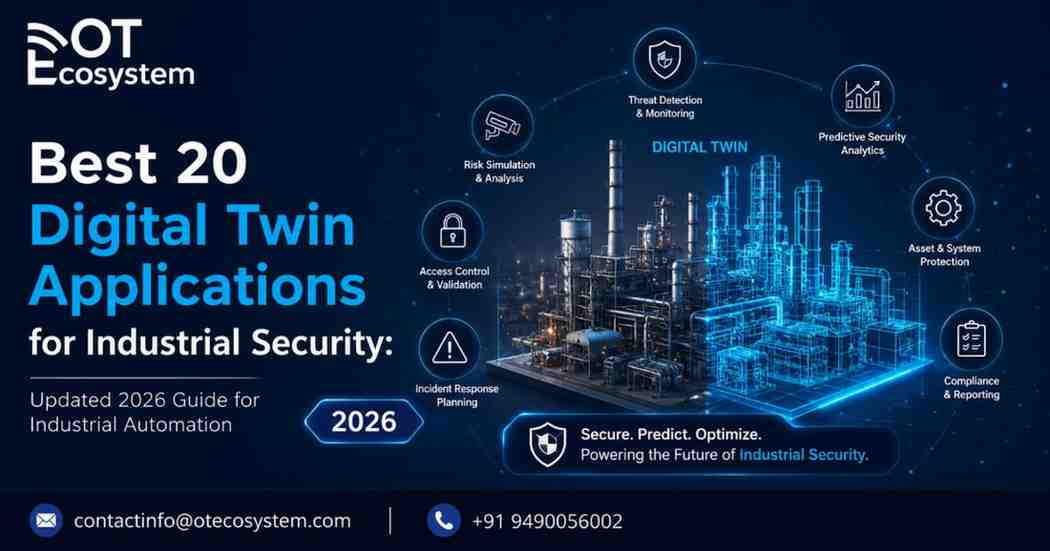
Best 20 Digital Twin Applications for Industrial Security
In the high-stakes realm of Operational Technology (OT) and Industrial Control Systems (ICS), cybersecurity operates under extreme constraints. You cannot simply run an aggressive vulnerability scanner or deploy an unverified patch across a plant floor the way you might in a corporate IT environment. One errant ping or unexpected reboot can knock a legacy Programmable Logic Controller (PLC) offline, halt a multi-million dollar production line, or, worse, cause a catastrophic safety incident.
This inherent fragility is precisely why digital twin technology has revolutionized industrial cybersecurity. For plant managers and CISOs navigating the convergence of IT and OT, digital twins offer a safe, isolated, and highly accurate environment to test defenses, simulate attacks, and monitor for anomalies without ever touching the physical infrastructure.
In this comprehensive guide for the OT Ecosystem, we will break down the background of digital twin security and explore the 20 best digital twin applications and software platforms safeguarding today’s industrial landscape.
The Role of Digital Twins in OT/ICS Cybersecurity
Traditionally, a digital twin was viewed merely as a 3D CAD model used by engineers to visualize equipment. However, in the context of cyber-physical systems (CPS), a digital twin is a dynamic, data-driven replica of your physical environment.
According to modern cybersecurity frameworks, an effective OT digital twin models the environment across several critical tiers:
- The Network Tier: Replicating topologies, communication protocols (like Modbus, DNP3, and PROFINET), and data flows.
- The Physical Tier: Modeling the physical characteristics and sensor configurations of industrial equipment like turbines and wellheads.
- The Process Tier: Capturing the logical flows, setpoints, and control algorithms that govern actual operations.
- The Application Tier: Emulating Human-Machine Interfaces (HMIs), historians, and engineering workstations.
By utilizing these multi-layered replicas, organizations can conduct Breach and Attack Simulations (BAS), validate firmware updates, and perform non-disruptive penetration testing. At the sensor level, these twins establish a baseline of normal “behavioral physics,” allowing security tools to detect when an attacker is spoofing data to trick a Distributed Control System (DCS).
Below is the definitive list of the top 20 digital twin applications and platforms leading the charge in industrial security in 2026.
Top 20 Digital Twin Applications and Platforms
1. Claroty xDome (Continuous Threat Detection)
Claroty excels at creating a comprehensive virtual model of the OT environment without disrupting delicate operations. By passively listening to network traffic, the platform builds a digital twin of the network topology, identifying every asset, proprietary protocol, and communication pathway. This allows security teams to simulate the impact of vulnerabilities and test micro-segmentation policies in the digital realm before enforcing them on the physical network, ensuring zero disruption to critical manufacturing processes.
2. Dragos Platform
The Dragos Platform goes beyond simple asset mapping by creating a behavioral twin of the industrial environment. Leveraging deep packet inspection and proprietary threat intelligence, Dragos models the expected, legitimate interactions between controllers, HMIs, and engineering workstations. When a threat actor attempts lateral movement or unauthorized process manipulation, the platform compares the real-time activity against the modeled baseline, instantly identifying the malicious deviation with context specific to the ICS domain.
3. Shieldworkz CPS Security Platform
Shieldworkz delivers a specialized security layer for the industrial edge, securing the “Level 0” protocols and hardware that define field instrumentation. At its core, Shieldworkz utilizes process-aware behavioral baselining-essentially constructing a functional digital twin of control sequences, operator workflows, and telemetry signatures. By monitoring the behavioral physics of sensor data, Shieldworkz can detect subtle anomalies. For instance, if the natural noise and jitter of a pressure sensor suddenly flatline, the platform recognizes this as a hallmark of a replay attack against the digital twin’s baseline. Using agentic AI-based posture calibration, Shieldworkz extends the security perimeter all the way to the sensor head without risking delicate control loops, ensuring compliance with IEC 62443 mandates.
4. Nozomi Networks Vantage
Nozomi Networks utilizes advanced AI to construct a dynamic, real-time digital replica of complex OT and IoT networks. This cloud-based application continuously ingests telemetry from across global industrial sites, allowing centralized security teams to visualize their entire operational footprint. The twin is used to identify misconfigurations, track rogue devices, and predict how a localized malware outbreak might propagate through the broader industrial control network.
5. Radiflow CIARA
Radiflow’s CIARA (Cyber Industrial Automated Risk Analysis) is explicitly built around the concept of a digital twin for continuous security testing. It creates an offline replica of the OT network to conduct non-intrusive Breach and Attack Simulations (BAS). By unleashing simulated threats against the digital twin, CIARA calculates the likelihood of an attack succeeding and quantifies the potential financial and operational impact, allowing OT leaders to prioritize their security investments based on empirical data rather than guesswork.
6. Siemens Omnivise T3000 Security
Siemens integrates digital twin technology directly into its Omnivise T3000 distributed control system, widely used in the power generation sector. The platform utilizes a digital replica of the power plant’s control logic to validate security patches and system updates before they are pushed to the live environment. This ensures that essential security upgrades do not inadvertently alter turbine speeds, pressure setpoints, or safety instrumented system (SIS) triggers.
7. Frenos ICS Digital Twin
Frenos specializes purely in building highly accurate digital twins specifically for OT cybersecurity. Their platform models the environment across multiple layers of abstraction-from external environmental factors down to the specific logic inside a PLC. This application is particularly valuable for training incident response teams. Operators can defend against live, simulated cyber-physical attacks on the digital twin, building muscle memory for crisis scenarios without ever endangering the real-world facility.
8. Microsoft Azure Digital Twins (with Defender for IoT)
Microsoft provides a foundational PaaS application for modeling physical environments. When industrial organizations pair Azure Digital Twins with Microsoft Defender for IoT, they create a formidable security architecture. The digital twin visualizes the spatial intelligence of a smart factory, while Defender for IoT maps vulnerability data and threat intelligence directly onto that 3D spatial model, allowing security analysts to literally see where a cyber threat is physically located within a facility.
9. Armis Centrix for OT/IoT
Armis operates on the principle of collective intelligence, utilizing a massive, cloud-based asset knowledge base that acts as a global digital twin for device behavior. By analyzing billions of device profiles, Armis knows exactly how a specific model of an industrial robotic arm or a medical imaging device should behave. If a device on your network begins acting outside of this globally established twin profile (e.g., a smart HVAC controller suddenly trying to query a domain controller), Armis instantly flags it as a compromised asset.
10. Forescout eyeInspect
Formerly known as SilentDefense, Forescout eyeInspect builds a contextual, passive model of the ICS network. This digital application is designed to understand the specific semantics of industrial protocols. It models the operational baseline so thoroughly that it can distinguish between a legitimate engineering command (like a scheduled firmware update) and a malicious command injection. The twin allows operators to test access control policies dynamically before enforcing them at the switch level.
11. Tenable OT Security
Tenable focuses heavily on comprehensive asset visibility and vulnerability management. To achieve this safely, Tenable OT Security creates an offline model of the PLC logic, firmware versions, and network states. Security teams can query this digital replica to identify known CVEs (Common Vulnerabilities and Exposures) and exposed attack surfaces without actively scanning the live PLCs, thereby eliminating the risk of crashing legacy hardware during an audit.
12. AWS IoT TwinMaker (with AWS IoT Device Defender)
Amazon Web Services provides IoT TwinMaker to help developers build operational digital twins of manufacturing plants and heavy equipment. From a security standpoint, integrating this application with AWS IoT Device Defender allows organizations to establish strict security policies based on the twin’s operational parameters. If physical sensors report data that violently contradicts the expected state of the twin-suggesting a False Data Injection (FDI) attack-the system can automatically quarantine the compromised edge devices.
13. Kaspersky Industrial CyberSecurity (KICS)
Kaspersky’s industrial solution relies heavily on modeling the normal operational parameters of SCADA networks and PLCs. By creating a mathematical model of the industrial process, KICS can detect logical anomalies. If a threat actor bypasses network security and sends a mathematically sound but operationally destructive command (e.g., opening a valve while the downstream pipe is pressurized), the twin recognizes the process deviation and alerts operators before physical damage occurs.
14. Cisco Cyber Vision
Embedded directly into the fabric of industrial networking equipment (like Cisco Catalyst switches), Cyber Vision builds a passive digital twin of the OT network flow. Because it operates at the edge, it creates an incredibly accurate map of device communications without requiring additional span ports or mirror traffic. The application uses this twin to help IT and OT teams collaborate on designing and testing Zero Trust micro-segmentation policies.
15. PTC ThingWorx
As a premier Industrial IoT platform, ThingWorx inherently relies on digital twins to monitor machine health and enable predictive maintenance. However, this same twin application is a powerful security tool. By establishing an airtight model of equipment performance, any deviation caused by malware or unauthorized tampering is immediately reflected in the twin’s performance metrics, turning predictive maintenance algorithms into advanced cyber-physical threat detectors.
16. Fortinet OT Security Fabric
Fortinet’s approach involves creating a virtualized security model of the industrial environment to enforce strict network segmentation. By modeling the Purdue Enterprise Reference Architecture within their management console, Fortinet allows architects to define conduits and zones virtually. The digital twin of the network ensures that any proposed firewall rules will effectively block lateral movement without cutting off vital historian data feeds to the enterprise IT layer.
17. Honeywell Forge Cybersecurity Suite
Honeywell Forge builds a comprehensive performance and security twin of industrial facilities, heavily utilized in the oil and gas and chemical sectors. The application aggregates data from hundreds of thousands of sensors to model the site’s security posture. It specializes in secure remote access modeling, allowing administrators to simulate vendor connections and ensure that third-party contractors only have access to the specific digital twin elements they are authorized to maintain.
18. GE Digital Proficy Cyber Security
GE Digital utilizes digital twin technology primarily to optimize asset performance, but this extends directly into its cybersecurity posture. The Proficy suite models the behavioral characteristics of heavy machinery. If a cyberattack attempts to manipulate the physical process (such as the Stuxnet centrifuge attack), the digital twin will detect the dissonance between the commanded state and the physical reality, providing an early warning system for sophisticated sabotage.
19. Rockwell Automation FactoryTalk Security
Rockwell’s FactoryTalk suite creates a “digital thread” throughout the manufacturing process. From a security perspective, this digital replica is used to centrally manage authentication and access control across the plant floor. Operators can use the virtual model to validate how firmware updates will propagate across interconnected devices, ensuring that a security patch applied to one machine cell does not break the automation sequence of the adjacent cell.
20. Palo Alto Networks Zero Trust OT Security
Palo Alto Networks utilizes machine learning to build a continuous, dynamic model of OT device behavior. Instead of relying purely on static signatures, the application creates a living twin of how each device communicates. This enables a true Zero Trust architecture in industrial environments; the firewall understands exactly what the device’s twin is authorized to do and automatically drops any packets that violate that established, modeled behavior.
The Business Impact of Digital Twin Security
The integration of digital twins into industrial cybersecurity is not just a technical upgrade; it is a fundamental shift in risk management. By deploying these applications, asset owners achieve:
- Zero-Downtime Security Testing: Vulnerabilities can be patched, and networks can be segmented in the virtual world, ensuring that security measures are mathematically proven before they ever touch the live plant floor.
- Bridging the IT/OT Divide: Digital twins provide a common visual language. IT security analysts can see the network packets, while OT engineers can see the physical process implications, fostering necessary collaboration.
- Regulatory Compliance: Platforms like Shieldworkz and Claroty utilize their digital models to automate evidence collection for rigorous frameworks like IEC 62443 and NERC CIP, transforming compliance from a manual headache into a continuous, automated process.
Conclusion
As industrial environments become increasingly connected, the traditional “air gap” is nothing more than an illusion. Threat actors are aggressively targeting cyber-physical systems, knowing that disruptions at the OT level cause immediate, real-world pain. The 20 digital twin applications listed above represent the frontline defense for the modern smart factory, power grid, and refinery. By investing in these platforms-and leveraging advanced behavioral baselining provided by specialized vendors like Shieldworkz-organizations can finally secure their operational technology with the same rigor as their IT infrastructure, all while keeping the engines of industry running safely and smoothly.