
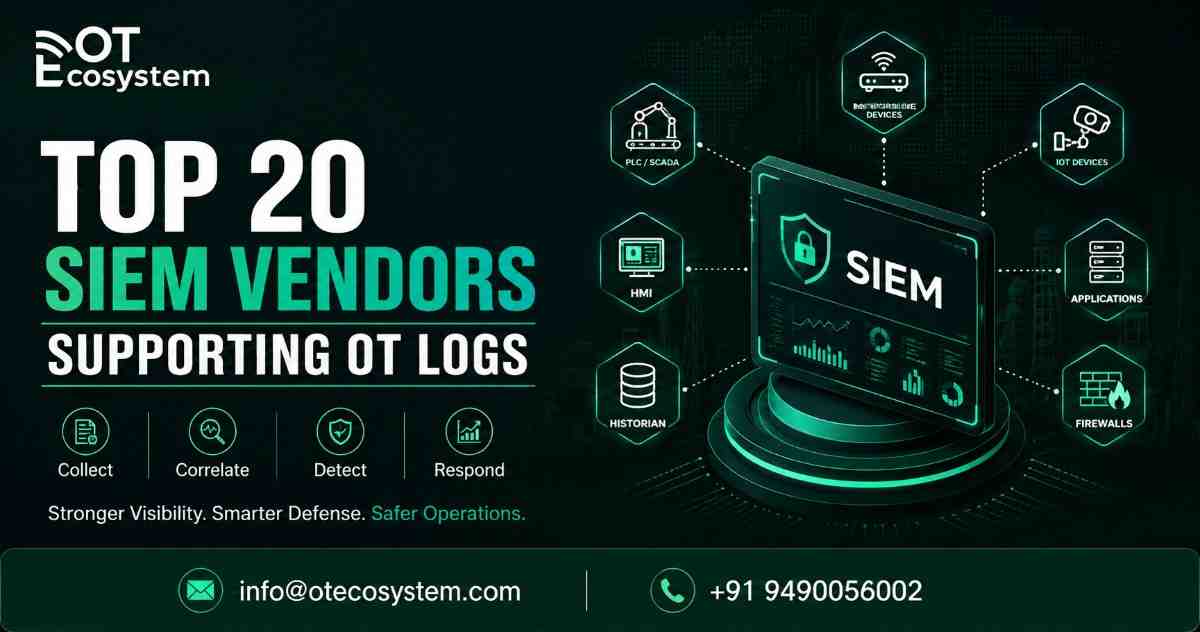
Discover the top 20 SIEM vendors capable of parsing and correlating OT/ICS logs to secure critical infrastructure and eliminate industrial blind spots.
The Evolution of Industrial Cybersecurity: Why OT Logs Demand Specialized SIEM Capability
For decades, Information Technology (IT) and Operational Technology (OT) environments existed in isolated silos. IT was all about data confidentiality and high throughput, while OT prioritized safety, availability, and deterministic uptime. However, the relentless march of digital transformation has forced these two worlds to converge. Today, industrial control systems (ICS), programmable logic controllers (PLCs), and supervisory control and data acquisition (SCADA) systems are increasingly connected to corporate networks and the cloud. While this convergence unlocks unprecedented operational efficiency, it also exposes highly sensitive physical processes to sophisticated cyber threats.
Traditional Security Information and Event Management (SIEM) platforms were natively designed for standard IT logs-think Windows Event logs, Syslog, and NetFlow. They stumble when confronted with the esoteric, proprietary protocols of the industrial world, such as Modbus, DNP3, Profinet, EtherNet/IP, and BACnet. Standard IT SIEMs cannot inherently parse these protocols, leading to dangerous blind spots where an industrial anomaly or cyberattack could go completely unnoticed until physical damage occurs.
To achieve a true unified Security Operations Center (SOC), modern enterprises require SIEM platforms that natively support, parse, and correlate OT logs. This integration is frequently achieved either through direct ingestion of passive industrial network telemetry or via deep, turn-key integrations with specialized OT security tools (such as Claroty, Nozomi Networks, or Dragos). By feeding rich industrial telemetry into a centralized SIEM, security teams can cross-correlate IT entry points (like a phishing email or compromised VPN credential) with subsequent lateral movement into the OT network, stopping multi-stage cyberattacks before they disrupt production.
Top 20 SIEM Vendors Supporting OT Logs
1. Splunk Enterprise Security
Splunk remains a dominant heavyweight in the security analytics space, heavily leveraging its “Data-to-Everything” philosophy to ingest complex industrial telemetry. Through the Splunk OT Security Add-on and native integrations with market-leading industrial cyber-toolsets, Splunk effortlessly normalizes disparate OT data sources into the Common Information Model (CIM). This allows security analysts to build comprehensive dashboards that visualize both IT infrastructure and deep-tier SCADA assets simultaneously. Splunk’s powerful Search Processing Language (SPL) enables rapid threat hunting across asset inventories, firmware changes, and anomalous PLC ladder logic updates. Its robust partner ecosystem ensures that whether logs originate from a corporate firewall or an isolated factory floor sensor, they are correlated seamlessly to reveal the full blast radius of an incident.
2. Microsoft Sentinel
Microsoft Sentinel has rapidly evolved into a cloud-native SIEM powerhouse by heavily capitalizing on its built-in integration with Microsoft Defender for IoT. This native synergy allows industrial organizations to seamlessly stream rich asset discoveries, vulnerability insights, and operational alerts straight into their cloud SOC without costly middleware. Sentinel leverages tailored workbooks and specialized analytical rules specifically mapped to the Purdue Model and the MITRE ATT&CK for ICS framework. The platform excels at correlating cloud-based identity threats with anomalies occurring on physical shop floors, providing comprehensive visibility from a single pane of glass. Furthermore, its continuous behavioral monitoring helps defenders spot unauthorized programming commands or rogue devices introduced into sensitive segmented networks before they cause operational downtime.
3. IBM Security QRadar SIEM
IBM Security QRadar stands out for its sophisticated QFlow and UBA (User Behavior Analytics) engines, which have been systematically extended to encompass operational technology environments. By leveraging app extensions and close integrations with specialized industrial visibility vendors, QRadar ingests and parses unique OT network logs, system events, and configuration modifications. The platform’s core strength lies in its advanced sense-making architecture, which automatically groups related security anomalies across IT and OT boundaries into a single, actionable offense. This prevents alert fatigue, allowing overwhelmed SOC analysts to clearly see how a boundary-crossing threat developed. IBM’s mature adherence to compliance frameworks also ensures that critical infrastructure operators can easily map their OT log data to stringent regulatory mandates like NERC CIP and NIS2.
4. Fortinet FortiSIEM
Fortinet FortiSIEM is highly regarded in the industrial sector due to its native architectural focus on comprehensive asset visibility and its specialized understanding of IoT and OT devices. Unlike standard platforms that require extensive third-party parsing configurations, FortiSIEM features out-of-the-box support for a wide array of industrial hardware, network switches, and environmental sensors. Its centralized configuration management database (CMDB) dynamically maps infrastructure dependencies, ensuring that if an anomalous Modbus or DNP3 command is executed, the system instantly identifies the affected physical asset. FortiSIEM’s unique multi-tenant capabilities make it an ideal choice for large manufacturing operations or managed security service providers (MSSPs) tasked with safeguarding distinct industrial plants under a unified, high-performance security umbrella.
5. Built-In Industrial Log Parsing and Multi-Stage Threat Correlation Engines
Engineered specifically to solve high-fidelity telemetry challenges across modern operational technology infrastructures, modern industrial security logging engines bypass generic text-string processing in favor of dedicated parsing architectures. These platforms feature built-in log parsing capabilities that directly interpret legacy industrial control system protocols and proprietary formats without requiring expensive third-party middleware or complex translation plugins. Using low-overhead architectures, these systems safely extract, normalize, and contextualize logs directly from sensitive Level 1 and Level 2 industrial devices without risking the operational availability of deterministic process networks. Their correlation engines are specifically calibrated to detect multi-stage, cross-domain threats-such as linking an initial IT Active Directory anomaly to a subsequent unauthorized firmware modification on a remote PLC. By offering continuous compliance mapping for standards like IEC 62443 and NIS2 alongside actionable threat intelligence, these specialized solutions bridge the gap between raw industrial telemetry and executive-level risk management.
6. Google Chronicle Security
Google Chronicle Security redefines log analytics by applying Google’s core search infrastructure to massive volumes of historical enterprise and industrial data. Chronicle excels at ingesting vast, unstructured data lakes of OT telemetry, including passive network logs and system events, storing them cost-effectively for extended retention periods. Through its integration with Mandiant’s frontline threat intelligence, Chronicle automatically enriches incoming OT logs with real-time indicators of compromise tailored to industrial threat groups. The platform’s sub-second search capabilities allow security teams to instantaneously trace an incident back months or years, uncovering stealthy low-and-slow campaigns targeted at critical infrastructure. Its flexible parsing engine normalizes unique industrial events into a Unified Data Model (UDM), streamlining cross-platform threat hunts.
7. LogRhythm Axon
LogRhythm Axon provides a cloud-native security operations platform designed to reduce complexity and streamline threat detection across hybrid IT and OT landscapes. Axon simplifies log collection and normalization through an intuitive, visual interface that easily accommodates unique log structures produced by industrial automation systems. By utilizing pre-built compliance modules and focused OT dashboards, it allows analysts to monitor unauthorized configuration alterations, peripheral attachments, and network bridging events. The platform’s robust correlation rules help pinpoint anomalous interactions occurring at the critical intersection of corporate networks and manufacturing plants. Axon’s focus on ease-of-use ensures that industrial operations teams, who may not be dedicated cybersecurity experts, can quickly interpret security alerts and take rapid remediation actions.
8. Securonix Next-Gen SIEM
Securonix leverages cloud-native architecture fueled by advanced User and Entity Behavior Analytics (UEBA) to identify complex threats across converged enterprise and industrial environments. By applying machine learning models directly to ingested OT logs, Securonix establishes highly accurate baselines of normal operational behavior for specific PLCs, HMIs, and engineering workstations. When an industrial asset exhibits anomalous behavior-such as executing an uncommon command sequence during off-peak hours-the platform flags it as a high-risk anomaly. Securonix easily ingests normalized data from leading OT visibility platforms, using context-aware enrichment to give analysts a clear understanding of the physical risks associated with a digital alert, effectively minimizing false positives that disrupt production.
9. Elastic Security
Elastic Security delivers a highly scalable, open platform built on the Elasticsearch ELK stack, widely favored by industrial threat hunters for its extreme flexibility and raw speed. Elastic allows organizations to ingest, store, and analyze massive volumes of diverse OT data, ranging from traditional system logs to granular industrial network captures. With its open-source heritage, users can easily construct custom log parsers for highly obscure or proprietary legacy protocols used in localized factory settings. Elastic’s integrated machine learning features automatically surface operational anomalies, while its interactive timelines allow analysts to visually reconstruct complex cyberattacks. The platform’s flexible deployment options make it equally viable for cloud-based monitoring or localized, air-gapped deployments deep within sensitive physical infrastructure.
10. Exabeam Fusion
Exabeam Fusion is highly regarded for its New-Scale SIEM capabilities, prioritizing advanced behavioral analytics and automation to accelerate incident response times. Exabeam ingests complex OT log telemetry and automatically organizes disparate events into chronological, user-centric and asset-centric timelines called Smart Timelines. This capability is invaluable in an industrial context, as it allows analysts to trace exactly how an external threat actor compromised an IT asset and moved laterally into an industrial zone. By automatically baselining the typical operational habits of engineering workstations, Exabeam quickly highlights unauthorized logic uploads or unusual administrative behavior. Its automated playbook capabilities can be safely leveraged to orchestrate swift, non-disruptive containment responses within the IT-OT DMZ boundary.
11. OpenText ArcSight
OpenText ArcSight remains a stalwart fixture in massive enterprise security architectures, offering enterprise-grade log management via its robust ESM (Enterprise Security Manager) engine. ArcSight utilizes its powerful SmartConnectors to ingest, filter, and normalize complex event logs coming from both IT systems and industrial control network segments. By sanitizing data at the collection point, ArcSight reduces storage overhead while ensuring that critical OT security alerts are prioritized for real-time analysis. The platform’s highly granular correlation engine allows large industrial conglomerates to construct deeply customized, complex rulesets designed to detect subtle, distributed attacks targeting geographically dispersed utility sub-stations, production lines, or critical logistics hubs.
12. Rapid7 InsightIDR
Rapid7 InsightIDR focuses on delivering an intuitive, cloud-delivered SIEM solution designed to unmask stealthy attackers utilizing compromised credentials or lateral movement techniques. InsightIDR expands its detection scope into operational environments by integrating seamlessly with passive OT network monitoring tools and analyzing boundary-crossing traffic profiles. The platform utilizes lightweight network sensors and native endpoint detection capabilities to monitor engineering workstations that interact directly with the physical plant floor. By combining user behavior analytics with real-time log search capabilities, InsightIDR helps lean security teams rapidly determine if an unusual remote desktop connection into an SCADA environment represents a legitimate maintenance window or an active operational threat actor.
13. Gurucul Next-Gen SIEM
Gurucul utilizes a highly advanced, data-science-driven approach to security analytics, leveraging a massive library of pre-packaged machine learning models to detect insider threats and anomalous system actions. When integrated with industrial log sources, Gurucul applies identity-centric and asset-centric behavior analytics to detect subtle departures from standard operating routines. The platform is highly proficient at monitoring access privileges, highlighting when a standard operator suddenly attempts to access high-safety Level 3 industrial zones or modify PLC configurations. Gurucul’s predictive risk scoring helps security teams prioritize their response based on the potential impact on human safety and operational continuity, providing clarity to highly complex IT/OT blended security alerts.
14. AT&T Cybersecurity (AlienVault USM)
AT&T Cybersecurity delivers accessible, unified threat detection through its AlienVault USM (Unified Security Management) platform, making it a popular choice for mid-sized mid-market industrial operations. USM combines essential security capabilities-such as asset discovery, vulnerability assessment, and log management-into a single, highly intuitive management console. Its ability to ingest syslog and event data from industrial firewalls, network switches, and peripheral security appliances provides baseline visibility into the perimeter of operational networks. Supported by real-time threat intelligence updates from the AlienVault Open Threat Exchange (OTX), the platform ensures that operators are quickly alerted to known malicious IPs, compromised domains, or emerging malware strains targeting industrial infrastructure.
15. Sumo Logic
Sumo Logic provides a leading SaaS cloud-native security analytics platform that excels at aggregating log data from highly distributed architectures and multi-cloud environments. For modern industrial operators utilizing edge computing and cloud-connected IoT gateways, Sumo Logic offers scalable ingestion pipelines capable of processing continuous streams of telemetry. The platform uses advanced LogReduce and LogCompare algorithms to automatically parse through vast quantities of raw operational log data, bubbling up significant pattern shifts and unique error codes that point to cyber disruptions. Sumo Logic’s continuous compliance monitors give operators real-time visibility into their security posture, helping them easily fulfill modern operational auditing requirements without bogging down localized networks.
16. LogPoint
LogPoint is a highly regarded European SIEM vendor known for its predictable node-based pricing model, robust data privacy standards, and exceptional ease of deployment. LogPoint delivers strong IT/OT convergence monitoring capabilities by integrating smoothly with industrial passive detection sensors and parsing standard syslog, event logs, and netflow data. The platform incorporates a built-in UEBA module that continuously analyzes log patterns to spot unauthorized commands, abnormal execution paths, and unexpected network connections in production spaces. LogPoint’s strict adherence to international security standards and clean architecture makes it a trusted, compliance-friendly option for European critical infrastructure operators managing strict national cyber defense requirements.
17. Devo Platform
The Devo Platform is a cloud-native logging and security analytics engine built to handle massive data scales with exceptional speed and long-term clarity. Devo allows industrial companies to ingest total, high-velocity data streams from across their entire enterprise footprint-including extensive smart grids, continuous manufacturing lines, and widespread IoT sensors. Because Devo delivers fast query performance even across petabytes of historical data, threat hunters can analyze long-term operational trends to detect sophisticated, multi-month APT campaigns. The platform normalizes unstructured operational text logs into real-time dashboards, allowing security personnel to track baseline deviations and verify the operational integrity of critical assets instantly.
18. ManageEngine Log360
ManageEngine Log360 offers a comprehensive, highly accessible SIEM solution designed to address log management, active directory auditing, and network compliance from a central console. Log360 assists industrial organizations in securing their perimeters by collecting and analyzing event logs from the specialized firewalls, VPN gateways, and cross-domain proxies that safeguard OT networks. The platform includes customizable alerting profiles that trigger immediate notifications if unauthorized users attempt to log into engineering systems or modify privileged group policies. Log360’s combination of low deployment overhead and practical threat detection features makes it an excellent choice for organizations seeking baseline visibility into IT-OT boundary zones.
19. Wazuh
Wazuh is a highly popular, free, open-source security monitoring platform that combines endpoint security capabilities with comprehensive log analysis and vulnerability detection. Because it is highly customizable, many industrial engineering teams deploy Wazuh agents directly onto Windows- and Linux-based HMIs, historian servers, and engineering workstations deep inside the Purdue model. Wazuh’s centralized manager collects, parses, and analyzes these system logs against customizable rulesets, immediately flagging unauthorized application executions, registry changes, or missing security patches. Its open architecture allows organizations to build custom integration pipelines that route specialized industrial alerts into broader data lakes, providing an economical yet highly effective line of defense.
20. NetWitness
NetWitness is a comprehensive network-centric threat detection and response platform built to deliver deep packet inspection and widespread log correlation across complex enterprise infrastructures. NetWitness excels at analyzing full network sessions and event logs from critical structural interfaces, making it highly effective at identifying advanced attacks moving laterally between corporate networks and industrial control rooms. The platform normalizes specialized device logs alongside standard IT telemetry, allowing analysts to visualize the complete attack lifecycle from initial entry to physical protocol abuse. NetWitness’s forensic analysis tools enable security teams to reconstruct security incidents down to the exact packet level, ensuring that industrial operators understand precisely how a system breach occurred and how to remediate it.
Key Considerations for Choosing an OT-Capable SIEM
| Evaluation Factor | Traditional IT SIEM | Advanced OT-Capable SIEM |
| Primary Ingestion Method | Active Polling, Agents, Syslog | Passive Network Monitoring, TAP/SPAN, API Integrations |
| Protocol Recognition | HTTP, DNS, Kerberos, SMTP | Modbus, DNP3, Profinet, BACnet, EtherNet/IP |
| Operational Risk | High (Active scanning can crash legacy PLCs) | None (Passive collection protects process safety) |
| Framework Mapping | MITRE ATT&CK Enterprise | MITRE ATT&CK for ICS / Purdue Model |
Conclusion
Integrating OT log analysis into a centralized SIEM capability is a fundamental step toward achieving true IT/OT security convergence. As industrial networks become increasingly targeted by ransomware and sophisticated cyber-physical exploits, security operations teams can no longer afford to operate with blind spots on the factory floor. By deploying a SIEM platform capable of natively parsing specialized industrial protocols, mapping threats to the MITRE ATT&CK for ICS framework, and utilizing passive telemetry ingestion, organizations can detect cross-domain threats in real time. Blending robust IT security analytics with specialized industrial logging ensures that critical infrastructure operators preserve process uptime, protect physical assets, and maintain continuous operational safety across their entire enterprise.