
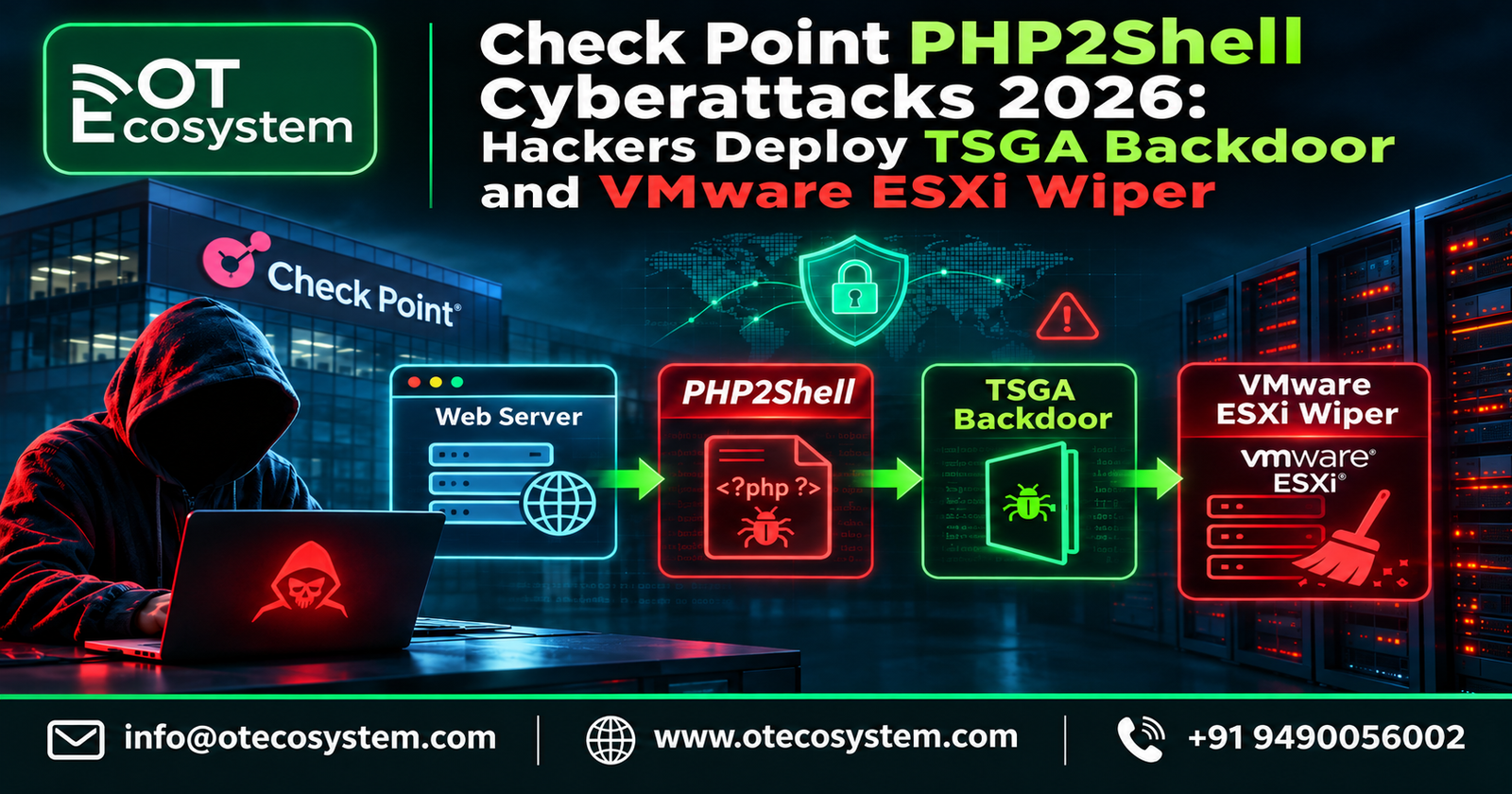
Check Point Research reported on November 12 that an unidentified actor chained the PHP2Shell flaws (CVE-2026-109618, CVE-2026-109619) with a previously unreported Gaia OS root escalation (CVE-2026-123039) to take over unpatched Check Point Security Gateways, install the TSGA backdoor, and in some Israeli cases pivot to a VMware ESXi host and run a wiper. Check Point does not claim to know who is behind it.
What happened: two waves against unpatched Check Point gateways
Beginning October 30, 2026, an attacker scanned for and exploited Check Point Security Gateways whose Mobile Access portals were still unpatched against PHP2Shell, according to Check Point Research’s November 12 report. The first wave hit Israeli organizations and included destructive activity against some of them. A second, broader wave on November 2 reached organizations in multiple countries and sectors, with no destructive activity observed. SecurityWeek carried the story on November 13.
Check Point saw no clear sector preference in either wave and calls the activity consistent with opportunistic initial-access attempts rather than sector-specific targeting. No victim has been named publicly.
Timeline
| Date (2026) | Event | Source |
| Oct 20–21 | Check Point issues IPS protection CPAI-2026-15172 for the PHP flaws | Check Point advisory |
| Oct 21 | PHP ships fixes for CVE-2026-109618 and CVE-2026-109619 | SecurityWeek |
| Oct 23 | Check Point posts a permanent hotfix (sk1000302), per a community report | fireverse.org (community blog) |
| Oct 26 | CISA adds the two PHP CVEs to its KEV catalog, per one outlet; not independently confirmed here | Daily CyberSecurity |
| Oct 30 | First wave: exploitation of Mobile Access portals in Israel, followed by wiper activity | Check Point Research |
| Nov 2 | Second wave: scanning and exploitation worldwide, no destructive activity seen | Check Point Research |
| Nov 8 | Check Point creates bulletin sk1000362 for CVE-2026-123039 | Check Point SK |
| Nov 12 | Check Point Research publishes its analysis; SK updated | Check Point Research |
Check Point’s own wording is that activity began “approximately one week after a security fix became available.” That is the central lesson: the patch gap, not a zero-day, opened the door.
Root cause: an internet-facing PHP bug plus a world-writable root socket
The intrusion needed two flaws, one for the way in and one for root. Neither alone gave the attackers what they wanted.
Initial access: PHP2Shell (CVE-2026-109618, CVE-2026-109619)
PHP2Shell is the name used for two critical remote code execution flaws affecting PHP from version 5 onward, patched by PHP on October 21, per SecurityWeek. Daily CyberSecurity lists both at CVSS 9.2 (CVSS v4) and gives fixed PHP releases of 8.2.35, 8.3.36, 8.4.27 and 8.5.12. SecurityWeek reports that exploitation began days before patches and escalated to mass exploitation soon after.
On Check Point gateways, the exposed component is the Mobile Access portal, which runs PHP. Exploitation gave the attackers code execution as the portal’s service account, not root.
Privilege escalation: CVE-2026-123039 in Gaia DynamicCLI
Check Point’s bulletin sk1000362 describes the second flaw as a local privilege escalation rated CVSS 7.8:
- Gaia’s dynamic CLI is served by a root process, dynamic_server, listening on the local socket /tmp/dynamic_socket.
- On affected builds the socket is created world-writable (0777) and does not authenticate the connecting process.
- The process runs whatever command string it receives as root, so any local user can get root with a single request.
Check Point stresses it is not remotely exploitable on its own: the attacker must already have local code execution. PHP2Shell supplied exactly that. The bulletin also states Check Point “observed an active exploit of this vulnerability against a couple of dozen customers.”
Affected: Check Point Force Firewalls, Management and Log Servers, Multi-Domain Security Management and Multi-Domain Log Server, and Maestro Orchestrator on R82.20, R82.10, R82, R81.20, R81.10 and R81. Spark Firewalls and Smart-1 Cloud are not affected.
Fixed in Jumbo Hotfix Accumulators: R82.20 Take 14, R82.10 Take 52, R82 Take 132 and R81.20 Take 174 (and later). The bulletin lists no fixed take for R81.10 or R81, both end-of-support.
Attack methodology: from a login portal to a wiped hypervisor
Check Point describes one investigated intrusion in detail. Not every victim necessarily followed every step; the ESXi stage in particular was seen only in the destructive cases.
- Exploitation of the Mobile Access portal. On October 30, PHP session files appeared under /opt/CPcvpn-R81.20/tmp/, some containing an upload_progress_pwn marker tied to the exploit. The portal’s Apache/PHP workers also logged hundreds of segmentation faults, a useful detection signal for repeated exploit attempts.
- Root via CVE-2026-123039. The attacker escalated from the portal service account to root through the DynamicCLI socket.
- Webshell persistence. Using root, they wrote PHP webshells named zz<random>.tpl into the portal’s templates directory, then swapped the first small shell for a more capable one. The upgraded shell needs a hardcoded key, runs OS commands and PHP code, and saves uploads to /tmp/.up.tpl, which was then copied into the portal as challenge_render.tpl.
- TSGA backdoor. The attackers launched /tmp/CPconfigdaemon in the background. As root it relocates itself and relaunches as slot_CPconfigdaemon in the boot persistence directory. Check Point lists encrypted remote access, configuration theft, backup and snapshot persistence, process injection and binary firewall-log tampering among its functions.
- TSProxy. TSGA carries an embedded library, dropped as /lib/libcpfwcommon.so, that is injected into selected appliance processes and intercepts networking functions so specially marked attacker connections are handled while normal traffic continues. It supports encrypted SOCKS-style proxying. Check Point’s summary: a persistent standalone backdoor combined with concealed access through existing appliance services.
- Internal discovery. The open-source gogo scanner was deployed on the gateway to map internal assets and services.
- Lateral movement to ESXi. The attackers connected over SSH to a VMware ESXi host, authenticating as the vpxuser service account. Check Point’s report does not say how those credentials were obtained.
- Destruction. They staged the destroy_v6 Linux ELF wiper on the host and ran it. It takes a target directory, recursively deletes files regardless of extension, skips directories on an exclusion list (-w), overwrites files with zeros first by default (skipped with -f fast mode), and writes DREAM_ANNEXATION.txt into each processed directory. The note carries a timestamp and rejects ransom negotiation.
TSGA technical notes
TSGA and TSProxy are modified variants of PhiliKit, a framework previously documented by ESET in Ivanti VPN attacks. Both TSGA and PhiliKit trace to Tiny SHell and speak authenticated, encrypted traffic over TCP port 11072 and the Unix socket /tmp/.p_sock. A notable difference: the analyzed PhiliKit build listens on loopback only, while TSGA listens on all IPv4 interfaces, which makes it directly reachable on the network by anyone holding the credentials.
Threat actor and attribution: no confident answer
Check Point does not name an actor and says the evidence “does not allow us to assess with high confidence the true nature of this operation.” I found no public claim of responsibility from any group as of November 13. The table separates what is established from what is only suggested.
| Claim | Status | Basis |
| TSGA and TSProxy are PhiliKit variants | Established by Check Point | Shared code, configuration and cryptographic material; TSProxy matches PhiliKit’s libdssafe.so on credentials, transport secrets, three activation-selector digests and the TLS certificate and private key |
| PhiliKit is linked to China-nexus UNC5221 | Prior third-party association | ESET’s earlier reporting on Ivanti attacks, cited by Check Point; not Check Point’s own conclusion about this case |
| Operators work in China hours | Circumstantial | Scanning concentrated 00:00–09:00 UTC, which is 08:00–17:00 in China |
| China-linked infrastructure and tooling | Circumstantial | Attacker IPs on LightNode VPS hosting; the gogo scanner appears in CISA reporting on China-nexus Ivanti exploitation |
| This was a China-nexus state operation | Not established | Destruction, the Israel focus, the Hebrew-language note and PhiliKit’s name (from the internal name “philistine”) do not fit known China-nexus motives |
| Actor is Israel-focused hacktivist or politically motivated | Not established | The note references the Israeli-Palestinian conflict, but Check Point does not treat it as proof of motive |
Check Point lists four scenarios it cannot rule out: the identified actor ran the whole campaign; the actor was only an initial access broker; a false-flag operation; or the destructive stage was a smoke screen.
The wiper note uses the Dream Security brand. Dream had recently published research on PHP2Shell exploitation of Palo Alto Networks devices by China-nexus actors. Check Point says the timing raises the possibility of retaliation but the evidence does not establish a clear motive. I could not open Dream’s post directly, so that detail rests on Check Point’s and SecurityWeek’s accounts.
Impact assessment: confirmed damage is narrow, exposure may be wider
Confirmed by Check Point
- Exploitation of CVE-2026-123039 against “a couple of dozen customers.” That figure describes the privilege-escalation exploit, not the number of organizations that lost data.
- Destructive wiper activity against some Israeli organizations in the October 30 wave.
- No destructive activity in the November 2 wave, which spanned multiple countries and sectors.
Not disclosed
- Victim names, sectors, and how many ESXi hosts or virtual machines were destroyed.
- Data loss, downtime, recovery cost or any financial figure.
- Any regulatory action or statement from an affected organization.
Assessment (mine, not Check Point’s): TSGA can steal gateway configurations, and the gateway sits between networks. Any organization with a confirmed TSGA or webshell artifact should treat VPN, user, certificate and shared-secret material on that appliance as exposed and rotate it, even if no wiper ran. A gateway implant that can tamper with binary firewall logs also means the gateway’s own logs cannot be the only evidence used to scope the incident. Reporting duties for a destructive incident vary by jurisdiction and sector; none have been reported publicly.
IT, OT and ICS implications: the firewall is the pivot
Check Point reported no industrial victims, and no OT process impact has been described. The relevance to OT is architectural, and the points below are my analysis of the attack path.
- Gateways sit on the IT/OT boundary. Perimeter firewalls and remote-access portals are often what stands between corporate networks, plant DMZs and vendor access. A root implant there can see and proxy traffic into zones the attacker could not otherwise reach. TSProxy’s SOCKS-style proxying supports exactly that kind of pivot.
- Virtualized industrial workloads. Many sites run SCADA servers, historians, HMIs, engineering workstations and jump hosts as VMs on ESXi. A wiper run on a hypervisor can affect every guest on it at once, and one that overwrites files with zeros first leaves little to recover. Check Point’s report does not say which ESXi directories were targeted.
- Management plane reachability. The attackers got from gateway to ESXi over SSH with a vCenter-style service account. If a perimeter device can open SSH to hypervisors, segmentation has a hole, regardless of how the OT zones are drawn.
- Detection blind spot. Log tampering on the gateway weakens the usual source of truth for IT/OT boundary monitoring. Passive network monitoring in the OT zone, which the attacker cannot reach from the gateway, becomes the independent record.
- Patch windows. Plants that defer firewall changes for uptime face the same one-week gap Check Point observed. Exposed remote-access portals are the highest priority for out-of-cycle patching.
- IoT and remote sites. Check Point’s bulletin lists gateways, management and log servers and Maestro as affected, and Spark Firewalls as not affected, so small branch appliances of that line are outside this issue.
The pattern, edge device to hypervisor to destruction, matches the broader trend of attackers targeting virtualization layers where recovery is hardest.
Response and recovery: fixes exist, victim recovery is unreported
Check Point has published fixes and mitigation for the privilege-escalation flaw, and earlier protections for the PHP flaws:
- CVE-2026-123039: fixed in the Jumbo Hotfix takes listed above. As a stopgap, Check Point advises stopping the dynamic_server process and preventing its restart; this breaks the Dynamic CLI commands listed in sk144112. The bulletin gives the exact dbset steps.
- PHP2Shell on gateways: IPS protection CPAI-2026-15172 was published October 21. Community posts on CheckMates report that R82.20 protects itself through that signature even with IPS disabled, and that a hotfix (sk1000302) followed on October 23 and requires a reboot. Treat these as community reports and confirm against the SK.
- Verification: after patching, /tmp/dynamic_socket should show 0660 root:config, not 0777.
Check Point has not described the recovery status of affected customers, and I found no statements from victim organizations. Patching does not remove implants already installed, so a fixed gateway can still be compromised.
Security recommendations
Items marked (vendor) come from Check Point’s bulletin; the rest are general best practice that fits this attack path.
1. Patch and shrink exposure
- Install the Jumbo Hotfix take that fixes CVE-2026-123039 (vendor), and confirm the PHP2Shell protection or hotfix is in place on every gateway with Mobile Access enabled.
- On R81.10 and R81, which have no fixed take, apply the dynamic_server mitigation (vendor) and plan an upgrade to a supported release.
- Keep Mobile Access portals and management interfaces off the open internet where the business allows, or restrict them to known source ranges.
2. Hunt before you trust the patch
On each gateway or cluster member, check the DynamicCLI log (vendor):
grep “Received =” /var/log/dynamicCli.log | grep -vF “CPprofile.sh >> /dev/null; export SP_DISTRIBUTE=0; set -o noglob;”
grep -F “Received = #return_value#” /var/log/dynamicCli.log
Also look for the artifacts in the indicators table below: zz*.tpl files in the portal templates directory, challenge_render.tpl, /tmp/.up.tpl, /tmp/CPconfigdaemon, slot_CPconfigdaemon, /lib/libcpfwcommon.so, /tmp/.bd.log, listeners on TCP 11072, and repeated Apache/PHP segmentation faults. After patching, blocked escalation attempts appear as “Rejected connection from unauthorized uid” (vendor).
Because TSGA can alter firewall logs, compare against independent records: NetFlow, upstream proxies, and ESXi and vCenter authentication logs.
3. Contain the gateway-to-hypervisor path
- Block SSH from gateways and DMZ hosts to ESXi management interfaces; allow management only from a hardened admin jump host.
- Disable the ESXi SSH service when not in use and enable lockdown mode.
- Alert on any vpxuser SSH login that does not originate from vCenter, and rotate host and service credentials if a gateway is suspected.
4. If a gateway is confirmed compromised
- Isolate it, preserve a forensic image, and rebuild from known-good media rather than cleaning in place.
- Rotate VPN credentials, certificates, pre-shared keys and admin passwords stored on or reachable from the appliance, since TSGA can copy configurations.
- Review ESXi hosts reachable from that gateway for unexpected SSH sessions and for DREAM_ANNEXATION.txt files.
5. OT-specific resilience
- Keep offline or immutable backups of ESXi host configurations and VM images for SCADA, historian and HMI servers, and test restores.
- Keep the IT/OT boundary monitored by passive sensors the gateway cannot alter.
- Rehearse manual operations and known-good rebuild procedures for virtualized control-room systems; confirm safety systems do not depend on the virtualization layer.
Latest developments (as of November 13)
- Check Point Research published its analysis on November 12 and updated sk1000362 the same day; SecurityWeek and The Hacker News followed on November 13.
- The actor remains unidentified, and no group has claimed the attacks.
- I found no reports of a third wave, newly named victims, or vulnerabilities beyond the three CVEs.
- I could not confirm whether CVE-2026-123039 has been added to CISA’s KEV catalog.
- Watch Check Point’s SK pages and Research blog for revised fix versions (notably for R81.10 and R81) and any IOC additions.