
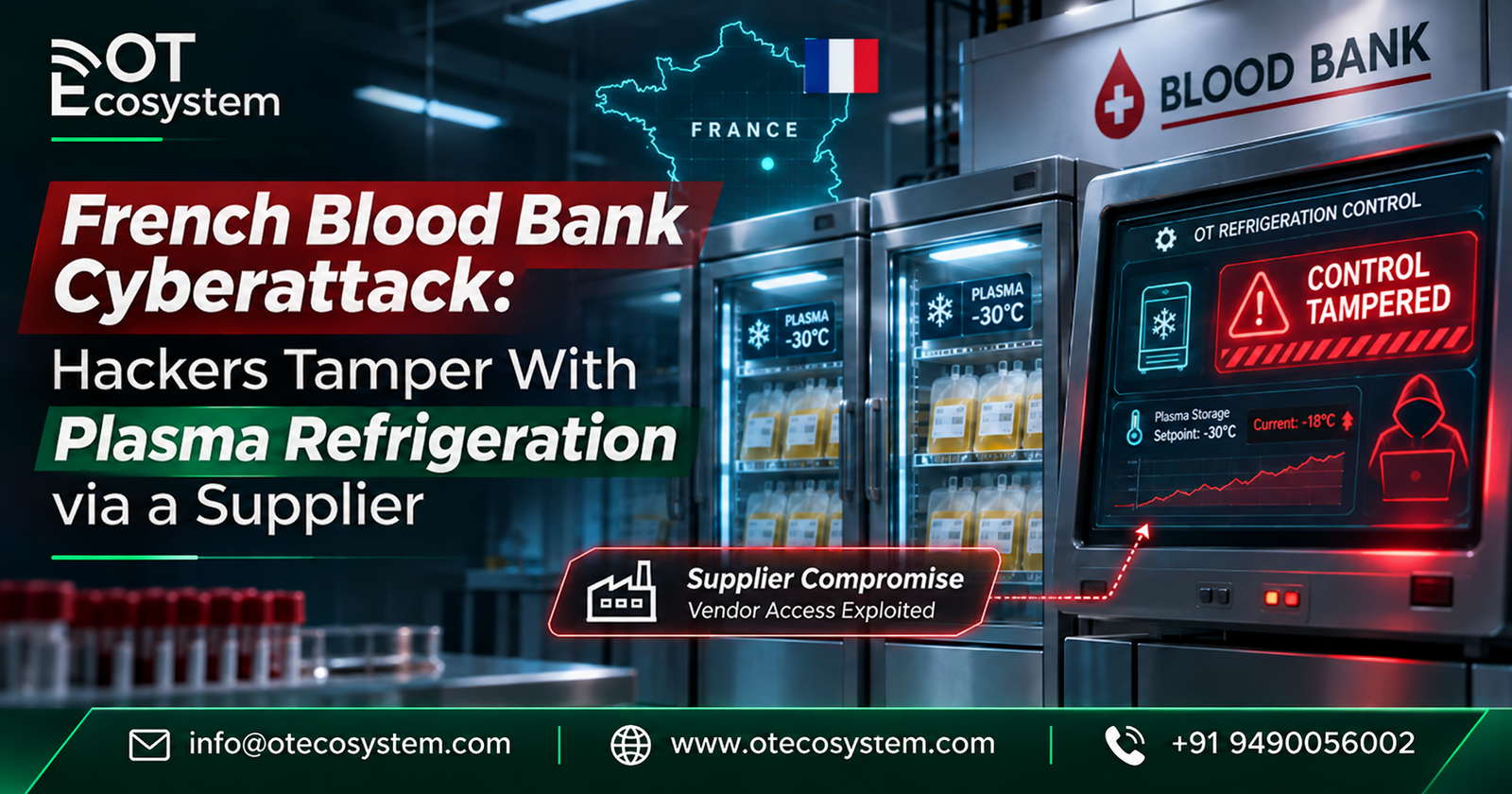
Attackers changed temperature and defrost thresholds at three French Blood Establishment (EFS) cold-storage sites. Monitoring caught it, and no blood products were lost. For OT teams, the lesson is about the supplier path, not the freezer.
An attack that began as a remote settings change on refrigeration equipment nearly turned into a loss of plasma meant for patients. In the early hours of Monday, November 2, 2026, attackers reached systems that control cold rooms used by France’s national blood service, the Établissement français du sang (EFS). The service says alarms and staff stopped the damage before any product was spoiled. It also says the attack hit a refrigeration-equipment supplier, not its own network.
This is an OT incident in the plainest sense: a physical process, temperature, was manipulated through a remotely reachable control system, and a third party sat in the middle. It also lands three weeks after a campaign against French supermarket refrigeration that spoiled food at hundreds of stores. Whether the two are connected is not established.
Incident overview: what is confirmed
Confirmed by EFS (as reported by AP):
- In a statement released late Tuesday, November 3, EFS said temperature and defrost thresholds were raised to “extremely high levels” on Monday at three of its cold-storage sites for plasma.
- The attack hit a supplier of refrigeration equipment at those three sites.
- The affected plasma included bags intended for transfusion and plasma used to make medicines. EFS says these were moved or secured.
- Monitoring and alarm systems detected the anomalies and staff acted. EFS reports no health consequences and no lost blood products.
- Blood collection and distribution continue without interruption.
- France’s national cybersecurity agency (ANSSI) and the Health Ministry are investigating.
Reported by the French press, not fully confirmed by EFS or authorities:
- Le Canard enchaîné revealed the story. It reported that equipment meant to hold material at about −30°C was commanded to reach as high as 110°C, and that sites in Bourgogne-Franche-Comté were among those concerned.
- The supplier was named as Coolworld, a refrigeration and maintenance company that serves healthcare and pharma. Reports say it maintains refrigerated storage containers for EFS. At the time of writing, no public statement from Coolworld was found.
- Press accounts say an on-call technician noticed the temperature rise overnight, and that the Health Ministry described the outcome as having zero operational consequences.
A caution on the 110°C figure. A setpoint is a command, not a measurement. Security outlets covering the story point out that a 110°C setting does not show that the storage compartments or plasma bags themselves reached that temperature. How hot the interiors actually got, and for how long, would show up in independent temperature logs, which have not been published.
A shifting description of the product. EFS initially described the material as donor samples kept for blood-safety monitoring. It later acknowledged that frozen plasma for patient transfusion was also involved. That evolution is worth noting for readers, but the final EFS statement is the authoritative account.
Root cause and attack methodology: largely unknown
The honest summary is that the initial access vector has not been disclosed.
What we do not know publicly:
- Which controller or supervision platform Coolworld or EFS used.
- Whether the entry point was an exposed management interface, a known vulnerability, stolen or default credentials, or the supplier’s remote-access tooling.
- Whether any malware was involved. Coverage so far describes no data theft and no encryption, and no ransomware has been reported.
What the evidence does support is the shape of the attack: the damage came from changing legitimate parameters (temperature and defrost thresholds) on cold-storage control systems at a supplier-managed installation, rather than from destroying data. That is a “living off the land” style of OT sabotage. No exotic exploit chain is needed once someone can reach a management interface with valid or guessable access.
One French security expert from ESET, quoted in the press, characterized these refrigeration attacks as not highly sophisticated. Treat that as an expert assessment, not a finding about this specific intrusion.
Possible link to the October supermarket campaign
On the night of October 11–12, 2026, remote attackers forced refrigeration systems at several hundred French supermarkets into continuous defrost, with temperatures reaching around 50°C. France’s finance minister told Parliament that about 700 of the country’s roughly 10,000 supermarkets were affected, and a Paris prosecutor opened an investigation.
Key facts from that campaign, which matter here as context:
- ANSSI’s CERT-FR published alert CERTFR-2026-ALE-012 on October 12, 2026, reporting numerous compromises of remote refrigeration controllers. It named Danfoss AK-SM and AK-SC series, and on October 13 added Copeland XWEB and Dixell XWEB systems. The alert was updated again on October 16.
- Danfoss said most affected units were legacy products running outdated firmware.
- Claroty’s Team82 had published research in August 2026 on the Danfoss AK-SM 800A (including CVE-2025-41451 and CVE-2025-41452) and on Copeland XWEB Pro. A separate Copeland weakness, CVE-2026-21718, involves predictable administrator credentials. None of this research has been publicly tied to the attacks. The access method in the supermarket case has not been disclosed either.
- Nobody has claimed responsibility and no ransom demand has been reported. Some outlets mention an unproven Russian lead; there is no public evidence supporting it.
What links the EFS incident to that campaign? Timing and technique. The French press reports that the Coolworld incident occurred the same night as disruption at supermarkets in other European countries, and describes the attack as part of a wave. But the CERT-FR alert does not mention EFS, no one has identified the controller model used at the EFS sites, and EFS does not publicly draw the connection. Attribution to the same actor is unverified.
Threat actors and attribution
There is currently no confirmed attribution and no claim of responsibility for the EFS incident. Treat any named group or nation-state as speculation. The absence of a ransom demand or stolen data across the wider refrigeration campaign has puzzled investigators, according to reporting on the supermarket case. Motive could range from disruption or hacktivism to experimentation by opportunists who found exposed devices. None of these can be asserted from public information.
Impact assessment
- Operational: EFS reports no interruption to collection or distribution. Plasma was transferred or secured at the three sites.
- Health: No health consequences identified. No lost blood products according to EFS.
- Data: No donor or patient data leak has been reported in the public material.
- Financial and regulatory: No figures published. Expect scrutiny of supplier oversight. Health-sector organisations in the EU are generally within the scope of NIS2-type obligations, so questions about third-party risk management are likely; this is an analysis, not a reported regulatory action.
- Reputational: Real. A national blood service with plasma for patients in the crosshairs is a high-visibility story, even with a clean outcome.
The counterfactual explains why this matters. Fresh frozen plasma is generally kept at −25°C or below. An unnoticed excursion would have forced quarantine or destruction decisions, with downstream effects on supply for both transfusion and plasma-derived medicines.
Why this matters for IT, OT, IoT and ICS security
1. The supplier is part of your attack surface. The EFS says it was not directly targeted; the attack went through the party that supplies and maintains the equipment. Refrigeration contractors typically need remote access to adjust settings and receive alarms. That path can expose a medical storage process even when the primary network is untouched. This is the same trust relationship that drove many industrial incidents.
2. Safety-critical processes hide in “facilities” equipment. Cold rooms, HVAC, and refrigeration controllers are rarely in the OT asset inventory, but for blood, vaccines, pharma and food they are a safety function.
3. Alarms detected the attack, which is the good news. The control that worked was monitoring and alarming with humans able to act. Commentary from a CSO Online OT consultant on the supermarket wave makes the same point: stores that reacted fast kept their stock, and the key variable was time from first warning to intervention.
4. The damage mechanism is legitimate functionality. Defrost cycles and setpoints are normal features. An alarm tells you the product is warming; it cannot tell you the command came from someone who should not be logged in.
5. End-of-life controllers. Reporting on the supermarket case says Danfoss ended updates for the AK-SM 800 in May 2021 and the AK-SC 355 in 2016, so there is nothing to patch. Whether similar equipment is in use at EFS sites is unknown.
Incident response and recovery status
- EFS operators detected the temperature rise through monitoring and alarms and moved or secured the plasma.
- According to the French press, technical teams are working with ANSSI and the Health Ministry, and temperature monitoring has been strengthened across the whole fleet of cold storage.
- ANSSI’s general guidance for compromised refrigeration controllers (from the supermarket alert) is to remove internet exposure, factory-reset, reconfigure, and restore access only through a secure VPN or protected network.
- Recovery status: EFS says operations are normal. No public information on remediation at Coolworld.
Latest developments (as of November 4, 2026)
- AP reported EFS’s statement on November 3–4, confirming three sites and no product loss.
- The Health Ministry and ANSSI investigation is ongoing; no technical report has been released.
- No claim of responsibility, no public attribution, and no confirmed link to the October supermarket campaign.
- ANSSI director Vincent Strubel had told the French Senate on October 21 that refrigeration systems are a weak point, including in healthcare, according to French reporting.
Security recommendations
For healthcare, pharma, food and any cold-chain operator:
- Inventory every refrigeration and storage controller by model, firmware, vendor support status, and network path. Include contractor-installed cellular routers and port forwards.
- Remove direct internet exposure. Management interfaces belong behind a VPN or a gateway you control, with MFA and accounts tied to named technicians. Search Shodan or Censys for your own exposed interfaces.
- Write the supplier path into contracts. Name every permitted remote access route, require logs, require notification when a controller leaves vendor support or a vulnerability is published, and keep the right to revoke access. CERT-FR also advises checking insurance terms before cutting a contractor’s data feed.
- Change default and vendor credentials, and rotate them after any suspected exposure.
- Alarm on the command, not just the temperature. Flag unexpected setpoint, defrost, or alarm-delay changes outside maintenance windows, especially several circuits at once.
- Add independent temperature loggers that do not share the controller’s network, so a compromised controller cannot hide the consequence.
- Define the 3 a.m. call chain with names, authority to act, and a rehearsed procedure for transferring product. Test it by changing a setpoint on a test circuit and timing the response.
- Plan replacement for end-of-life controllers with an owner and a budget line; a firewall alone is a stopgap.
- Document excursion handling for quality teams: what temperature data is needed to release or quarantine product after an incident.