
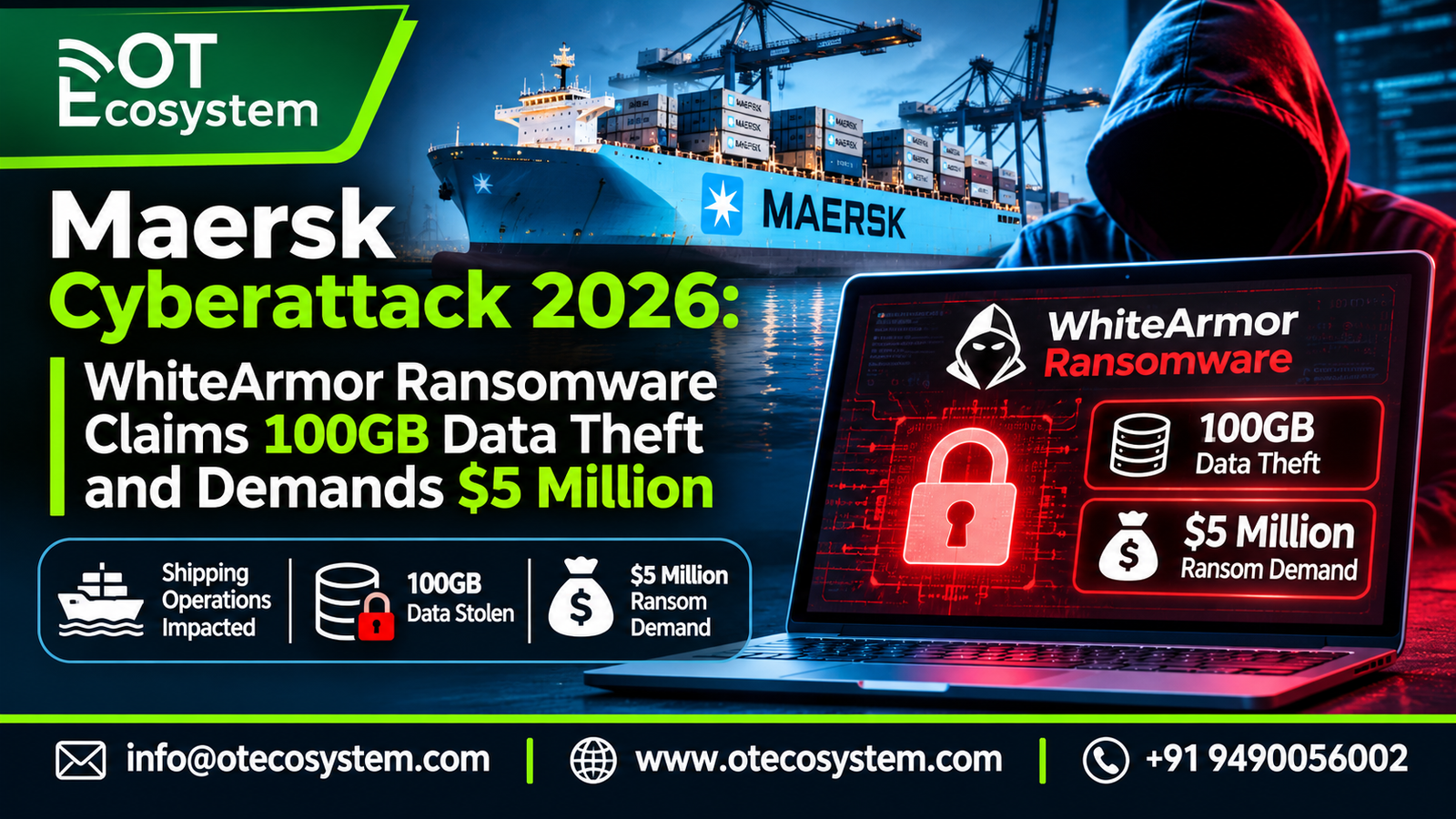
What happened: incident overview
Maersk published a notice on 11 November 2026 saying a threat actor gained unauthorized access to a local legacy system and took data from it. BleepingComputer reports that Maersk did not say which system was affected, what kinds of data were involved, or when the intrusion began.
The disclosure followed a claim by WhiteArmor, which, according to BankInfoSecurity, took responsibility on Saturday, 7 November. Trackers such as DeXpose and f4n6 also logged the listing on 7 November.
Confirmed by Maersk (per press reports of its notice)
- An attacker accessed a legacy IT system inherited through an acquisition and extracted data.
- The company’s own security team found the intrusion and contained it.
- Early findings “strongly suggest” no sensitive data was disclosed, per Cybernews.
- The incident is isolated to a local system, and Maersk has found no sign of impact on other Maersk systems or on customer and partner systems connected through integrations such as APIs and EDI.
- No operational disruption is anticipated, and customers can keep booking and managing shipments on Maersk platforms.
- The investigation is continuing.
Claimed by WhiteArmor (unverified)
- Roughly 100 GB of data from Maersk’s OCF/LF Logistics platform.
- Contents including driver records, staff accounts, delivery recipients’ names and addresses, and mobile device logs holding phone numbers, emails and device identifiers (BankInfoSecurity).
- More than 16,000 Maersk driver passwords stored in plain text, per the leak-site listing as reported by Cybernews.
- A $5 million ransom payable in bitcoin within 30 days, or the files will be published.
The volume, the data categories and the ransom figure all come from the attacker. None has been independently confirmed. The tracker f4n6 noted that its own sourcing for the claim was the leak-site post indexed by ransomware.live, with no verified samples.
Root cause: what is known and what is not
No root cause has been published. Maersk has not disclosed the initial access vector, and no CVE has been tied to the incident. Any statement about a specific vulnerability or stolen credential would be speculation.
What the public record does support is the setting. The affected system came with a business Maersk bought. Maersk acquired Hong Kong-based LF Logistics in 2022, reported by Neowin at $3.6 billion, and Cybernews researchers link the breach to that platform. Cybernews notes the platform mostly holds data belonging to other logistics companies, and says that by abusing admin accounts an attacker could alter customer account data, including creating or deleting orders. That is a researcher assessment of what such access would permit, not a finding that it happened.
The plain-text password claim, if true, would point to weak credential storage in the acquired platform. It is a claim, not a finding.
Attack methodology
Technical detail is thin. What can be said:
- No encryption reported. Maersk has reported no outage, and Danish outlet Ingeniøren, via Container News, cites specialists who consider the claim plausible but see a data theft and extortion case, not a conventional encrypting ransomware attack.
- Exfiltration is the pressure point. The threat is to publish stolen files if the ransom is not paid.
- Unknown: initial access, dwell time, privilege escalation, lateral movement and tooling. None has been disclosed.
For context on how this group may operate, SOCRadar analysed a separate WhiteArmor claim against J.B. Hunt and found fresh infostealer records tied to that company’s SSO portal around the listing date. SOCRadar itself says this does not show WhiteArmor used those credentials. It is a different victim and should not be read across to Maersk.
Threat actor and attribution
WhiteArmor is new. BankInfoSecurity reports it has been active since 21 October and has claimed more than 20 organizations worldwide, including large logistics firms, a furniture retailer and an electronics manufacturer. Its alleged attack on J.B. Hunt led to a proposed class action. Tracker counts differ widely (one lists a single victim, another 18), which reflects how new the group is and how inconsistent leak-site indexing can be.
Attribution status:
- Confirmed: nothing about the group’s identity, origin or affiliations.
- Contested: whether Maersk has tied its incident to WhiteArmor. Cybernews reported that Maersk confirmed the notice describes the same breach WhiteArmor claims, while Container News and Ships & Ports say Maersk has not confirmed WhiteArmor was responsible. Treat the link as likely but not settled.
- Unverified: that the data WhiteArmor holds is the same data Maersk says was extracted. Container News reports no independent evidence of a match.
- Not established: any nation-state link. Everything points to financially motivated extortion.
WhiteArmor told ISMG that Maersk had not contacted it to negotiate. That is the attacker’s account.
Impact assessment
- Operational: none reported. Maersk says bookings and shipment management continue normally.
- Data and privacy: unknown. If the claimed driver, staff and recipient data is real, individuals in several countries could be affected. Maersk’s early view that sensitive data was not disclosed has not been tested against the leaked material, because nothing has yet been published.
- Partners and customers: because the platform reportedly holds third-party logistics data, customers of the acquired business may have notification and contractual questions even if Maersk’s core systems were untouched.
- Financial: no loss figure exists. For scale, the 2017 NotPetya attack cost Maersk an estimated $250 to $300 million, forced reinstallation of about 4,000 servers and 45,000 PCs, and took its network offline for roughly 10 days (BleepingComputer archive; BankInfoSecurity). This incident is a different category: data theft from an isolated system, with no reported outage.
- Regulatory and legal: if personal data is confirmed stolen, GDPR breach-notification duties (72 hours to the supervisory authority) and NIS2 incident reporting for maritime transport entities may apply. Maersk has not said what it has filed. The J.B. Hunt case shows that class actions can follow within days of a claim, even before the data is verified (The Loadstar).
- Reputational: Maersk’s 2017 recovery is a case study in cyber resilience, so a breach in an inherited system lands awkwardly. The company’s quick public statement limits some of that.
Why it matters for IT, OT, IoT and industrial security
This is an enterprise IT incident. Nothing reported touches vessel systems, terminal operating technology, cranes, gate automation or other OT. It is still relevant to industrial and maritime defenders for three reasons.
- Inherited infrastructure is the soft edge. Acquired platforms often run with different identity systems, patch levels and logging than the parent. Security teams in ports, shipping and manufacturing buy or merge with operators regularly, and each deal imports unknown assets.
- Logistics platforms sit next to operational flows. Warehouse, driver and delivery systems connect to ordering, EDI and APIs that feed physical movement of goods. Maersk says its integrations were not affected, which is the property good segmentation is meant to provide. Whether that holds up under investigation is the open question.
- Driver and mobile device data is an IoT-adjacent exposure. Device logs with identifiers and contact details, if genuine, can support phishing and fraud against a mobile workforce.
For OT owners, the takeaway is architectural. Zone and conduit models under IEC 62443 and the guidance in NIST SP 800-82 exist so that a compromise of a business-side platform stays business-side. Maritime operators should also check how this maps to IACS UR E26 and E27 for ships and to IMO cyber risk management expectations.
Incident response and recovery status
As of 12 November 2026:
- The affected system has been isolated and the incident contained, according to Maersk.
- The investigation is ongoing, and Maersk has said findings so far point to no disclosure of sensitive data.
- Maersk has not said whether it will negotiate or pay. WhiteArmor says no contact has been made.
- We found no reports that the data has been published, and the attacker’s 30-day window runs to roughly early December.
- Maersk’s wider operations are described as running normally.
Security recommendations
These are general practices prompted by the incident, not claims about what Maersk did or failed to do.
For M&A and inherited systems
- Inventory every acquired system within the first 30 days and give each an owner, an internet-exposure review and a decommission or integrate decision.
- Do not connect acquired networks to the parent until identity, logging and patching meet a baseline. Until then, treat them as untrusted zones.
- Put an end-of-life date on every legacy platform and enforce it.
Identity and credentials
- Store credentials with modern salted hashing, never plain text. Audit acquired apps for this directly.
- Enforce phishing-resistant MFA on admin and remote access, and rotate privileged and service credentials after any suspected intrusion.
- Monitor for infostealer-sourced credentials tied to your domains and force resets on matches.
Detection and containment
- Alert on large outbound transfers and unusual archive creation, since extortion-only attacks depend on exfiltration.
- Centralize logs from legacy systems early so investigators can establish timeline and scope.
- Keep egress filtering tight on isolated segments.
IT/OT and supply chain
- Verify segmentation by testing it, including API and EDI paths between business platforms and operational systems.
- Review supplier contracts for breach-notification duties and confirm who to call at logistics partners.
- Rehearse an extortion scenario with legal, communications and privacy teams, including how to verify an actor’s claims before responding.
If you are a Maersk or LF Logistics customer or driver
- Reset any reused passwords, watch for targeted phishing, and ask your account contact what data of yours sat on the affected platform.
Latest developments
- 11 November: Maersk publishes its notice. BankInfoSecurity reports WhiteArmor’s 7 November claim and the 30-day deadline.
- 11 to 12 November: Danish and trade outlets report that experts regard the claim as credible but more likely extortion without encryption. Whether the attacker’s dataset matches Maersk’s extracted data remains unconfirmed.
- Still unknown: access vector, intrusion dates, volume actually taken, number of people affected, and whether any regulator has been notified.