
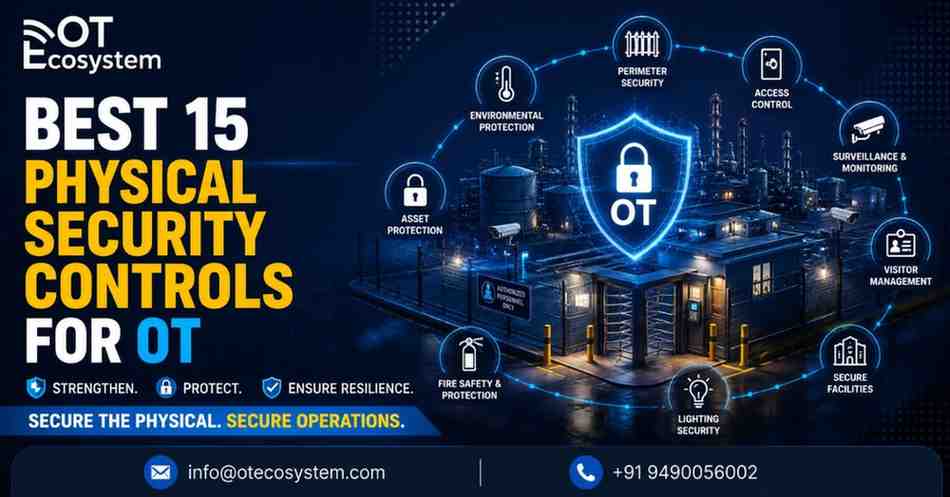
The 15 Best Physical Security Controls for OT and ICS Environments
In the high-stakes world of Industrial Control Systems (ICS) and Operational Technology (OT), cybersecurity dominates the headlines. We constantly read about sophisticated ransomware gangs targeting manufacturing plants, state-sponsored actors probing power grids, and zero-day vulnerabilities in Programmable Logic Controllers (PLCs). Yet, among the intense focus on firewalls, network segmentation, and intrusion detection, a fundamental truth is often dangerously overlooked: If an attacker can physically touch your OT equipment, it is no longer your equipment.
Welcome to a comprehensive deep dive brought to you by OT Ecosystem. Today, we are taking a step back from the digital realm to focus on the tangible, concrete, and physical defenses that form the absolute bedrock of industrial cybersecurity.
A compromised digital network can often be isolated, segmented, and scrubbed. A destroyed Remote Terminal Unit (RTU) at a remote electrical substation, or a manipulated sensor on an oil pipeline, requires physical replacement and can lead to immediate, catastrophic kinetic impacts-including environmental disasters, massive financial losses, and threats to human safety.
In this guide, we will explore the critical background of physical OT security and break down the top 15 physical security controls you must implement to harden your industrial environments.
The Background: Why Physical Security in OT is Radically Different
To understand modern physical security controls for OT, we must first understand how industrial environments differ from standard corporate IT spaces.
In traditional enterprise IT, physical security is relatively straightforward: put the servers in a locked, climate-controlled data center in the basement of a secure office building. Issue badge access to authorized IT personnel, and the job is largely done.
OT environments, however, are sprawling, decentralized, and often inherently exposed. Consider the architecture of modern critical infrastructure:
- Water Treatment Facilities: Sprawling campuses with open-air reservoirs and remote pumping stations miles away from the main facility.
- Energy Sector: Thousands of miles of pipelines with exposed block valve stations, or vast wind farms situated in completely unmonitored rural landscapes.
- Manufacturing: Massive, chaotic plant floors where hundreds of contractors, maintenance workers, and operators require access to heavy machinery and the PLCs that control them.
Historically, industrial sites relied on the “Guns, Guards, and Gates” approach. A chain-link fence and a padlock were considered sufficient because the internal control systems were air-gapped and relied on obscure, proprietary protocols. Today, IT/OT convergence has obliterated the air gap. A physical breach at a remote, unmanned pump station can provide an attacker with a direct, hardwired entryway into the broader corporate network, completely bypassing the expensive perimeter firewalls protecting the IT environment.
Compliance frameworks like NERC CIP (North American Electric Reliability Corporation Critical Infrastructure Protection) and IEC 62443 have recognized this paradigm shift, mandating strict physical access controls. Modern physical security must be layered, intelligent, and deeply integrated with the cybersecurity posture of the organization.
The Concept of “Physical Defense in Depth”
Just as we apply “Defense in Depth” to our network architectures via the Purdue Model, we must apply it to our physical spaces. A single locked door is a point of failure; a layered approach ensures that if one physical control is bypassed, another stands in the attacker’s way.
The physical defense architecture is generally broken down into three concentric zones:
- The Perimeter: The outermost boundary of the facility or remote site.
- The Facility/Building: The structural envelope of the control rooms, substations, or plant floors.
- The Cabinet/Device Level: The specific enclosures housing sensitive OT assets like PLCs, RTUs, HMIs (Human-Machine Interfaces), and engineering workstations.
With this layered approach in mind, let’s dive into the 15 most effective physical security controls for modern OT and ICS environments.
Top 15 Physical Security Controls for Critical Infrastructure
1. Advanced Perimeter Fencing and Anti-Climb Barriers
The first line of defense is always the physical boundary. However, standard chain-link fences are easily cut or climbed and offer zero deterrence to a determined attacker. Modern OT facilities must upgrade to high-security fencing (such as palisade or welded wire mesh) that is difficult to grip, cut, or scale. Furthermore, perimeter barriers should include anti-ram features (bollards) near critical assets to prevent vehicular attacks, a growing concern for roadside substations and remote infrastructure.
2. Intelligent Perimeter Intrusion Detection Systems (PIDS)
A fence is only an obstacle; it is not an alarm. PIDS transform passive barriers into active alert systems. By installing microphonic cables, fiber-optic sensors, or seismic sensors directly onto the fencing, security teams are instantly alerted to vibrations caused by cutting, climbing, or lifting. When integrated with PTZ (Pan-Tilt-Zoom) cameras, a PIDS alarm can automatically direct a camera to the exact zone of the disturbance, giving security personnel immediate visual confirmation of the threat.
3. Unified Physical Security Integration Platforms
As operational technology environments become increasingly complex, managing fragmented physical security systems becomes a major vulnerability. Centralizing physical defenses into a unified, enterprise-grade physical security management platform provides critical operational clarity. Rather than juggling disconnected applications for video feeds, badge access, and environmental alarms, a unified control framework allows security teams to manage access control, perimeter intrusion alerts, and environmental sensors from a single, hardened interface. Integrating physical security management tools eliminates administrative blind spots and accelerates response times across critical facilities.
4. High-Definition, AI-Enhanced Video Surveillance
CCTV is standard, but passive recording is no longer sufficient for ICS environments. Security teams cannot watch dozens of monitors continuously. Modern OT video surveillance must leverage edge-based AI analytics. These systems can differentiate between a stray animal, a moving vehicle, and a human intruder loitering near a critical valve. Features like virtual tripwires, facial recognition, and license plate reading allow the camera system to proactively alert guards before a physical breach occurs, rather than just providing footage for a post-incident forensic investigation.
5. Multi-Factor Biometric Access Controls
Traditional RFID proximity cards are easily cloned, lost, or stolen. In a highly sensitive OT environment-such as a central control room or engineering workstation lab-access must be tied to the individual, not just a piece of plastic. Biometric controls (fingerprint scanners, iris readers, or facial geometry) paired with a PIN or a smart card create physical Multi-Factor Authentication (MFA). This ensures that the person operating the HMI is undeniably authorized to do so.
6. Mantraps and Turnstiles (Tailgating Prevention)
“Tailgating” or “piggybacking”-where an unauthorized person closely follows an authorized employee through a secure door-is one of the most common ways physical security is bypassed. To combat this, facilities must employ full-height turnstiles at perimeter entrances and mantraps (security vestibules) at highly sensitive interior zones. A mantrap requires the user to pass through one authenticated door, which must close and lock behind them before the second door can be opened, making tailgating physically impossible.
7. Strict Visitor and Contractor Management Systems
OT environments rely heavily on third-party vendors, system integrators, and maintenance contractors. Relying on a paper logbook is a massive vulnerability. Modern facilities require digital Visitor Management Systems (VMS) that scan government-issued IDs, conduct instant background checks against watchlists, and issue temporary, time-expiring badges. Furthermore, these systems should tie into the plant’s safety protocols, ensuring contractors have completed mandatory safety briefings before access is granted.
8. Physical Port Blockers and Locks
The most devastating malware in OT history was introduced via a USB drive. While software-based endpoint protection can disable USB ports, a determined insider or attacker can sometimes bypass these digital controls. Physical port blockers are cheap, highly effective plastic or metal inserts that lock into unused USB, RJ45 (Ethernet), and serial ports on PLCs, HMIs, and switches. They require a specialized physical key to remove, providing a tangible layer of defense against the introduction of rogue devices or malware.
9. Tamper-Evident Seals and Cabinet Locks
Often, OT equipment like RTUs and network switches are housed in metal enclosures distributed across a factory floor or along a pipeline. These cabinets must be physically locked with high-security, pick-resistant padlocks. Additionally, security teams should employ tamper-evident seals (uniquely numbered plastic or metal zip-ties). While a seal won’t stop a crowbar, it guarantees that if a cabinet is opened, the breach is undeniably visible during the next security patrol or maintenance check.
10. Environmental Monitoring and Control Systems
Physical security isn’t just about stopping malicious humans; it’s about stopping physical destruction. Critical OT assets are highly sensitive to temperature spikes, humidity, and water damage. Attackers have been known to target HVAC systems in server rooms to cause thermal shutdowns. Robust physical security includes environmental sensors inside control rooms and network cabinets that alert operators to sudden changes in temperature, the presence of smoke, or water pooling on the floor.
11. Secure Cable Routing and Conduits
An attacker doesn’t always need to access a switch to cause a disruption; sometimes, cutting a vital industrial Ethernet cable or fiber optic line is enough to sever visibility to a remote substation. All critical communications and power cabling must be run through heavy-duty, tamper-resistant steel conduits. Exposed cabling is an invitation for sabotage. Additionally, junction boxes where cables are spliced should be treated as critical assets and locked accordingly.
12. RFID Tracking for Removable Media and Critical Assets
In environments where specialized laptops, calibration tools, or secure USB drives (used for patching air-gapped systems) are moved around, keeping track of physical assets is a nightmare. Applying Active RFID (Radio Frequency Identification) tags to these items allows security teams to track their exact location within the facility in real-time. If an engineering laptop is suddenly moved toward an exit gate without authorization, alarms can be triggered instantly.
13. Anti-Drone (UAV) Defenses
The physical threat landscape is moving into the sky. Commercial off-the-shelf drones pose a significant threat to industrial sites. They can be used for aerial reconnaissance to map security blind spots, drop payloads to damage exposed infrastructure, or even hover near facilities to sniff wireless ICS traffic. Implementing RF (Radio Frequency) scanners to detect drone controllers, and optical/acoustic sensors to spot UAVs, is becoming a necessary control for top-tier critical infrastructure.
14. EMP and RF Shielding (Faraday Cages)
For the most sensitive infrastructure-such as nuclear facilities or massive regional power grid hubs-protection against Electromagnetic Pulses (EMP) or severe Radio Frequency Interference (RFI) is considered. Malicious actors can use portable RF jammers to disrupt wireless sensor networks or overwhelm unshielded PLCs. Implementing Faraday cages around critical control cabinets blocks external electromagnetic fields, ensuring the continuous, stable operation of microprocessors inside.
15. Regular Physical Security Penetration Testing
A control is only as good as its last test. Organizations heavily invest in digital penetration testing (Red Teaming), but frequently ignore physical pen-testing. Hiring specialized security teams to actively attempt to break into a facility-picking locks, tailgating employees, cloning badges, and bypassing fences-is the only way to truly validate that your physical security controls are functioning as intended. Physical pen-tests expose the gap between what is written in the security policy and what actually happens on the plant floor.
Conclusion
Securing operational technology and industrial control environments requires an integrated approach where physical security and cybersecurity work hand in hand. Physical perimeters, cabinet locks, access management platforms, and environmental controls form the first line of defense against both targeted physical intrusions and accidental operational disruptions.
By implementing these 15 essential physical security controls, industrial organizations can protect critical assets from physical tampering, limit insider threats, and maintain operational resilience across facilities, substations, and plant floors. Physical security is not merely a background function-it is a foundational pillar of modern industrial cybersecurity defense.