
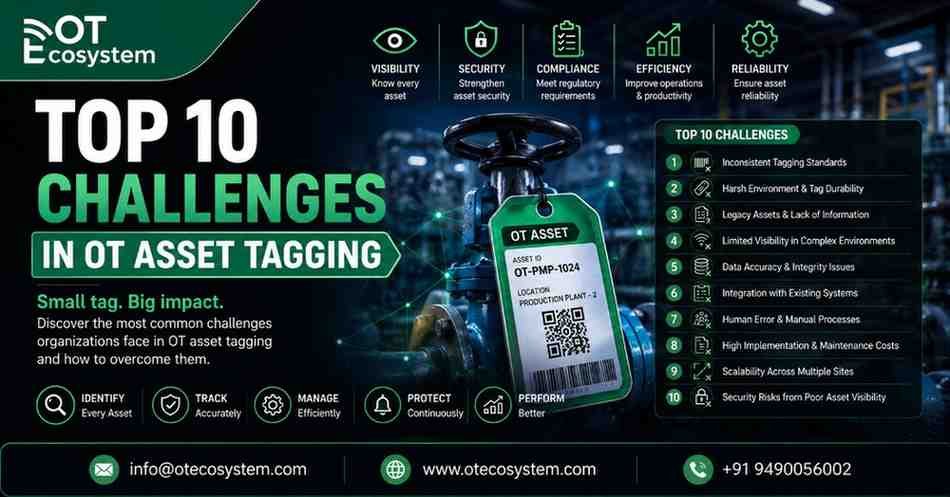
Struggle with OT asset visibility? Explore the top 10 challenges in OT asset tagging and how modern solutions can bridge the gap.
In the hyper-connected era of 2026, the convergence of Information Technology (IT) and Operational Technology (OT) has fundamentally shifted the security landscape. While IT asset management has long relied on standardized agents and scanners, the industrial sector-comprised of PLCs, HMIs, sensors, and legacy SCADA systems-remains shrouded in a “visibility fog.” Asset tagging in an OT environment is not just a clerical task; it is a foundational pillar of cybersecurity. If you cannot identify a device, you cannot patch its vulnerabilities, monitor its behavior, or secure it against emerging threats.
However, unlike the uniform world of enterprise IT, the OT shop floor is a chaotic mix of proprietary protocols, long-lifecycle hardware, and environments where downtime is simply not an option. As we move deeper into the age of Industry 4.0, understanding the roadblocks to accurate asset tagging is essential for any industrial leader striving for cyber resilience.
The Top 10 Challenges in OT Asset Tagging
1. Proprietary Protocol Complexity
Unlike IT networks that lean on standard communication protocols, OT networks utilize a vast array of specialized industrial protocols like Modbus, DNP3, EtherNet/IP, and Profinet. These protocols were historically designed for function rather than metadata-rich identification. Consequently, traditional network discovery tools often fail to “fingerprint” a device accurately, leaving asset tags incomplete or generic. This technical friction makes it incredibly difficult to achieve a granular, “Single Source of Truth” for your industrial inventory.
2. Resistance to Active Scanning
In an IT environment, scanning for assets is a routine, low-risk activity. In OT, an active scan can inadvertently overwhelm a legacy Programmable Logic Controller (PLC) or crash a sensitive communication bus, leading to unplanned production downtime. This “fear of the scan” often leads engineers to bypass automated discovery, resulting in manual, fragmented, and outdated asset records that miss critical configuration details.
3. Dynamic Telemetry and Metadata Extraction Gaps
Extracting actionable metadata without interrupting active control loops represents one of the steepest operational hurdles in OT tagging. Industrial endpoints frequently communicate using stripped-down data frames that omit key identifying information, such as model numbers, firmware builds, or rack configurations. Capturing this deep contextual data requires specialized parsing capable of decoding native industrial traffic passively in real time. Without advanced telemetry extraction, asset records remain surface-level, leaving security teams unable to correlate devices with active CVE databases or accurately evaluate operational risk.
4. Legacy Lifecycle Management
Many assets on the plant floor have been operational for 15, 20, or even 30 years, long predating the modern concept of “cybersecurity tagging.” Tracking the versioning, firmware history, and maintenance records of such long-lived equipment is a monumental task. When hardware remains in service far beyond its original design life, metadata becomes brittle and difficult to map against modern CVE databases, creating significant gaps in your vulnerability management strategy.
5. Highly Distributed Site Architectures
Global manufacturing and utility operations are often spread across diverse geographical locations, ranging from remote substations to high-density factory floors. Maintaining a centralized, unified asset tag registry across these decentralized zones is complex. Variations in local maintenance habits, different regional vendor deployments, and network segmentation hurdles often lead to a “siloed” view where the head office has little insight into the true hardware footprint of remote locations.
6. Lack of Standardized Naming Conventions
In the absence of a top-down governance model, individual plant engineers often develop their own unique methods for naming and tagging assets. One plant might label a controller by its function (e.g., “Boiler_PLC_01”), while another uses a manufacturer-based code (e.g., “AB-1769-L30ER”). This lack of standardization creates immense overhead when attempting to aggregate data for enterprise-wide risk assessment, compliance audits, or rapid incident response.
7. High Frequency of “Shadow OT”
As operational requirements shift, technicians or third-party contractors often connect new IIoT sensors, gateways, or temporary diagnostic laptops to the network without notifying the security team. This “Shadow OT” frequently bypasses standard procurement and onboarding processes, meaning these devices exist without tags, firmware visibility, or access controls, creating blind spots that attackers can easily exploit to gain a foothold.
8. Integration Gaps with Security Operations (SecOps)
A major challenge is the disconnect between asset management systems and actual security monitoring tools. Even when an asset is correctly tagged, that information rarely flows seamlessly into EDR (Endpoint Detection and Response) or SIEM platforms. This siloed data means that when a security alert triggers, the incident responder might not immediately know the context of the device-such as its criticality to the physical process-hindering their ability to prioritize the threat.
9. Rapid Convergence and Interconnectivity
The modern factory floor is increasingly integrated with cloud services and enterprise IT systems to drive efficiency. This constant flux of connectivity means that assets are not static; they are frequently updated, swapped, or re-configured. Traditional, static tagging methods cannot keep pace with this dynamic environment, and without continuous, automated discovery, your asset inventory is often obsolete the moment it is finalized.
10. Compliance and Regulatory Pressure
Frameworks such as IEC 62443, NIS2, and NERC CIP demand rigorous evidence of inventory management. Meeting these standards requires more than just a list of device names; it requires a deep, defensible audit trail of asset configurations and software versions. The burden of maintaining this documentation manually is not only costly but prone to human error, which can lead to significant audit failures and potential legal exposure.
Conclusion
OT asset tagging is the cornerstone of industrial cyber-physical security. By moving away from manual, spreadsheet-based tracking and adopting specialized automated solutions, organizations can evolve from a state of “blind operations” to “informed resilience.” The goal is not merely to list your assets, but to understand their role, their risks, and their behavior.
As we look toward the remainder of 2026, the organizations that succeed will be those that view asset visibility as a continuous, automated, and intelligent process rather than an annual checklist. Start by breaking down your silos and ensuring that your visibility tools are as robust as the industrial processes they are meant to protect.