
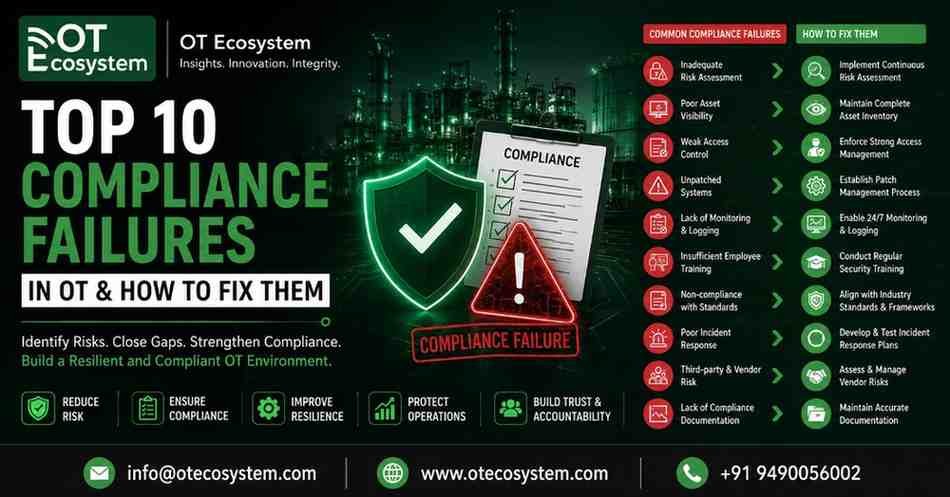
As a senior cybersecurity editor who has spent years analyzing the high-stakes convergence of IT, Operational Technology (OT), and MIoT, I’ve seen the fallout when industrial compliance is treated as a mere checklist. When an enterprise IT network falls, data is lost; when an OT environment is breached, assembly lines halt, water supplies are contaminated, and human lives are put at severe risk. Regulatory bodies are losing their patience. Fines for NERC CIP violations can range from $100,000 to over $10 million, and the EU’s NIS2 directive imposes penalties reaching up to 2% of a company’s global revenue. Yet, despite these staggering financial and operational risks, many critical infrastructure operators continue to make foundational errors in their security architectures. To ensure your organization isn’t making headlines for the wrong reasons, here is our newsroom’s definitive guide to the top 10 compliance failures in industrial environments and exactly how to fix them.
Top 10 Compliance Failures in OT & How to Fix Them
1. Failure to Implement OT-Specific Asset Visibility (The Blind Spot)
Many organizations cannot produce a current, accurate list of every connected device on their industrial networks, fundamentally failing compliance mandates. Equipment is frequently added to the factory floor without IT involvement, and legacy systems or third-party devices operate entirely off the grid. This lack of passive discovery violates the core “Identify” function of the NIST CSF and IEC 62443 standards, which demand absolute network transparency. The fix requires deploying OT-native, agentless discovery platforms that leverage deep packet inspection (DPI) to monitor proprietary ICS protocols like Modbus and DNP3. By continuously mapping the network passively, security teams can comprehensively catalog shadow IoT and MIoT assets without disrupting fragile production environments.
2. Relying on Flat Network Architectures (The Lateral Pathway)
Operational technology was originally designed when air-gapping provided absolute protection, but digital transformation has thoroughly shattered those boundaries. Today, one of the most critical compliance failures under NERC CIP and NIS2 is operating a flat, unsegmented network where IT and OT systems freely communicate. A compromised email server in the corporate domain can easily allow ransomware to pivot directly into a SCADA console or programmable logic controller (PLC). To fix this, organizations must rigorously enforce the Purdue Model by deploying industrial-grade firewalls and strict demilitarized zones (DMZs). Micro-segmentation guarantees that even if the IT perimeter falls, the blast radius is contained, preserving physical safety and operational uptime.
3. Inadequate Third-Party and Supply Chain Risk Management
Industrial environments rely heavily on specialized original equipment manufacturers (OEMs) and external contractors for routine system maintenance. A massive compliance failure occurs when these third-party vendors are granted unfettered, poorly monitored remote access to critical infrastructure. The SolarWinds breach starkly demonstrated that supply chain exploits are a favored tactic for advanced persistent threats (APTs), compromising thousands of organizations through a single vendor. Fixing this requires enforcing strict Role-Based Access Control (RBAC), implementing Zero Trust architectures, and mandating Multi-Factor Authentication (MFA) for every remote session. Continuous monitoring of vendor activity ensures contractors do not inadvertently introduce vulnerabilities or bypass safety protocols.
4. Applying IT Patching Strategies to Fragile OT Systems
Treating OT devices like enterprise IT endpoints is a recipe for operational disaster and a very common regulatory audit failure. Standard vulnerability scanners can actually crash legacy PLCs, and applying patches blindly often requires shutting down critical production lines that must operate continuously. Compliance frameworks acknowledge this tension, yet organizations repeatedly fail by not implementing compensating controls for unpatchable legacy systems. The remediation strategy involves deploying OT-aware exposure management that prioritizes vulnerabilities based on actual operational impact rather than standard CVSS scores. When patching is impossible, teams must rely on network segmentation, secure data diodes, and virtual patching to mitigate risks until planned downtime.
5. Misconfigured IT/OT Convergence and Cloud Integrations
As manufacturers rush to embrace Industry 4.0, they often connect heavily regulated industrial control systems directly to the cloud without proper safeguards. According to industry analysts, a staggering 99% of cloud security failures result directly from human error in configuration. We frequently see SCADA systems exposed to the public internet because of hastily deployed, misconfigured remote access solutions. To resolve this, security teams must treat cloud-connected OT with the exact same rigor as on-premise critical infrastructure, ensuring encrypted transport layers and strict API security. Auditing these boundary connections regularly against ISA/IEC 62443 standards prevents accidental exposure of critical physical processes to the global internet.
6. Neglecting the Physical Security of Cyber Assets
A sophisticated cyber defense is entirely rendered useless if an attacker or malicious insider can simply walk up to a PLC cabinet with a USB drive. Many organizations fail NERC CIP and TSA pipeline directives by focusing exclusively on digital firewalls while completely ignoring physical access controls to critical operational technology. Compliance requires a holistic approach where physical security and cybersecurity are treated as inextricably linked domains. The fix includes securing server rooms, mandating biometric or badge access for sensitive factory zones, and disabling unused physical ports on all industrial equipment. Integrating physical access logs with your central Security Information and Event Management (SIEM) system provides a complete defense against insider threats.
7. Failing to Monitor for Anomalous Behavioral Deviations
Relying solely on signature-based antivirus solutions is a critical compliance failure in OT environments, as nation-state actors frequently use “living off the land” techniques. They leverage legitimate administration tools to mask their movements, bypassing traditional intrusion detection systems completely and remaining undetected for months. Mandates like the EU’s NIS2 explicitly require operators of essential services to implement technical measures for continuous network monitoring and early incident detection. To fix this vulnerability, organizations must deploy AI-driven behavioral analytics that establish a rigid baseline of normal industrial operations. When a robotic arm or valve deviates from its programmed parameters, the system instantly flags the anomaly before physical damage occurs.
8. Insufficient Logging and Lack of Forensic Audit Trails
When an incident occurs in an industrial environment, the inability to trace the attack vector constitutes a severe governance and regulatory compliance failure. Many OT environments lack centralized logging, meaning that when an auditor asks for evidence of compliance or an investigator seeks the root cause of a breach, the data simply does not exist. Frameworks like NIST and IEC 62443 demand comprehensive, verifiable audit trails to ensure total accountability across the plant floor. Fixing this requires aggregating logs from firewalls, PLCs, and HMIs into an OT-specific SIEM or immutable logging repository. Secure, tamper-proof audit trails not only satisfy strict regulatory requirements but also dramatically accelerate the incident response process during a crisis.
9. Absence of Converged IT/OT Incident Response Plans
A cyber incident response (IR) plan that solely focuses on data loss and IT recovery is dangerously inadequate for protecting critical infrastructure. When ransomware with physical consequences strikes an OT environment, process engineers and cybersecurity analysts often lack a unified, rehearsed playbook. This failure results in uncoordinated responses, prolonged factory downtime, and severe physical safety risks to on-site plant personnel. The remediation requires developing and regularly testing converged IT/OT tabletop exercises that explicitly define thresholds for network isolation and manual operational overrides. A unified IR plan ensures that defenders know exactly when to sever digital connections to prevent a catastrophic process failure.
10. Lack of Executive Accountability and GRC Automation
Regulatory bodies are increasingly holding boards of directors and CEOs personally liable for cybersecurity compliance failures, yet many organizations still track OT risks using disjointed spreadsheets. This manual tracking is always trailing reality; a device whose status changed weeks ago might remain unaccounted for, leading to massive fines under modern frameworks. To fix this systemic failure, enterprises must implement specialized OT Governance, Risk, and Compliance (GRC) platforms that replace manual labor. These tools automate evidence collection, seamlessly mapping real-time network telemetry to global compliance mandates natively. By translating technical OT metrics into quantifiable financial risks, executives can finally make defensible decisions regarding their industrial security investments.
Conclusion
Achieving compliance in operational technology is no longer about simply checking boxes for an annual audit; it is about engineering fundamental resilience into the physical systems that power our world. The convergence of IT and OT has brought incredible efficiency, but it has also introduced enterprise-scale vulnerabilities to the factory floor. By addressing these top 10 failures-ranging from establishing absolute asset visibility to bridging the cultural gap in incident response-organizations can transform regulatory mandates from a cumbersome burden into a strategic operational advantage. True industrial cybersecurity ensures that when the inevitable attack comes, your organization is prepared to defend not just its data, but its physical reality.