
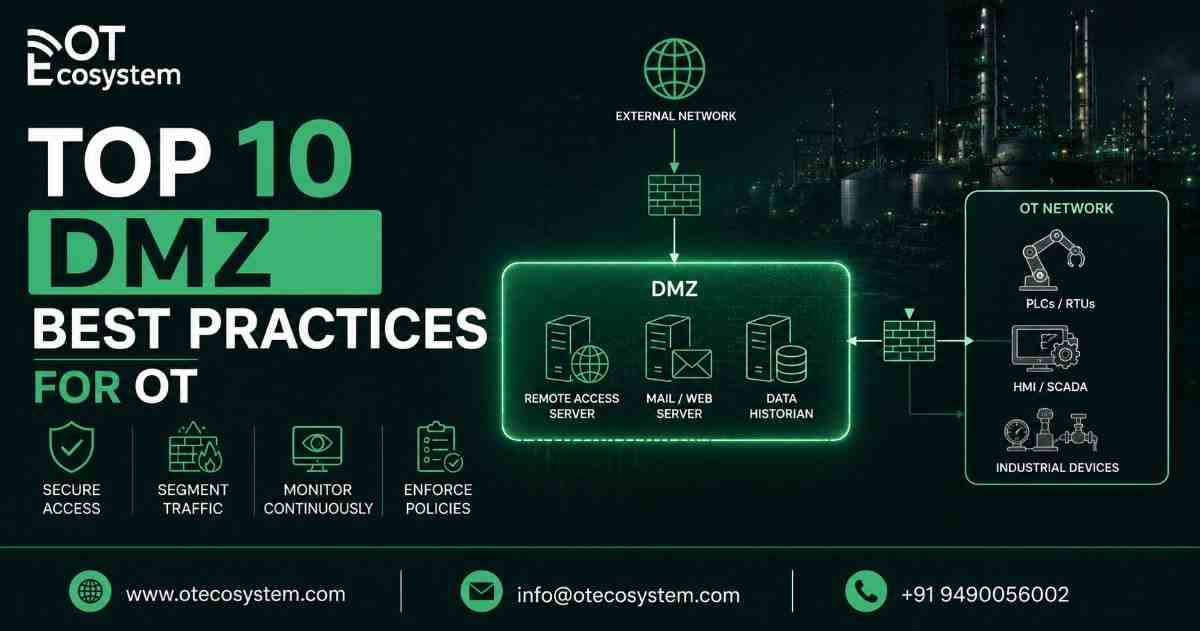
The Evolution of the Industrial Demilitarized Zone: Background
For decades, Operational Technology (OT) networks relied on the comforting illusion of physical isolation-the classic “air-gap”-to protect critical infrastructure from enterprise threats. As modern digital transformation integrates IIoT sensors, cloud analytics, and remote monitoring into manufacturing floors, energy grids, and water facilities, that physical barrier has completely dissolved. In 2026, threat actors are aggressively targeting industrial control systems (ICS) using automated reconnaissance and agentic AI, turning every poorly configured network bridge into an open invitation. The Demilitarized Zone (DMZ) serves as the crucial architectural buffer between enterprise IT and the sensitive plant floor, acting as an isolated staging ground where data can be shared without exposing controllers to direct external threats. However, a misconfigured OT DMZ can easily become a backdoor for lateral movement rather than a shield. Implementing rigorous DMZ best practices is no longer just a networking exercise; it is the absolute foundation of operational resilience and cyber-physical safety.
Top 10 DMZ Best Practices for OT
1. Enforce Strict Purdue Model Segmentation
The foundational rule of industrial network design is the absolute adherence to the Purdue Reference Model, which establishes clear hierarchical boundaries between enterprise IT (Levels 4 and 5) and control operations (Levels 0 through 2). The OT DMZ must sit squarely at Level 3 as an intermediary buffer zone, preventing any direct, unmediated communication lines from bypassing the architecture. By enforcing strict segmentation, security teams ensure that enterprise traffic terminates within the DMZ and never establishes a raw layer connection directly with PLCs or HMIs. This layered approach guarantees that even if the corporate enterprise network suffers a severe ransomware breach, the core industrial control loops remain safely isolated behind structured firewall boundaries.
2. Implement Unidirectional Data Flow for Historian Replication
Industrial historians and enterprise resource planning (ERP) systems constantly demand operational telemetry, but data must flow strictly outward from the plant floor without creating an inbound vector. Administrators should configure DMZ data replication using unidirectional gateways or tightly controlled proxy mechanisms that prevent any return connection paths from enterprise networks into the control zone. By ensuring that historical data is pushed outward into the DMZ staging servers while blocking inbound traversal, organizations eliminate the risk of external actors leveraging reporting connections to inject malicious commands. This single-direction philosophy maintains business intelligence visibility while preserving absolute structural integrity for the underlying industrial control processes.
3. Shieldworkz
Shieldworkz redefines industrial boundary security and data traffic oversight by pairing advanced OT/ICS network detection and response with agentic-AI-powered risk analysis, perfectly complementing industrial DMZ architectures. Positioned to monitor and protect critical interchange points, the platform continuously evaluates protocol traffic and identifies hidden vulnerabilities across legacy and modern assets without risking downtime. When Shieldworkz detects anomalous lateral movement, unauthorized command sequences, or cross-zone policy violations within the DMZ, it dynamically coordinates with perimeter firewalls to trigger automated containment rules. This proactive integration bridges the gap between passive visibility and active enforcement, providing an indispensable layer of cyber-physical protection for critical infrastructure operators navigating complex hybrid networks.
4. Deploy Dual-Firewall Architecture with Independent Vendors
Relying on a single firewall to separate enterprise IT from the OT DMZ introduces a single point of failure that, if compromised, exposes the entire industrial environment. Best practice dictates deploying a robust dual-firewall architecture where an external firewall separates the corporate network from the DMZ, and an internal firewall separates the DMZ from the Level 2 control zone. Furthermore, organizations should consider utilizing firewalls from different vendors for the inner and outer perimeters to mitigate the risk of shared zero-day firmware vulnerabilities. This defense-in-depth configuration ensures that an attacker must successfully bypass two distinct, independently configured security gates before reaching sensitive industrial controllers.
5. Mandate Strict Application Layer Filtering and Proxies
Standard packet filtering is insufficient for modern OT DMZ deployments because malicious payloads can easily masquerade as legitimate traffic on approved ports. Security architects must configure application-layer gateways and proxy services within the DMZ to terminate incoming sessions, inspect the payload contents, and reconstruct authorized traffic before forwarding it to its destination. For example, remote management traffic or web-based HMI portals should never pass raw through the DMZ; instead, they must be proxied, authenticated, and deeply inspected. This rigorous inspection layer ensures that protocol anomalies, malformed headers, and hidden command injections are intercepted and dropped before crossing the inner boundary.
6. Centralize Secure Remote Vendor Access via Jump Hosts
Third-party maintenance contractors and equipment vendors frequently require access to industrial equipment, representing one of the highest-risk vectors in operational cybersecurity. Organizations must eliminate permanent external VPN tunnels directly into the plant floor, routing all vendor access exclusively through hardened jump hosts located within the DMZ. These jump hosts must enforce multi-factor authentication (MFA), session time limits, and comprehensive video and keystroke recording for every active connection. By forcing external actors to land inside the DMZ and pass through rigorous authentication checks before touching any control assets, organizations maintain complete visibility and accountability over third-party activities.
7. Prohibit Direct Domain Trusts Between IT and OT
In many legacy or poorly managed architectures, enterprise Active Directory domains are extended directly into the OT environment, creating a catastrophic vulnerability. If an attacker compromises a single corporate laptop, they inherit administrative credentials that grant them domain-wide control over industrial workstations and servers. Best practice demands completely severing domain trusts between IT and OT, utilizing localized authentication stores, independent identity providers, or secure federation services within the DMZ. Isolating identity management ensures that credential theft on the corporate side cannot be instantly weaponized to unlock administrative control panels on the plant floor.
8. Enforce Principle of Least Privilege on DMZ Jump Servers
Jump servers and staging systems operating inside the OT DMZ are prime targets for lateral movement and must be locked down aggressively. Administrators must enforce the principle of least privilege, ensuring that these systems have access only to the specific internal IP addresses and ports required for their designated operational function. Unnecessary services, local user accounts, and administrative tools that are not actively required for daily maintenance must be disabled or uninstalled entirely. Implementing application whitelisting on DMZ endpoints ensures that unauthorized binaries or malicious scripts cannot be executed even if an adversary gains initial foothold access.
9. Establish Comprehensive Log Forwarding and SIEM Integration
The OT DMZ is the busiest interchange point in the industrial network, making it the primary location for capturing security telemetry and audit logs. All firewalls, proxy servers, jump hosts, and network monitoring tools within the DMZ must be configured to forward their event logs in real-time to a centralized Security Information and Event Management (SIEM) platform. Security analysts must establish custom correlation rules to detect suspicious patterns, such as repeated failed authentication attempts, unusual outbound traffic spikes, or unauthorized configuration changes. Having centralized, tamper-proof logging within the DMZ ensures that security teams can reconstruct attack timelines and detect lateral movement during the earliest stages of an incident.
10. Conduct Regular Vulnerability Assessments and Firewall Audits
Configuring an OT DMZ is not a “set-it-and-forget-it” project; network topologies shift, firmware updates introduce bugs, and firewall rules accumulate legacy exceptions over time. Organizations must establish a routine schedule for conducting rigorous vulnerability scans, penetration testing, and firewall rule-base audits specifically tailored for the DMZ environment. Automated auditing tools can identify shadowed rules, overly permissive port openings, and outdated software packages hiding within staging servers. Maintaining a disciplined review cadence ensures that the DMZ evolves alongside emerging threat vectors, preserving its structural integrity and protecting critical infrastructure from stealthy intrusions.
Conclusion: Securing the Industrial Core
As industrial environments grow increasingly interconnected, the OT Demilitarized Zone stands as the critical guardian between enterprise productivity and operational safety. Relying on outdated network designs or permissive DMZ configurations invites catastrophic risk, exposing fragile control loops to modern, automated threat actors. Whether you deploy advanced dual-firewall architectures, leverage the agentic-AI protection of Shieldworkz, or enforce strict least-privilege access rules, proactive DMZ management safeguards your critical infrastructure. Evaluate your network architecture, audit your existing cross-zone traffic flows, and harden your staging boundaries today to secure your operational future.