
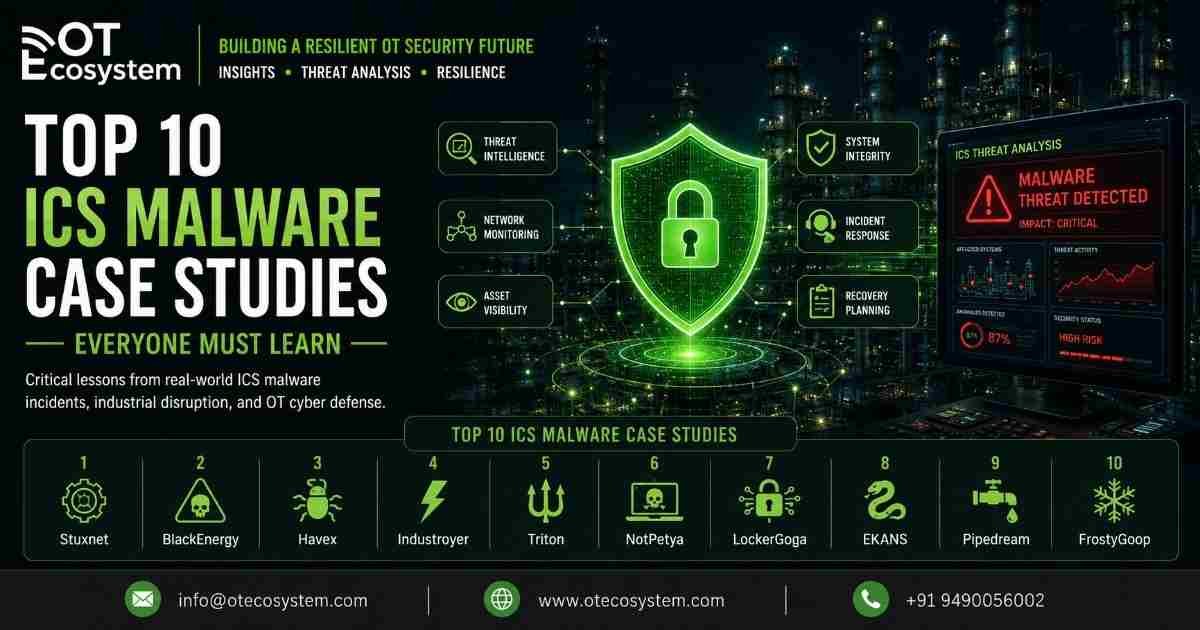
As the boundaries between enterprise IT and operational technology (OT) continue to dissolve, industrial cybersecurity has moved from an obscure engineering sub-discipline to the front line of national security and economic survival. Traditional malware targets files, databases, or user credentials; Industrial Control System (ICS) and Operational Technology (OT) malware targets physical reality-pumps, valves, power substations, safety instrumented systems, and manufacturing lines.
Studying historical and advanced ICS malware case studies is no longer optional for security architects, plant directors, or incident responders. Analyzing how these cyber-physical weapons bypass air-gaps, manipulate proprietary protocols, and subvert safety loops provides the critical insights needed to defend modern infrastructure. Below are the 10 most defining ICS malware case studies every security professional must learn.
Top 10 ICS Malware Case Studies Everyone Must Learn
1. Stuxnet (2010): The Genesis of Cyber-Physical Warfare
- The Target: Siemens SIMATIC S7 PLCs and WinCC SCADA systems governing uranium enrichment centrifuges at Iran’s Natanz facility.
- How it Worked: Stuxnet utilized four zero-day vulnerabilities, stolen digital signing certificates, and a complex worm propagation mechanism via USB drives to cross air-gapped networks. Once inside, it injected malicious blocks into the PLC logic to spin centrifuges at dangerously fluctuating speeds while replaying normal sensor feedback to operators.
- The Takeaway: Stuxnet shattered the myth of the air-gap, proving that software code can cross physical boundaries to cause destructive mechanical failure without triggering immediate control-room alarms.
2. Night Dragon (2010): Coordinated Industrial Espionage
- The Target: Global oil, energy, and petrochemical corporations across the Middle East, North America, and Asia.
- How it Worked: A targeted campaign leveraging social engineering, spear-phishing, and remote administration tools (RATs) to infiltrate Windows-based HMI and engineering servers. The actors harvested proprietary operational data, financial bids, and structural field drawings.
- The Takeaway: Highlighted the severe risks of enterprise-to-OT convergence, showing how attackers use business-tier networks as staging grounds to quietly vacuum up valuable industrial intellectual property.
3. Havex / Dragonfly Campaign (2013–2014): Supply Chain Reconnaissance
- The Target: Industrial automation equipment manufacturers, energy grid operators, and defense contractors across Europe and North America.
- How it Worked: Adversaries compromised legitimate industrial software vendor websites with watering-hole attacks and trojanized legitimate ICS software installers. Embedded within the malware was a specialized OPC (Open Platform Communications) scanner module designed to sweep internal networks and map connected industrial hardware.
- The Takeaway: Demonstrated the weaponization of the software supply chain, proving that trusted vendor update channels can be hijacked to conduct automated reconnaissance inside closed OT environments.
4. BlackEnergy 2 & 3 (2014 – 2015): HMI Subversion and Modular Extensibility
- The Target: Energy companies, manufacturing plants, and media outlets, notably weaponized against Ukrainian electrical infrastructure.
- How it Worked: Evolving from a simple DDoS botnet into a modular cyber-espionage platform, BlackEnergy utilized custom plugins designed to target Human-Machine Interfaces (HMIs), harvest credentials, and drop destructive wipers capable of rendering engineering workstations unbootable.
- The Takeaway: Showed the danger of modular malware design, where a simple initial backdoor can dynamically download specialized ICS reconnaissance and destructive components once inside the network perimeter.
5. Industroyer / CrashOverride (2016): The First Electrical Grid Destroyer
- The Target: High-voltage electrical transmission substations in Ukraine, leading to a localized blackout in Kiev.
- How it Worked: Industroyer was the first malware custom-built to directly attack electrical grid operations. It natively spoke industrial communication protocols (IEC 60870-5-104, IEC 61850, and OPC DA), allowing it to directly issue commands to substation circuit breakers and protection relays, causing them to trip simultaneously.
- The Takeaway: Proved that attackers do not need to exploit unknown zero-days; they can weaponize the native, unencrypted design features of standard industrial protocols to cause physical disruption.
6. Triton / Trisis (2017): Direct Attack on Safety Instrumented Systems
- The Target: Critical industrial process plants (petrochemical facilities in the Middle East), specifically targeting Safety Instrumented Systems (SIS).
- How it Worked: Triton targeted Schneider Electric Triconex safety controllers. By reverse-engineering the proprietary TriStation protocol, the malware attempted to modify the execution memory of safety controllers. While an inadvertent configuration error caused a safety trip that revealed the attack, the framework’s intent was to disable emergency shutdown (ESD) capabilities.
- The Takeaway: Represented a terrifying escalation: malware designed explicitly to disable safety mechanisms, leaving physical facilities vulnerable to catastrophic explosions or toxic releases without human intervention.
7. Shamoon / DistTrack (2012 & 2016): Destructive Enterprise Wipers
- The Target: National oil and gas producers in the Middle East (such as Saudi Aramco and RasGas).
- How it Worked: While Shamoon targeted enterprise IT systems rather than direct ICS PLCs, its payload overwrote the Master Boot Records (MBR) of over 30,000 corporate workstations, replacing critical files with an image of a burning American flag. The resulting paralysis cut off administrative visibility, accounting, and supervisory control monitoring.
- The Takeaway: Emphasized that crippling enterprise business systems can effectively blind plant operators and halt industrial production just as effectively as direct PLC manipulation.
8. Pipedream / Incontroller (2022): The Modular ICS Attack Toolkit
- The Target: Global critical infrastructure sectors, discovered proactively before widespread operational deployment.
- How it Worked: A highly sophisticated, state-sponsored toolkit designed to attack multiple vendor hardware platforms (including Schneider Electric and OMRON controllers). It featured modules for universal asset discovery, native protocol exploitation, and direct device bricking across Purdue levels 0 through 2.
- The Takeaway: Marked a shift toward reusable, cross-platform ICS attack toolkits rather than single-target custom scripts, drastically lowering the barrier for adversaries to disrupt industrial processes.
9. EKANS / Industroyer2 (2022): Ransomware Tailored for OT Disruption
- The Target: Manufacturing, automotive, and energy sector industrial networks.
- How it Worked: EKANS (Snake spelled backwards) ransomware specifically searched for and terminated running processes and services associated with industrial control systems, data historians, and SCADA monitoring software before encrypting enterprise and hybrid IT/OT servers. Simultaneously, newer variants of Industroyer were deployed to drop custom scripts directly onto substation controllers.
- The Takeaway: Demonstrated the financial monetization of industrial disruption, proving that ransomware operators have evolved past IT-only encryption to actively target operational resilience.
10. Fuxnet (2024): Advanced Sensor and Telemetry Manipulation
- The Target: Modern industrial control networks and critical infrastructure monitoring sensors.
- How it Worked: Emerging as a stealthy telemetry-targeting framework, Fuxnet was engineered to compromise data historians and manipulate sensor feedback loops, feeding falsified operating parameters to SCADA dashboards while quietly altering underlying process states.
- The Takeaway: Highlights the modern adversary’s focus on “stealth disruption”-blinding operators through subtle data poisoning rather than loud, easily detectable physical shutdowns.
Integrating Advanced OT Visibility Solutions to Neutralize Malware
To protect industrial environments from these sophisticated malware frameworks, modern plant operators deploy specialized continuous threat monitoring solutions. While established asset discovery tools from legacy vendors like Nozomi Networks, Dragos, Claroty, Shieldworkz, and TXOne provide essential network packet analysis, anomaly detection, and protocol decoding, advanced platforms are necessary to bridge the gap between raw telemetry and real-time defense. By enforcing strict Purdue model segmentation and monitoring protocol states across levels zero through four, industrial organizations can intercept malware during its early reconnaissance phase.
Conclusion
The evolution of ICS malware-from the precision engineering of Stuxnet to the modular threat toolkits of Pipedream and Fuxnet-demonstrates that cyber-physical threats are growing more adaptable and destructive. Protecting critical infrastructure requires looking past traditional IT antivirus solutions and adopting deep, process-aware monitoring. By learning the tactical lessons embedded in these 10 case studies, security leaders can build resilient architectures that detect hidden intrusions, protect safety systems, and safeguard the physical continuity of industrial operations.