
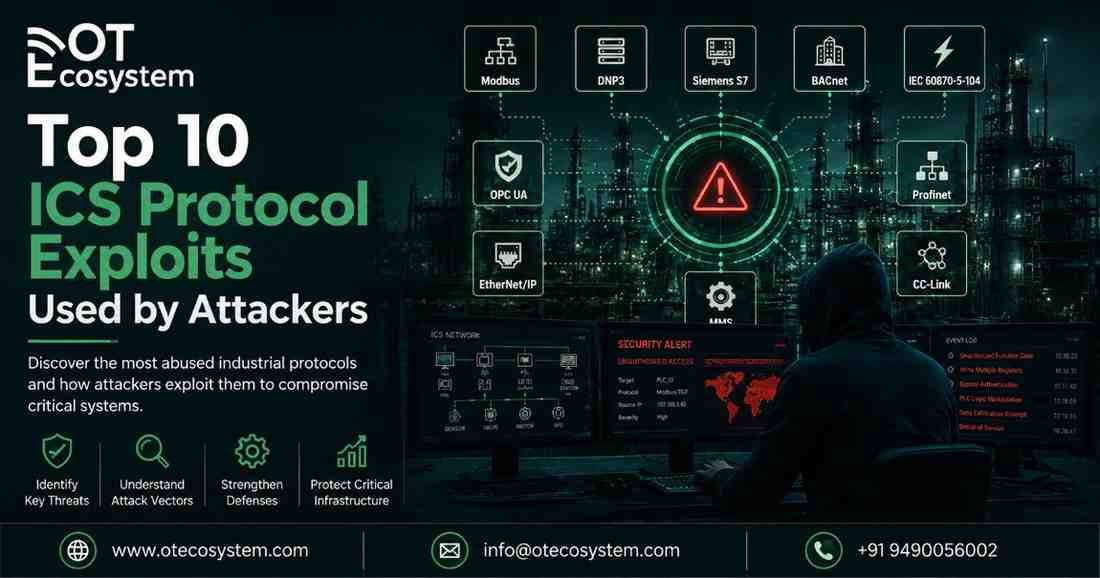
As the convergence of enterprise IT and Operational Technology (OT) accelerates, critical infrastructure sectors face an alarming surge in targeted cyber-physical attacks. Modern threat actors have shifted their focus away from generic IT perimeter breaches, choosing instead to weaponize the fundamental architectural flaws inherent in industrial communication standards. Designed decades ago for absolute reliability and efficiency rather than confidentiality or cryptographic authentication, legacy industrial control systems (ICS) and supervisory control and data acquisition (SCADA) protocols leave massive security blind spots. With industrial cyber incidents scaling significantly year-over-year, understanding how adversaries exploit these protocols is paramount for defense-in-depth engineering.
Navigating the complex matrix of industrial telemetry demands deep technical insight into protocol-level vulnerabilities. Below are the top 10 ICS protocol exploits utilized by advanced cyber adversaries to compromise critical infrastructure worldwide.
Top 10 ICS Protocol Exploits Used by Attackers
1. Modbus TCP Function Code Injection and Register Manipulation
Modbus remains one of the most ubiquitous protocols in industrial automation, yet it completely lacks native authentication and encryption. Attackers leverage man-in-the-middle (MitM) positions to inject malicious function codes directly into the network stream, altering holding registers or forcing programmable logic controllers (PLCs) into stop states. Because the protocol blindly trusts any command originating from a valid network node, unauthorized operators can easily manipulate critical physical thresholds, such as valve pressures or motor speeds, without triggering standard security alarms.
2. DNP3 Master Impersonation and Unauthenticated Replay Attacks
The Distributed Network Protocol version 3 (DNP3) is heavily relied upon by electrical power grids and water utilities for real-time telemetry. Traditional DNP3 implementations lack robust cryptographic validation, making them highly susceptible to master impersonation. Adversaries capture legitimate polling packets and replay them or spoof master station commands to outstations. This allows threat actors to issue unauthorized cold restarts, disable unsolicited alarm messages, or mask ongoing physical tampering across wide-area utility networks.
3. IEC 60870-5-104 Telecontrol Command Injection
Widely deployed across European and global electrical transmission grids for remote substation management, IEC 60870-5-104 inherits the structural vulnerabilities of its serial predecessor. Attackers routinely exploit its lack of built-in transport encryption and weak session management to launch unauthorized command injections. By spoofing application layer ASDU (Application Service Data Unit) packets, threat actors can remotely manipulate circuit breakers or alter protective relay settings, introducing catastrophic risks of cascading regional blackouts.
4. OPC Classic (DCOM) Remote Code Execution and Privilege Escalation
Object Linking and Embedding for Process Control (OPC) bridges real-time industrial hardware data with upper-layer Windows-based SCADA human-machine interfaces (HMIs). Because classic OPC relies heavily on Microsoft’s legacy Distributed Component Object Model (DCOM), it introduces massive attack vectors. Adversaries frequently target DCOM misconfigurations to execute arbitrary remote code with SYSTEM privileges on engineering workstations, achieving a seamless bridge from enterprise IT networks straight down to plant-floor Level 0 controllers.
5. EtherNet/IP and CIP Explicit Messaging Abuse
The Common Industrial Protocol (CIP) running over EtherNet/IP manages high-speed automation across modern manufacturing plants. However, its explicit messaging tier often lacks rigorous access control or payload verification. Threat actors exploit this gap to flood controllers with malformed industrial object requests, triggering denial-of-service (DoS) conditions, crashing I/O modules, or executing unauthorized parameter changes that disrupt high-precision robotic assembly lines.
6. Profinet and Profibus Unauthenticated Parameter Modification
Profinet and Profibus protocols facilitate high-speed, deterministic real-time communication between industrial drives, sensors, and controllers. Despite their performance advantages, standard Profinet configurations do not enforce mandatory device authentication for engineering connections. Attackers scanning factory floors can discover exposed diagnostic endpoints, upload malicious device descriptions, or modify parameter configurations on drives to cause physical equipment overspeeds or catastrophic mechanical failures.
7. BACnet Building Management System (BMS) Spoofing
Building Automation and Control networks (BACnet) govern critical environmental controls, HVAC systems, and physical security infrastructures in smart facilities and data centers. Because foundational BACnet architectures operate without mandatory encryption or packet signing, threat actors routinely abuse broadcast management messages. Attackers can spoof environmental sensor readings, manipulate smoke extraction dampers, or lock out physical access control gates, weaponizing intelligent buildings against their occupants.
8. IEC 61850 Substation GOOSE Message Spoofing and Tampering
IEC 61850 is the modern international standard for electrical substation automation, utilizing Generic Object Oriented Substation Events (GOOSE) for ultra-fast peer-to-peer tripping commands. Because GOOSE messages rely on Ethernet multicast without native encryption or cryptographic token validation in legacy deployments, malicious actors positioned on the substation LAN can inject forged trip commands. This bypasses physical safety interlocks and forces emergency circuit breaker openings across electrical grids.
9. Foundation Fieldbus and HART Remote Parameter Overwrites
Highway Addressable Remote Transducer (HART) and Foundation Fieldbus protocols combine digital communication with legacy analog loops in process industries like oil, gas, and chemical refining. Because field devices often reside in remote, unmonitored outdoor areas, attackers intercept unencrypted communication loops to execute remote calibration overrides. By altering transmitter scaling factors, adversaries can trick operators into reading safe tank levels while physical containers approach dangerous over-pressurization states.
10. MQTT and IIoT Lightweight Broker Authorization Bypass
As industrial environments adopt Industrial IoT (IIoT) frameworks, Message Queuing Telemetry Transport (MQTT) has become the de facto messaging protocol for cloud telemetry ingestion. Misconfigured MQTT brokers frequently suffer from weak client authentication, default admin credentials, or missing access control lists (ACLs). Attackers exploit these gaps to subscribe to sensitive sensor streams, publish malicious command payloads to edge actuators, or execute unauthorized man-in-the-middle data interception across multi-tenant cloud ecosystems.
Conclusion
The relentless evolution of industrial cyber threats demonstrates that legacy trust models no longer suffice in modern interconnected environments. Attackers continuously weaponize the inherent architectural design flaws of foundational ICS protocols to compromise operational integrity and threaten physical safety. To neutralize these vectors, industrial security leaders must implement rigorous network segmentation, deploy deep packet inspection (DPI) monitoring tools capable of parsing proprietary industrial payloads, and transition toward cryptographic protocol overlays and zero-trust architectures across both IT and OT domains.