
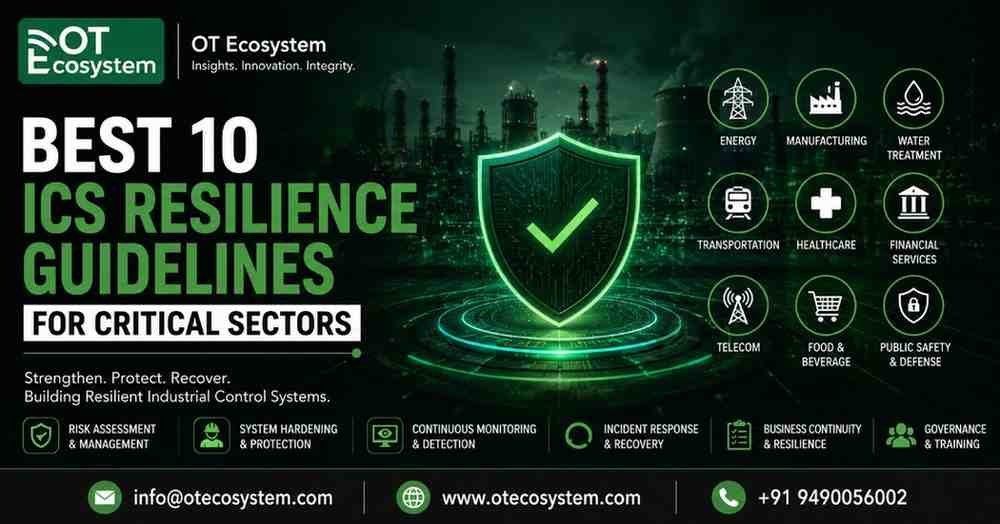
As a cybersecurity editor who has spent years analyzing the convergence of enterprise IT, Operational Technology (OT), and the sprawling landscapes of IoT and MIoT (Medical IoT), I can tell you that the stakes have never been higher. When a cyberattack breaches a manufacturing facility or a municipal water plant, the impact transcends data privacy-it becomes a physical, real-world crisis that demands an immediate, life-saving response. Recent industry telemetry indicates that organizations implementing advanced OT risk management achieve a massive return on investment simply by preventing catastrophic operational downtime. However, securing Industrial Control Systems (ICS) requires entirely different strategies than traditional IT defense; you are dealing with fragile, legacy PLCs, proprietary protocols, and environments where availability and physical safety are absolute mandates. To build a resilient security architecture that withstands the threats of 2026, organizations must move beyond generic IT practices and deploy specialized industrial guidelines. Below is our newsroom’s definitive, technically vetted list of the top 10 ICS resilience guidelines for critical sectors.
Best 10 ICS Resilience Guidelines for Critical Sectors
1. Enforce the Purdue Model with Modern Network Segmentation
Effective network segmentation remains the absolute bedrock of industrial resilience, separating critical operational systems from corporate IT networks to prevent lateral movement. In 2026, relying on a flat network architecture is practically an invitation for ransomware to jump from a compromised email server directly to a SCADA console. By enforcing the Purdue Model, organizations create hierarchical levels with strict demilitarized zones (DMZs) that halt unauthorized traffic between enterprise and industrial zones. Modern implementation requires industrial-grade firewalls that understand the specific telemetry of the factory floor, ensuring that while IT and OT converge for business intelligence, their control planes remain fiercely isolated to protect physical safety.
2. Implement Deep Packet Inspection (DPI) for ICS Protocols
Standard IT firewalls are completely blind to the proprietary languages spoken by operational technology, which is why deploying Deep Packet Inspection (DPI) tailored for ICS is non-negotiable. Protocols like Modbus, DNP3, and OPC UA require specialized firewalls from OEMs like Siemens or Phoenix Contact to filter and validate every command sent to a programmable logic controller (PLC). Without DPI, a malicious command disguised as a routine firmware update can bypass perimeter defenses and manipulate physical processes directly. Real-time telemetry analysis through DPI allows security operations centers (SOC) to detect abnormal process behaviors-such as an unexpected valve opening-halting cyber-physical attacks before they result in catastrophic equipment failure or safety hazards.
3. Hardening Legacy PLCs and Programmable Devices
Programmable Logic Controllers (PLCs) and Remote Terminal Units (RTUs) are the nervous system of critical infrastructure, yet many still operate on legacy firmware lacking modern cryptographic protections. Hardening these devices is a paramount guideline, starting with the immediate removal of hardcoded default passwords and disabling all unnecessary ports and services to drastically shrink the attack surface. Security teams must strictly follow OEM guidance for applying firmware updates, testing patches in isolated sandbox environments before ever deploying them to live production lines. Restricting physical access to PLC cabinets on the shop floor is equally critical, as an attacker with a USB drive can easily bypass the most sophisticated perimeter firewalls if physical security protocols are neglected.
4. Mandating Strict Access Controls and Identity Governance
Controlling exactly who and what can access your industrial control systems is a critical aspect of defense, especially as remote work and third-party vendor maintenance become the industry standard. Organizations must strictly enforce Role-Based Access Control (RBAC) and the principle of least privilege, ensuring that plant operators and engineers only have the specific permissions required for their daily shifts. Furthermore, Multi-Factor Authentication (MFA) or Public Key Infrastructure (PKI) certificates must be mandatory for any remote connection tunneling into the OT environment. Comprehensive audit logging of all administrative actions and login attempts ensures total accountability, actively deterring insider threats while providing forensic teams with the exact breadcrumbs needed during a post-incident investigation.
5. Establishing Threat-Informed Continuous Monitoring
Relying on periodic vulnerability scans is an outdated strategy that leaves critical sectors dangerously exposed; continuous, threat-informed monitoring is the new mandate for 2026. Deploying specialized OT Intrusion Detection Systems (IDS) enables security teams to identify unusual traffic patterns, unauthorized PLC commands, or suspicious Human-Machine Interface (HMI) activity in real-time. Integrating these OT logs directly into enterprise Security Information and Event Management (SIEM) platforms provides a centralized, unified view of the entire threat landscape across both digital and physical domains. By mapping detected anomalies against established frameworks like MITRE ATT&CK for ICS, organizations transition from a reactive posture to a proactive defense, neutralizing advanced persistent threats (APTs) early.
6. Bridging the IT/OT Airgap with Integrated Incident Response
Even the most fortified ICS networks will inevitably face security incidents, making a well-defined, highly rehearsed incident response (IR) plan the ultimate safety net. However, an IR plan that only addresses IT data loss is useless during an OT breach; cybersecurity analysts and process engineers must operate as a fully integrated response team. Workflows must explicitly define the thresholds for detection, isolation, containment, and recovery, ensuring that network defenders know exactly when to sever a connection to prevent a total plant shutdown. Conducting regular cyber-physical simulation drills-such as responding to a simulated ransomware attack targeting SCADA servers-ensures that when a real crisis hits, the organization can restore operations rapidly while preserving human safety.
7. Securing the Supply Chain and Third-Party Vendor Access
In modern manufacturing and energy sectors, third-party vendors, contractors, and original equipment manufacturers (OEMs) frequently require remote access to maintain complex machinery and sensors. This creates a massive, highly regulated attack vector, mandating that organizations evaluate third-party security practices just as rigorously as their own internal controls. Enforcing strict contractual security requirements, implementing continuous third-party risk management (TPRM) monitoring, and utilizing secure, heavily audited zero-trust access gateways are essential steps to reduce supply chain risks. By centralizing vendor risk profiles and ensuring external partners adhere to your internal compliance standards, you guarantee that a compromised vendor does not become the hidden weak link.
8. Aligning with Global Frameworks like IEC 62443 and NIS2
In 2026, regulatory compliance is no longer a localized issue; critical infrastructure operators must align their security postures with rigorous, internationally recognized frameworks. Adhering to the ISA/IEC 62443 series provides a comprehensive blueprint for securing industrial automation, emphasizing a “security by design” approach and defining clear maturity levels for risk management. Simultaneously, mandates like the EU’s NIS2 directive and the TSA security directives for pipeline operators enforce strict, auditable baselines that carry heavy financial penalties for non-compliance. Organizations must leverage specialized OT GRC platforms to automate evidence collection, mapping their technical controls to these frameworks to prove continuous adherence to auditors without disrupting ongoing utility services.
9. Utilizing Agentless Discovery for Shadow IoT and MIoT Assets
You cannot protect what you cannot see, and the massive explosion of connected IoT and Medical IoT (MIoT) devices has created a sprawling landscape of unmanaged, invisible endpoints. Installing traditional security agents on these fragile, specialized devices is often impossible and can even void expensive manufacturer warranties. Therefore, implementing agentless asset discovery tools that passively monitor network traffic is a critical guideline for identifying shadow IT and rogue devices hidden deep within the OT environment. By continuously analyzing device behavior against known vulnerability databases, these tools establish a precise risk score for every connected asset, allowing security operations centers to prioritize remediation based on actual operational impact rather than theoretical vulnerability metrics.
10. Validating Recovery Procedures Through Secure Backups
When all preventative measures fail and a destructive cyberattack halts industrial processes, the speed and reliability of your recovery procedures dictate the ultimate survival of the business. Implementing secure, isolated backup solutions is non-negotiable for business continuity, ensuring that critical operational data, PLC logic, and SCADA configurations are protected from ransomware encryption. Organizations must regularly test these recovery procedures in simulated environments to verify that complex distributed control systems can be restored quickly and accurately following a catastrophic system failure. A validated, offline backup strategy transforms a potential months-long, multi-million dollar recovery nightmare into a manageable, temporary disruption, cementing the organization’s long-term cyber resilience.
Conclusion
Do not treat industrial control system security as a simple extension of your IT compliance checklist. The digital and physical realms are inextricably linked; a failure in cyber governance on the factory floor or power grid can lead directly to catastrophic operational downtime, massive financial losses, and severe human safety hazards. The top 10 guidelines detailed above represent the vanguard of critical infrastructure defense precisely because they respect the delicate physics, legacy hardware, and proprietary protocols of operational technology environments. By investing in specialized network architectures, continuous threat monitoring, and rigorous supply chain oversight, you guarantee that your organization is engineering true operational resilience, not just generating meaningless regulatory paperwork.