
The myth of the airgap has been unequivocally shattered. As industrial environments increasingly embrace hyper-connectivity to drive predictive maintenance and operational efficiency, the convergence of Information Technology (IT) and Operational Technology (OT) has fundamentally redrawn the cyber battleground. Today, a compromised corporate email account can serve as a direct pivot point into the programmable logic controllers (PLCs) governing a power grid, a water treatment facility, or an automated manufacturing line.
Recent industry data paints a stark picture: upwards of 75% of successful attacks on industrial control systems (ICS) originate as lateral movement from a breached corporate IT network. When flat, unsegmented architectures allow ransomware to bleed from HR departments directly onto the factory floor, the resulting impact is measured not just in data loss, but in catastrophic physical downtime and severe safety hazards.
To defend the modern industrial edge, security architects must deploy strategies that move far beyond generic IT firewalls. Securing OT requires a highly specialized approach that respects the absolute priority of process safety and continuous uptime. Here are the ten most effective, field-proven network segmentation techniques to lock down your critical infrastructure.
Top 10 Network Segmentation Techniques for OT Environments
1. Modernizing the Purdue Model with a Hardened iDMZ
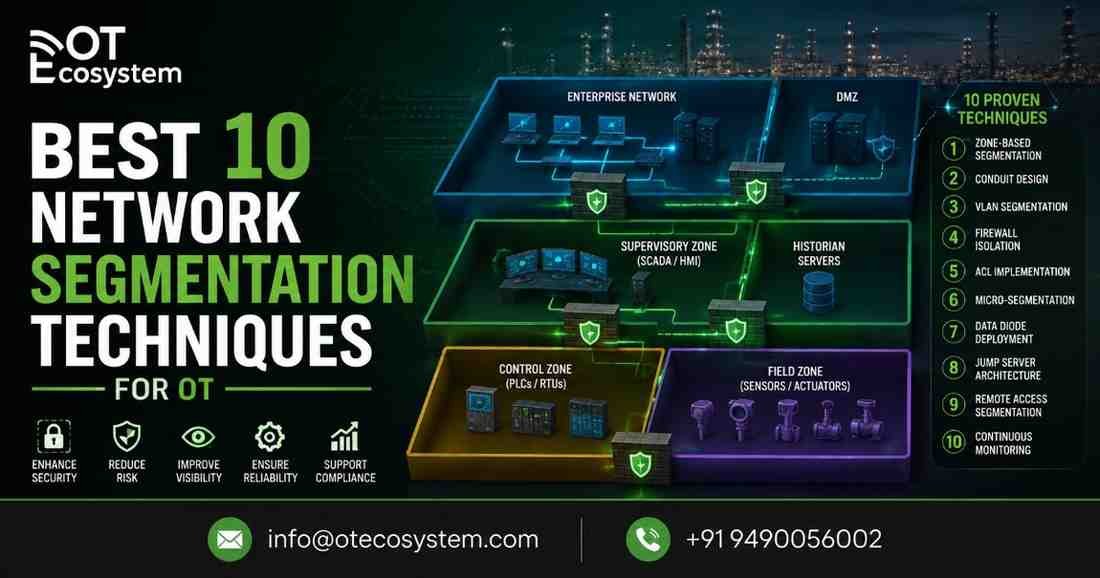
The Purdue Enterprise Reference Architecture (PERA) remains the foundational blueprint for industrial segmentation, but it requires modern enforcement. Organizations must establish strict macro-segmentation between the enterprise zones (Levels 4 and 5) and the manufacturing zones (Levels 0 through 3). The linchpin of this separation is the Industrial Demilitarized Zone (iDMZ) at Level 3.5. Direct routing between IT and OT must be absolutely forbidden. All communication must terminate within the iDMZ using proxies, jump hosts, and application gateways, ensuring no direct network pathway exists for automated lateral movement.
2. Implementing Industrial Deep Packet Inspection (DPI)
Traditional IT firewalls operate at the port and IP level, leaving them dangerously blind to the nuances of ICS traffic. Allowing port 502 for Modbus TCP is essentially an open door if the firewall cannot distinguish between a routine “read coil” command and a critical “stop CPU” instruction. Effective OT segmentation demands firewalls equipped with Industrial Deep Packet Inspection (DPI). Positioned at the boundaries of operational cells, DPI appliances dissect industrial protocols-such as DNP3, CIP, Profinet, and IEC 61850-at the application layer, ensuring only authorized engineering commands cross the segmentation boundary.
3. Deploying Unidirectional Security Gateways (Data Diodes)
For highly critical infrastructure where the risk tolerance is absolute zero-such as nuclear generation or primary transmission grids-software-based firewalls fall short. Unidirectional security gateways, commonly known as data diodes, enforce one-way data transfer at the physical hardware layer. This physical segmentation allows vital real-time telemetry and historian data to flow out to the IT environment for analysis, while making it physically impossible for any inbound network traffic to reach the OT environment.
4. Granular Micro-Segmentation at the Manufacturing Cell Level
Relying exclusively on a perimeter firewall leaves the internal plant floor entirely vulnerable once the edge is breached. Micro-segmentation addresses this by dividing the OT environment into the smallest possible functional zones, often isolating individual manufacturing cells or process skids. If a compromised USB drive introduces malware into a specific Human-Machine Interface (HMI), micro-segmentation contains the east-west lateral spread, preventing the infection from crawling across the network to compromise safety instrumented systems (SIS) or neighboring PLCs.
5. Comprehensive OT Asset Discovery as a Segmentation Prerequisite
You cannot segment what you cannot see. Before any VLAN is configured or firewall rule applied, organizations must achieve total visibility into their industrial environments. Utilizing passive scanning technologies-which safely listen to network traffic without actively pinging fragile legacy devices-security teams must map every asset, its baseline communication patterns, and its protocol usage. This continuous asset discovery feeds the data flow analysis required to build precise, non-disruptive segmentation policies.
6. Transitioning to OT-Tailored Zero Trust Network Access (ZTNA)
The legacy model of implicit trust based on an internal IP address is obsolete. Adapting Zero Trust for OT shifts the segmentation perimeter directly to the identity and the asset context. Before remote engineers or third-party vendors can access a supervisory system, an OT-specific ZTNA broker verifies their cryptographic identity and device security posture. It then provisions a secure, ephemeral tunnel exclusively to the single application or asset they are authorized to manage, effectively cloaking the rest of the ICS network.
7. Isolating the IIoT and MIoT Edge from Legacy Core Systems
The rapid deployment of the Industrial Internet of Things (IIoT) and Medical IoT (MIoT) introduces a fleet of smart sensors that often bypass traditional network hierarchies to communicate directly with cloud analytics platforms. These edge devices represent a massive shadow IT risk. Best practice dictates placing all cloud-connected edge devices on entirely isolated network segments. By severing their direct pathways to unpatched, legacy SCADA servers, you ensure a compromised smart sensor cannot serve as a backdoor into the core control infrastructure.
8. Enforcing Network Access Control (NAC) with MAC-Level Security
In sprawling industrial facilities with exposed switch ports, physical security and network security are deeply intertwined. Network Access Control (NAC) combined with robust MAC-based port security ensures the network dynamically segments or blocks unverified hardware. If an unauthorized device attempts to connect, and its behavioral fingerprint or MAC address fails to match a strict whitelist of known industrial equipment, the switch port is immediately disabled or dropped into a quarantined VLAN.
9. Logical Isolation via VLANs and Restrictive Access Control Lists (ACLs)
While Virtual Local Area Networks (VLANs) are a standard networking tool, their application in OT requires extreme operational precision. Using managed industrial Ethernet switches, architects must logically separate traffic based on critical function-creating isolated VLANs for standard control traffic, safety instrumented systems, and physical security feeds. Crucially, these VLANs must be governed by highly restrictive Access Control Lists (ACLs) operating on a default-deny stance, permitting only the highly specific inter-VLAN communications validated during asset discovery.
10. Software-Defined Networking (SDN) for Dynamic Process Routing
The future of OT segmentation is agility. Static firewall rules are prone to configuration drift and create friction during critical maintenance windows. Software-Defined Networking (SDN) solves this by decoupling the control plane from the data plane, enabling dynamic, intent-based segmentation. During a scheduled update, an SDN controller can instantly provision a secure, isolated pathway for an engineer. The moment the maintenance window closes, the fabric automatically revokes the route, returning the plant to a state of absolute lockdown without manual firewall interventions.
Conclusion
Effective OT network segmentation is no longer an optional architectural enhancement; it is the fundamental baseline for industrial cyber resilience. As threat actors increasingly target the physical systems that underpin global supply chains and critical infrastructure, the ability to isolate and contain a breach determines the difference between a minor operational hiccup and a catastrophic physical event. By moving beyond flat networks and implementing these advanced segmentation techniques-from DPI-enabled firewalls to granular micro-segmentation and strict iDMZ enforcement-security leaders can confidently embrace digital transformation while safeguarding the systems that power the modern world.