
The industrial threat landscape has fundamentally shifted. The Dragos 2026 OT Cybersecurity Report confirms a sobering reality: adversaries are no longer relying solely on noisy IT malware. Instead, they are actively positioning for OT impact-quietly mapping control loops, analyzing engineering project files, and staging long-term access within operational technology networks.
If your OT network was designed on the premise of “implicit trust” or the illusion of an air gap, it is already obsolete. According to the SANS State of ICS/OT Cybersecurity Survey for 2025, 22% of industrial organizations reported an incident in the past year, with nearly 20% taking over a month to remediate.
To stop threat actors from weaponizing your legacy infrastructure, you must engineer security directly into the fabric of your network. Here are the top 10 proven OT network design best practices to secure your industrial control systems.
Top 10 OT Network Design Best Practices
1. Ground Architecture in IEC 62443 Zones and Conduits
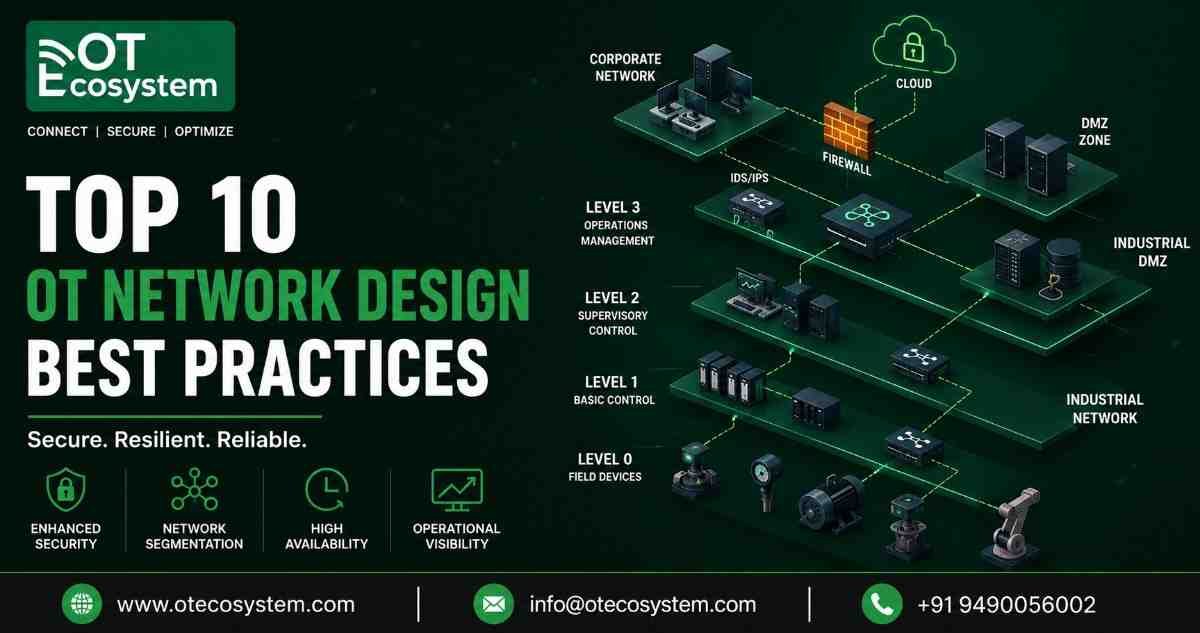
Do not reinvent the wheel. The IEC 62443 standard is the gold standard for industrial cybersecurity. The foundation of any modern OT network design is the concept of Zones and Conduits. Group assets with similar security requirements and trust levels into logical “Zones.” The communication paths between these zones must be restricted to tightly controlled “Conduits.” A simplified zone model makes it drastically easier to enforce segmentation and monitor anomalous traffic.
2. Implement the Purdue Enterprise Reference Architecture (PERA)
The Purdue Model is not dead; it just requires modern enforcement. You must strictly separate your corporate IT networks (Levels 4 and 5) from your manufacturing operations and physical processes (Levels 0 through 3). If a ransomware actor breaches your corporate email, a rigorously implemented Purdue architecture ensures that the infection cannot effortlessly pivot down into your supervisory control systems (SCADA) or Programmable Logic Controllers (PLCs).
3. Enforce an IT/OT Industrial DMZ (iDMZ)
Direct communication between the IT network and the OT network should never occur. Establish an Industrial Demilitarized Zone (iDMZ) at Level 3.5. All data traffic-whether it is a historian server replicating data for corporate analytics or a remote maintenance session-must terminate in the iDMZ. The iDMZ acts as a buffer proxy, ensuring that no direct routing exists between the enterprise and the plant floor.
4. Engineer for Absolute Asset Visibility
You cannot protect what you cannot see, and the SANS 2025 survey highlights that only 19.7% of organizations have full visibility into Level 3 (Operations Systems), dropping to a mere 10% at Level 2 (Supervisory Control). Standard IT discovery tools (like active ping sweeps) can crash fragile legacy PLCs. Design your network with strategically placed SPAN ports and network taps to facilitate passive, OT-native anomaly detection that builds a real-time asset inventory without injecting disruptive packets.
5. Deploy Micro-Segmentation at the Process Level
While the Purdue model handles macro-segmentation, modern threats require micro-segmentation within the OT environment itself. A compromised Human-Machine Interface (HMI) governing a water mixing valve should not have network line-of-sight to a PLC controlling a high-pressure boiler across the facility. Use industrial firewalls to isolate specific control loops and manufacturing cells, applying the principle of least privilege to internal OT traffic.
6. Adopt a “Least Functionality” (Minimalist) Design
Complexity is the enemy of security. Design your OT network using a minimalist approach. Can a control system perform its function with fewer network connections, fewer running services, or fewer open ports? Often, the answer is yes. Disable unused physical ethernet ports, shut down unencrypted management protocols (like Telnet or HTTP), and enable only what is absolutely necessary for physical operations.
7. Secure and Monitor Remote Access (ZTNA for OT)
Unauthorized external access accounted for half of all incidents in the SANS 2025 survey, yet only 13% of organizations have fully implemented advanced controls like ICS-aware access. Replace legacy vendor VPNs with Zero Trust Network Access (ZTNA) designed for OT. External contractors should be authenticated via multi-factor authentication (MFA) and granted access strictly to the single IP address of the machine they are maintaining, with all sessions recorded.
8. Deploy OT-Native Deep Packet Inspection (DPI)
Standard IT firewalls operate at the IP and port levels, which is inadequate for industrial protocols like Modbus or DNP3 that transmit data in cleartext. Deploy DPI-capable industrial firewalls that can dissect OT protocols. This allows you to write granular rules-for example, permitting an engineering workstation to issue a “Read” command to a sensor, but blocking any unauthorized “Write” or “Firmware Update” commands.
9. Establish Compensating Controls for Unpatchable Legacy Assets
You will inevitably encounter 15-year-old controllers that run on outdated operating systems and cannot be patched without voiding vendor warranties or risking catastrophic downtime. Instead of accepting the risk, design compensating controls into the network. Isolate these fragile assets behind dedicated protocol gateways, lock down their MAC addresses on switch ports, and strictly restrict their communication pathways.
10. Design for Resiliency and OT-Specific Incident Response
Finally, design your network to fail safely. While IT prioritizes Confidentiality, OT must prioritize Availability, Integrity, and Safety (AIC). If a segment of your network is compromised, the architecture should allow operators to manually sever the connection and drop back to local, analog control without halting physical production. Ensure your network design supports rapid, tested backup restorations and safe manual restart procedures.
Conclusion
Securing an industrial control system is not an IT problem; it is a complex engineering challenge defined by the fraught convergence of bits, bytes, and physical infrastructure. As adversaries pivot from opportunistic ransomware to deliberate positioning for physical disruption, organizations must abandon legacy assumptions. By grounding your architecture in IEC 62443, enforcing strict macro and micro-segmentation, and engineering for unyielding visibility, you can transform a fragile, implicit-trust network into a resilient fortress capable of defending the world’s most critical infrastructure.