
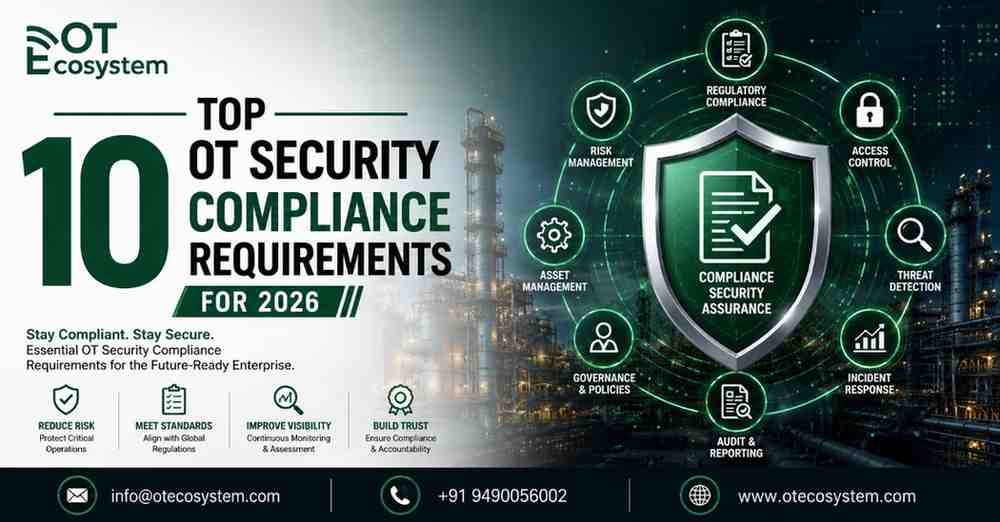
In 2026, Operational Technology (OT) security has officially graduated from a “best-effort” IT add-on to a rigorous, board-level governance requirement. With global regulators-from the EU’s NIS2 Directive to India’s updated RBI/SEBI frameworks-tightening the screws, organizations can no longer hide behind outdated “air-gapped” myths.
As a cybersecurity editor tracking the convergence of IT and OT, I’ve analyzed the shifting regulatory landscape. If your organization operates in critical infrastructure, manufacturing, or energy, compliance is no longer just about passing an annual audit; it is about proving operational continuity in the face of sophisticated state-sponsored and AI-accelerated threats.
Top 10 Compliance Requirements for Industrial Resilience
1. Mandatory 24-72 Hour Incident Reporting
Regulators are decisively moving away from “reasonable effort” frameworks toward strict liability models that penalize delayed disclosure. Under the EU NIS2 Directive, essential entities must submit an initial “early warning” within 24 hours of detecting a significant incident, followed by a comprehensive technical notification within 72 hours. Similar high-speed mandates are emerging globally, including strict regional reporting windows such as India’s CERT-In directives. To maintain compliance, industrial enterprises must abandon manual reporting workflows entirely and deploy pre-defined, automated incident classification playbooks that instantly route telemetry to security operations centers and regulatory portals without human bottlenecks.
2. Supply Chain Provenance & SBOMs
The implementation of the EU Cyber Resilience Act (CRA) shifts the immense burden of cybersecurity directly to the product lifecycle, forcing manufacturers and asset owners to account for every digital component. Organizations must now mandate and maintain detailed Software Bills of Materials (SBOMs) and Hardware BOMs (HBOMs) for all digital assets deployed within industrial control networks. Procurement contracts must legally bind third-party suppliers to deliver verified component manifests, cryptographic signatures, and prompt vulnerability disclosures, effectively eliminating blind spots in legacy software dependencies.
3. Executive Accountability (Governance-by-Design)
Cybersecurity has officially graduated from a technical IT concern into a legally binding fiduciary duty for corporate leadership. Under Article 20 of the NIS2 Directive, management bodies are held personally accountable for approving cybersecurity measures and overseeing their implementation, meaning executive ignorance is no longer a valid legal defense. Furthermore, evolving financial and critical infrastructure regulations require Chief Information Security Officers (CISOs) to maintain structural independence, reporting directly to risk and audit committees rather than traditional IT management to prevent conflicts of interest.
4. Identity-Based Micro-segmentation
Static VLANs and perimeter-based network defenses are fundamentally obsolete in modern, hyper-connected industrial environments. Regulatory frameworks aligned with NIST SP 800-82 Rev. 3 now demand that network access be granted strictly based on verified device and user identity rather than physical location. Industrial organizations must implement granular micro-segmentation and Just-In-Time (JIT) access models for third-party maintenance vendors, effectively creating virtual air-gaps that halt lateral threat movement instantly if an enterprise perimeter is breached.
5. Continuous Asset Visibility & “Drift” Monitoring
Compliance audits are permanently shifting away from annual point-in-time checkups toward continuous automated assurance. If an authorized PLC firmware version changes, an unapproved engineering workstation connects to the plant floor, or an unmanaged IoT sensor appears, it must trigger an immediate compliance drift alert. Integrating comprehensive OT asset inventories directly into centralized Governance, Risk, and Compliance (GRC) platforms ensures real-time operational visibility and satisfies the rigorous continuous monitoring expectations of modern auditors.
6. Phishing-Resistant MFA for Industrial DMZs
The dangerous historical era of shared vendor accounts, static passwords, and unmonitored remote desktop gateways is completely over. Global regulatory bodies, including NERC CIP-003-9, now mandate robust access controls and cryptographic verification for every single connection entering the sensitive Industrial DMZ. Transitioning entirely to phishing-resistant multi-factor authentication methods-such as FIDO2 hardware tokens or WebAuthn protocols-is now a baseline compliance requirement for all remote engineering, maintenance, and contractor portals
7. OT-Specific Threat Hunting (LotL Detection)
Modern state-sponsored adversaries frequently utilize “Living off the Land” tactics, leveraging legitimate, native OT communication protocols like Modbus, DNP3, or CIP to alter physical process setpoints without triggering legacy antivirus signatures. Regulators now expect security teams to monitor deep process behavior and controller logic rather than relying solely on signature-based malware detection. Ingesting industrial Historian data and PLC execution state logs into your SIEM/SOC is essential to catch anomalous physical operations and unauthorized configuration writes instantly.
8. Physical Incident Response Drills
Advanced digital network recovery and backup restoration are practically useless if your plant floor engineers do not know how to operate heavy machinery safely under manual control. New compliance frameworks and NERC CIP-008 require periodic, highly rigorous tabletop exercises that simulate a total Human-Machine Interface (HMI) or network lock-out scenario. Detailed documentation of these hands-on, eyes-on manual control drills is now a core audit requirement for proving genuine operational resilience and emergency readiness.
9. Secure Lifecycle & Patch Management
Regulations like the EU Cyber Resilience Act and NERC CIP mandate that critical industrial control devices receive continuous security support and patch management throughout their expected operational lifespan. Organizations must establish a formal End-of-Life policy for legacy OT assets, ensuring that older machinery is securely isolated via compensating controls, virtualized in software layers, or completely replaced if it can no longer receive critical vendor security updates. Ignoring aging legacy systems during a compliance audit now results in severe operational penalties.
10. Third-Party Risk Management (TPRM)
Legal and regulatory liability no longer stops at the edge of a primary vendor contract. Under NIS2 and updated regional financial regulations, your enterprise is held entirely responsible for the security posture and compliance failings of your third-party suppliers and contractors. Organizations must extend internal security baselines to mandate strict right-to-audit clauses, mandatory incident notification protocols, and continuous posture assessments for all critical ICT and OT vendors operating within the supply chain ecosystem.
Conclusion
As industrial organizations navigate the complex realities of 2026, OT security compliance can no longer be treated as a static checkbox exercise or an afterthought left to IT teams. The regulatory environment has matured into a comprehensive, accountability-driven mandate where executive liability, continuous monitoring, and supply chain provenance are non-negotiable. By moving beyond reactive measures and embedding these top 10 compliance requirements directly into your industrial architecture, you protect not only your data and network perimeters, but human safety, environmental integrity, and the physical backbone of global critical infrastructure.