
OT asset inventory is no longer a back-office recordkeeping task. Current guidance from NIST and CISA treats asset inventory as a core OT security capability, because defenders need accurate visibility into systems, firmware, software, owners, and communication paths before they can manage risk effectively. CISA’s 2025 OT asset inventory guidance says the process should include scope definition, asset identification, attribute collection, data management, and lifecycle management, while NIST SP 800-82r3 stresses complete inventories and safer passive monitoring methods in sensitive OT environments.
That is why spreadsheets keep failing industrial teams. A spreadsheet can list assets, but it cannot reliably maintain OT taxonomy, track lifecycle changes, or support safe, passive discovery in complex environments. NIST’s current OT guidance also warns that active scanning can interfere with device process state, which makes manual spreadsheet upkeep a weak substitute for a living asset program.
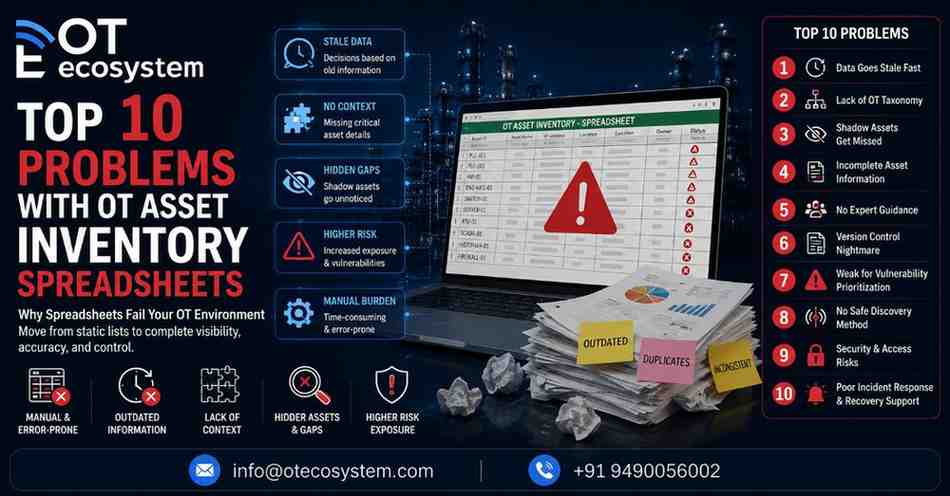
Top 10 Problems with OT Asset Inventory Spreadsheets
1. Spreadsheets go stale too quickly
A spreadsheet only reflects the last time someone edited it. In OT, that is a serious problem because devices change during maintenance, vendor support visits, line expansions, and emergency replacements. CISA’s 2025 guidance treats lifecycle management as part of the inventory process for exactly this reason: the record has to stay current, not just exist.
When the list is stale, teams begin working from fiction instead of reality. A controller may be retired in the plant but still appear active in the sheet, or a new HMI may be missing altogether. That leads to bad remediation decisions, missed vulnerabilities, and delayed incident response.
2. There is no OT taxonomy behind the data
CISA’s 2025 OT inventory guidance says organizations should create an OT taxonomy that organizes assets by function and criticality. That is the missing layer in most spreadsheets: a simple row and column format does not show whether a device supports safety, production, engineering, or remote access.
Without taxonomy, every asset looks equally important, even when it is not. That makes spreadsheets poor at prioritization because they cannot easily answer the question industrial teams care about most: which assets matter first if something goes wrong? A real OT inventory needs structure, not just entries.
3. Lack of Integration with Specialized OT Security Solutions
Many organizations struggle with static spreadsheets because they fail to connect inventory data into an operational OT security workflow or specialized industrial monitoring solution. Relying on manual file updates isolates asset visibility from key industrial frameworks like IEC 62443, NIST SP 800-82, and CISA guidelines, which recommend active lifecycle governance and continuous monitoring. Without integration into dedicated OT asset discovery and management systems, spreadsheet records remain completely disconnected from real-time network visibility, automated segmentation rules, incident response playbooks, and automated compliance tracking.
4. They rarely capture the details OT teams actually need
A useful OT inventory has to include vendor, model number, firmware, operating system, and software versions. NIST explicitly says those attributes help with vulnerability identification, tracking, and remediation. A spreadsheet often stops at hostname, IP address, and maybe a business owner, which is not enough to support industrial security operations.
That gap matters because OT defenders do not just need to know what exists. They need to know what version is running, whether it is supported, and whether it is exposed to known issues. A spreadsheet without those details becomes a label, not a security tool.
5. Shadow assets and undocumented changes slip through
Spreadsheets rely heavily on people remembering to update them. That is exactly how rogue laptops, temporary engineering devices, replacement PLCs, and maintenance workarounds get missed. NIST recommends passive monitoring and manual inspection to keep OT inventories current, because those methods can reveal live devices and changes that paperwork alone will not catch.
When an organization depends on manual spreadsheet updates, every undocumented change becomes a blind spot. In OT, blind spots are costly because even one forgotten asset can create a new attack path, a maintenance risk, or an unsupported system that no one is watching.
6. Version control becomes a nightmare
Spreadsheets invite duplicate copies, conflicting edits, and “latest_final_v7” problems. In OT, that is more than an administrative inconvenience because the wrong version can send teams to the wrong asset, the wrong firmware record, or the wrong maintenance history. CISA’s inventory guidance emphasizes data management and lifecycle management for a reason: inventory is a living system, not a one-time file.
Once multiple copies circulate by email or shared drive, no one knows which one to trust. That makes audits harder, troubleshooting slower, and incident response less accurate. A single source of truth beats a dozen contradictory files every time.
7. They are weak for vulnerability and patch prioritization
NIST’s OT guidance says accurate inventory data supports vulnerability identification, tracking, and remediation. A spreadsheet usually does not connect asset identity to exposure, criticality, or patchability, so security teams still have to do the hard work manually. That is why spreadsheets are a poor foundation for risk-based OT vulnerability management.
In practice, teams end up chasing every alert equally, even when some assets are far more critical than others. NIST’s current OT guidance and CISA’s OT taxonomy approach both point toward prioritization by function, asset type, and operational importance, not just by who updated a row in Excel last.
8. They do not provide a safe discovery method
OT environments are sensitive, and NIST warns that active scanning can negatively affect systems or process state. Spreadsheets cannot solve that problem because they are only a storage format, not a discovery method. They depend on someone already knowing what to write down, which is exactly where OT visibility often breaks down.
This is why passive monitoring is so important. NIST says passive monitoring can help keep inventories up to date without injecting traffic into fragile OT environments. A spreadsheet may store the result, but it cannot safely discover the data on its own.
9. They are hard to secure and easy to leak
A spreadsheet that contains an industrial asset list, firmware data, and remote access details is sensitive information. It can be copied, emailed, renamed, forwarded, or stored on personal devices with very little control. That creates unnecessary exposure for the organization because the inventory itself becomes a target.
NIST’s CSF 2.0 reinforces the need for structured governance and ongoing management rather than ad hoc records. A mature inventory system can support access control, change tracking, and role-based visibility. A spreadsheet often cannot do any of that well enough for OT risk management.
10. They do not support incident response or recovery well
When an incident happens, responders need to know what the asset is, who owns it, how critical it is, and what it talks to. NIST says OT inventories support business continuity, disaster recovery planning, and vulnerability remediation. A spreadsheet may provide a list, but it rarely supports fast triage, communication, or restoration workflows.
That is why current OT guidance favors ongoing inventory management tied to taxonomy and lifecycle processes. In a real incident, the organization needs more than a table. It needs a live operational picture that helps security, engineering, and management act quickly and safely.
What a Better Alternative Looks Like
A stronger OT asset inventory program combines passive discovery, manual verification, OT taxonomy, firmware and software details, ownership, and lifecycle controls. CISA’s 2025 guidance lays out that approach clearly, and NIST’s OT guidance supports passive monitoring plus careful, validated use of discovery tools. The goal is a current inventory that can support security, maintenance, compliance, and recovery at the same time.
That also means moving beyond spreadsheets into workflows. The inventory should feed vulnerability management, incident response, and continuity planning, not sit in a folder waiting for the next audit. In OT, visibility only matters when it is current, trusted, and actionable.
Conclusion
OT asset inventory spreadsheets fail because they are static in a dynamic environment. They age quickly, miss context, struggle with taxonomy, and do little to help with discovery, prioritization, or response. NIST and CISA both now treat OT inventory as a structured and continuously managed process, not a manual document.
For industrial organizations, the real objective is not to keep a prettier spreadsheet. It is to maintain a living picture of the environment that supports safer operations, faster response, and better resilience. That is the difference between inventory for compliance and inventory for cyber defense.